Blog Details
Table of Contents
- Why Your Medical Technology Partner Choice Matters More Than the Device
- How to Evaluate Medical Laser Supplier Support Before You Sign
- TGA Medical Device Compliance for Clinics: What to Verify
- Technical Due Diligence: Matching Technology to Your Clinical Workflow
- Aesthetic Practice Equipment Financing Options Compared
- Source Code Ownership, Exit Strategy and Post-Launch Maintenance
- Red Flags and Common Mistakes When Choosing a Medical Technology Partner
- Frequently Asked Questions
Last Updated: September 25, 2026
Why Your Medical Technology Partner Choice Matters More Than the Device
The equipment in your treatment room is only as reliable as the company behind it. Choosing a medical technology partner determines whether your laser platform performs for a decade or becomes an expensive fixture you can’t get serviced. Practices spend months comparing specifications while treating the supplier relationship as an afterthought. That’s backwards. (Source: Therapeutic Goods Administration’s requirements)
- Continuity of support after installation, not just at the point of sale
- Documented compliance with the Therapeutic Goods Administration’s requirements for medical devices supplied in Australia
- Clarity on ownership, including who holds source code, service documentation and calibration records
How to Evaluate Medical Laser Supplier Support Before You Sign
Ask what happens on day 400, not day one. Most pitches focus on installation and training. The real test is the response when a handpiece fails mid-treatment or a software fault locks your console.
What Ongoing Support Actually Looks Like
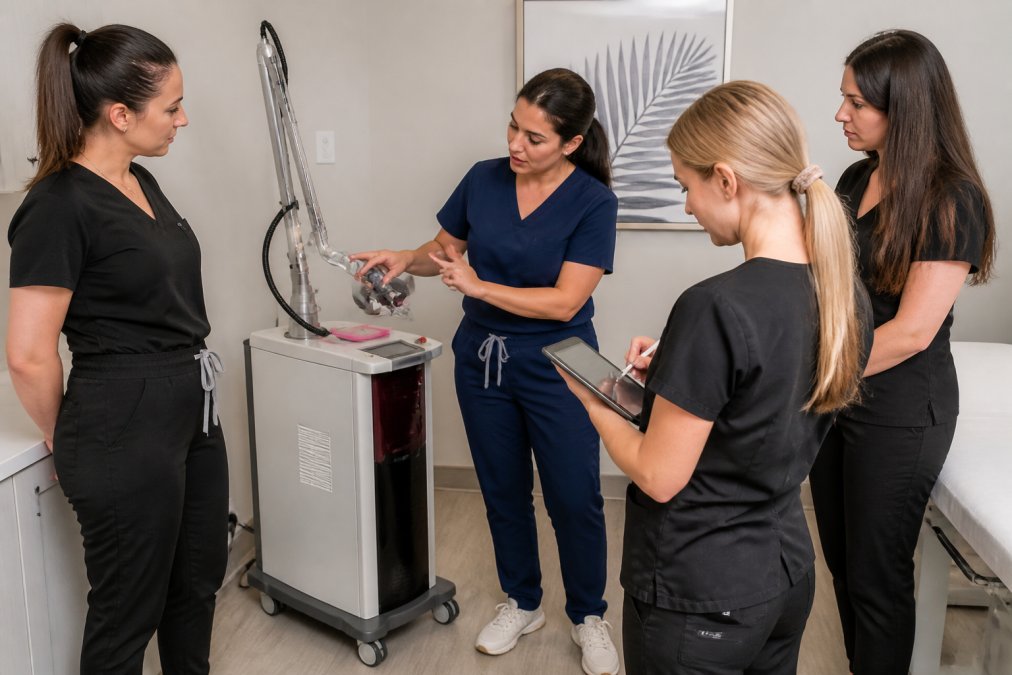
Ongoing support covers scheduled maintenance, calibration, software updates, replacement parts, and clinical retraining as your team changes. A common mistake is accepting a verbal promise of “ongoing support” without a written schedule. Support quality also varies enormously between in-house servicing and subcontracted third parties.
- Preventive service intervals and what each visit covers
- Calibration and safety testing frequency
- Software and firmware update policy
- Clinical retraining entitlements when staff turnover occurs
- Parts availability commitments and typical lead times
Service Level Agreements and Response Times
A service level agreement (SLA) defines how quickly a supplier must respond to a fault and what remedy applies if they don’t. Insist on a written SLA with defined response and resolution windows, not a statement of intent.
Signing without a written SLA is a common mistake. When equipment sits idle for weeks waiting on a subcontracted technician, you lose bookings you cannot recover, and a verbal promise gives you nothing to enforce.
TGA Medical Device Compliance for Clinics: What to Verify
TGA medical device compliance for clinics means confirming every device in your treatment room is included on the Australian Register of Therapeutic Goods (ARTG) and that the supplier can produce evidence of that inclusion. Using a device not properly included on the ARTG exposes your practice to regulatory and insurance risk.
Before you sign, ask the supplier for:
- The ARTG inclusion number for each device model
- The manufacturer’s name as recorded on the register
- Evidence of the device’s classification and intended purpose
- Confirmation of who holds the sponsor obligations for ongoing compliance
Technical Due Diligence: Matching Technology to Your Clinical Workflow
Technical due diligence tests whether a device’s actual capabilities match the treatments you plan to offer, before you commit capital. Brochure specifications describe what the hardware can theoretically do; due diligence establishes what it will do in your rooms, with your staff, on your patient mix.
Run this as a structured assessment:
- Map your treatment menu against the device’s cleared indications
- Test the user interface with the staff who will actually operate it
- Confirm consumable and handpiece costs per treatment, not just the platform price
- Check room requirements, including power, ventilation and floor space
- Ask for a live demonstration on a comparable device, not a video
Interoperability and API Integration Standards
Interoperability determines whether your new equipment talks to the systems you already run. If your skin analysis system cannot export structured data into your practice management software, your team re-enters results by hand and errors creep in.
What to verify in writing:
- Which standard and version the device actually supports (“FHIR R4” is a specific claim; “FHIR-compatible” is not)
- Whether the API is documented with a published specification, authentication model and rate limits
- What data objects are exposed, patient demographics, images, measurements, treatment parameters, audit logs
- Whether export is real-time, batched, or manual, a CSV download button is not an API
- Who maintains the integration if the vendor updates their schema, and at what cost
Request a test export of anonymised data from the device into your own practice management system before purchase. A supplier confident in their integration standards will accommodate this.
Testing Integration Before You Commit
A showroom demonstration is not an integration test. Ask for a sandbox or staging environment, or a supervised test against your own systems using de-identified data. Confirm three things: data arrives in the fields you expect, in a usable timeframe, and the vendor’s support team can troubleshoot a failed transmission without escalating to a third party. (Source: service level agreements)
Matching the Device to Your Clinical Workflow
Beyond integration, walk through a full treatment day with the supplier’s clinical trainer. Where does the device sit in the room? How long does set-up take between patients? What is the actual hands-on time versus the marketing claim? Ask to see it used on a patient type comparable to your typical caseload, not a model with ideal skin. The gap between a demonstration and a Tuesday afternoon clinic is where most purchase regrets originate.
Aesthetic Practice Equipment Financing Options Compared
Aesthetic practice equipment financing options generally fall into four structures: outright purchase, chattel lease, equipment finance agreement, and vendor-provided payment terms. Each shifts risk differently between you and the financier.
| Structure | Ownership | Cash Flow Impact | Best For |
|---|---|---|---|
| Outright purchase | Immediate | Large upfront outlay | Established practices with capital reserves |
| Chattel lease | Financier until final payment | Predictable monthly cost | Practices preserving working capital |
| Equipment finance | Yours, secured against asset | Lower deposit, fixed term | Growing clinics adding capacity |
| Vendor terms | Varies by agreement | Negotiated schedule | Bridging timing gaps only |
Source Code Ownership, Exit Strategy and Post-Launch Maintenance
Source code ownership and exit strategy are the two areas competitors gloss over, and where practices get hurt. Most guides treat the purchase as the end of the relationship. In practice, the relationship is the product, and the terms you sign determine what happens when it ends.
Source Code, Configuration and the Difference That Matters
If your device runs software, establish in writing who owns the code, who can modify it, and what happens to your data if you change suppliers. The distinction that catches practices out is between source code (the underlying program the vendor wrote or licensed) and configuration (the settings, templates and customisations built for your practice). You will rarely own the former. You can and should own the latter.
Ask these questions before signing:
- Who owns the source code and any custom configuration built for your practice?
- If the vendor ceases trading or is acquired, what happens to your access to the software and your data?
- On termination, will you receive your patient and operational data in a portable, machine-readable format (not a PDF dump)?
- What is the notice period, and what decommissioning support is included?
- Who retains calibration and service records, and will they be handed over?
- Is there an escrow arrangement for the source code, and who triggers release?
Exit Strategy as a Contractual Term, Not an Afterthought
An exit strategy is not a plan you make when you are unhappy. It is a set of clauses you negotiate while you still have leverage, before signing. The clauses that matter are data portability, notice periods, transition assistance, and the fate of hardware locked to the vendor’s software.
Vendor lock-in rarely appears as a single clause. It accumulates through proprietary consumables, software that only runs on the vendor’s hardware, data stored only in the vendor’s cloud, and service contracts that require their technicians. Map each of these dependencies before you sign, and ask what it would cost to unwind each one.
Post-Launch Maintenance and Technical Debt
Post-launch maintenance planning matters as much as the selection decision. Technical debt accumulates when software is patched reactively rather than maintained on a schedule. A supplier who plans updates and documents changes protects your investment; one who only responds to failures leaves you exposed.
- Update frequency, are firmware and software updates scheduled, and are they included in the support fee or charged separately?
- Change documentation, do you receive release notes explaining what changed and what it affects?
- Backward compatibility, will an update break your existing integrations or consumable compatibility?
- End-of-life policy, how many years of support are committed for this model, and what is the notice period before support ends?
- Parts availability, what is the committed availability window for critical components after the model is discontinued?
Planning for the Day Two Relationship
The selection phase is a courtship; the partnership is the marriage. Practices that get the most from their equipment schedule a twelve-month review with their supplier, covering service response times, training gaps, integration performance and emerging needs, rather than waiting for something to break.
Red Flags and Common Mistakes When Choosing a Medical Technology Partner
The warning signs are consistent. A supplier who cannot produce an ARTG inclusion number, avoids putting support commitments in writing, or cannot name their escalation contacts is a risk you do not need to carry.
Watch for these specific red flags:
- No written SLA or a vague one with no remedy clause
- Pressure to sign before you have verified TGA registration
- No named local service technician, only a call centre
- Training described as a one-off workshop with no retraining entitlement
- Reluctance to discuss exit terms or data portability
- Pricing that omits consumables, calibration or insurance costs
Frequently Asked Questions
What criteria should aesthetic practices use to evaluate medical laser suppliers?
Start with TGA compliance: confirm the device and the supplier are listed on the Australian Register of Therapeutic Goods. Then assess clinical training depth, response times in the service level agreement, local spare parts availability, and whether the supplier provides ongoing education rather than a one-off workshop. Ask for references from clinics of similar size and specialty, and check how long the supplier has operated. A medical technology partner that only sells boxes without structured after-sales support will cost you more in downtime than any upfront saving.
How does the TGA regulate medical technology partnerships?
The Therapeutic Goods Administration regulates medical devices through the Australian Register of Therapeutic Goods. Devices must be included on the ARTG before they can be lawfully supplied, and the sponsor, often the supplier, holds responsibility for post-market obligations including adverse event reporting and recalls. When choosing a medical technology partner, verify their ARTG sponsor status and ask how they handle post-market surveillance. Compliance is not a one-time checkbox; it continues for the life of the device.
What are the benefits of choosing a local medical technology partner?
A local partner can attend your clinic for installation, training and repairs without international shipping delays or time zone friction. They understand the TGA regulatory environment and can support you through audits. Spare parts arrive faster, and technicians are available for on-site visits. For multi-practitioner centres where downtime directly reduces revenue, local presence is often the deciding factor. Ask any prospective partner where their service technicians are based and how quickly they can reach your clinic.
How do you assess the long-term support capabilities of a medical device supplier?
Request the service level agreement in writing and check the guaranteed response and resolution times. Ask whether preventive maintenance is included or billed separately, and confirm the cost of replacement parts beyond the warranty period. Find out how long the supplier has supported the specific model you are buying and whether they stock parts locally. Speak to at least two existing clients who have owned the device for more than two years. Their experience with breakdowns and support quality tells you more than any brochure.