Blog Details
Table of Contents
- Why a Preventative Medical Laser Maintenance Program Matters
- Medical Laser Servicing: The Component-by-Component Schedule
- Medical Laser Downtime Prevention: Keeping Your Clinic Running
- Medical Laser Maintenance Costs and Return on Investment
- What a Medical Laser Service Agreement Should Cover
- Documentation, Compliance and Audit-Ready Records
- Common Mistakes That Undermine Laser Maintenance Programs
- Conclusion: Building a Maintenance Program That Protects Your Practice
- Frequently Asked Questions
Last Updated: October 14, 2026
Why a Preventative Medical Laser Maintenance Program Matters
A preventative medical laser maintenance program is a scheduled plan of inspections, servicing and performance checks that keeps a laser device working safely and predictably across its whole life. At DermTech Devices, we supply medical-grade laser platforms and skin analysis systems. (Source: Therapeutic Goods Administration guidance)
Lasers are medical devices, and their performance drifts with use. Cooling systems collect dust, optics lose clarity, and handpieces take knocks.
Maintenance is a risk-reduction task that protects four things at once.
- Patient safety – worn parts and drifting output raise the chance of burns, uneven results or undertreatment.
- Device reliability – regular checks catch faults while they are small and cheap to fix.
- Treatment accuracy – calibration keeps energy output consistent between sessions and between practitioners.
- Your money – planned servicing costs far less than emergency repairs and lost bookings.
The Therapeutic Goods Administration guidance on medical device maintenance is clear that devices must be kept in safe working order. A written program is how you show that you do.
Preventative maintenance is not a cost you absorb. It is the cheapest form of insurance you can buy for a laser platform, and it protects patient safety, uptime and revenue at the same time.
Medical Laser Servicing: The Component-by-Component Schedule
Medical laser servicing works best broken down by component, because each part wears at its own rate. A single annual visit is not enough: some parts need weekly attention from your staff, others a qualified technician every few months.
| Component | Check | Who does it | How often |
|---|---|---|---|
| Cooling system | Coolant level, filters, airflow | Clinic staff | Weekly |
| Cooling system | Full flush and pressure test | Service technician | Every 6-12 months |
| Optical components | Lens and fibre inspection, cleaning | Trained staff | Before each session |
| Optical components | Alignment and output testing | Service technician | Every 6-12 months |
| Handpiece | Tip and casing inspection | Clinic staff | Before each session |
| Handpiece | Calibration and performance testing | Service technician | Every 6-12 months |
| Safety systems | Interlocks, warning lights, eyewear | Clinic staff | Weekly |
| Full device | Comprehensive service and records review | Service technician | Annually |
Your team handles daily and weekly checks because they are cheap and quick; a qualified technician handles calibration, alignment and the cooling loop, which need test equipment and training.
Cooling System and Optical Components
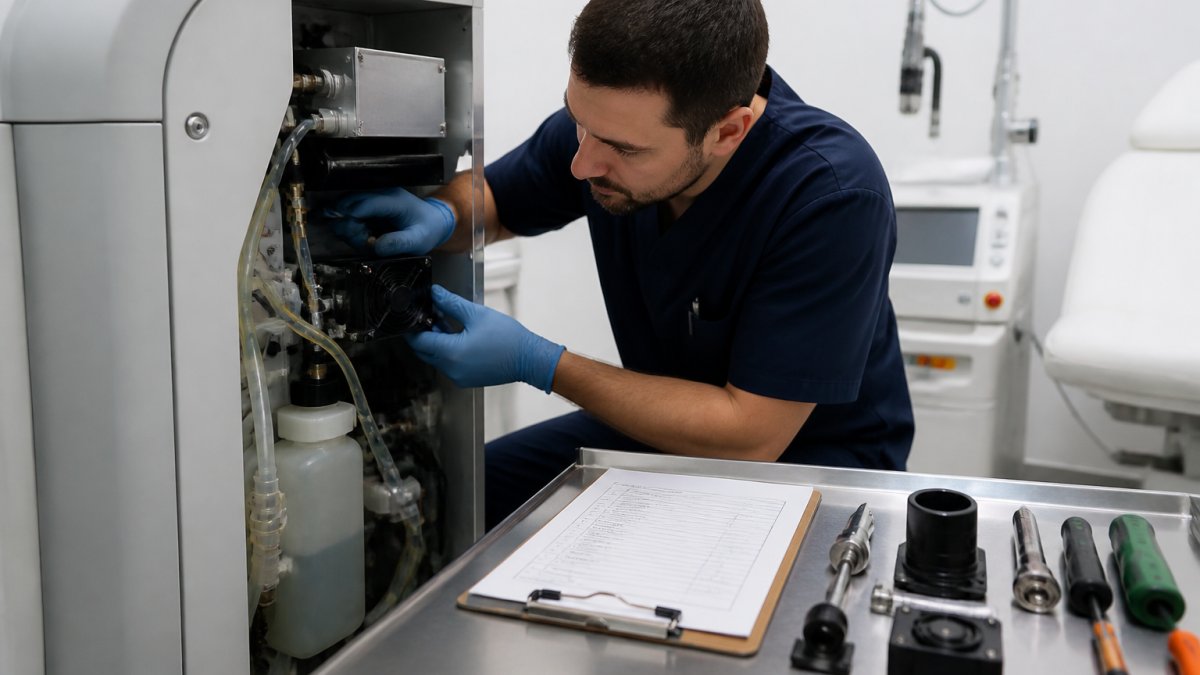
The cooling system and optical components are where neglect causes the most expensive damage. A clogged filter or low coolant level lets heat build up, and heat kills laser diodes and shortens device lifespan.
Daily cleaning of lenses and fibres takes minutes. Ask any technician what causes the worst failures they see, and blocked cooling and contaminated optics come up again and again.
Handpiece Inspection and Calibration
Handpiece inspection and calibration keeps treatment output consistent from one patient to the next. Tips wear, casings crack, and the energy leaving the handpiece can drift from what the screen says.
Medical Laser Downtime Prevention: Keeping Your Clinic Running
Medical laser downtime prevention comes down to one habit: fix small faults before they become failures. A device that stops mid-treatment costs you the session, the patient’s confidence and the bookings that follow, and emergency repairs take longer because parts must be ordered and a technician slotted in.
A few practical steps cut downtime sharply:
- Keep a small stock of consumables such as filters, tips and eyewear.
- Log every fault, even minor ones, so patterns show up early.
- Book servicing in your quiet periods, not your busiest month.
- Train more than one staff member on daily checks, so cover never depends on one person.
- Agree response times with your service provider in writing before you need them.
Early fault detection is the whole game here. A noise from the cooling fan or a slightly dimmer beam is a warning, not a nuisance. Acting on it takes a device out of service for an afternoon instead of a fortnight.
Skipping a scheduled service to avoid a short closure often backfires. The device usually fails at the worst possible time, and emergency repairs cost more than the service you postponed.
Medical Laser Maintenance Costs and Return on Investment
1. Planned servicing cost. The predictable line: scheduled visits, calibration, consumables and any fixed annual fee in a service agreement. It is the easiest number to get because providers quote it.
2. Unplanned repair cost. Emergency call-outs, urgent parts, after-hours labour and diagnostic time.
3. Lost treatment revenue. Every day a device is out of service is a day of cancelled or unbooked sessions.
**4.
A Transparent ROI Framework
Use a simple annual comparison:
- Annual planned cost = service agreement fee + consumables + internal staff time on daily and weekly checks.
- Annual unplanned cost = emergency repair invoices + urgent parts + call-out fees.
- Annual downtime cost = number of device-down days × average daily treatment revenue.
- Total cost of ownership = planned + unplanned + downtime + a share of replacement cost.
Compare two scenarios over the same period. In the reactive scenario, unplanned and downtime costs are high and unpredictable. In the preventative scenario, planned cost rises modestly while unplanned and downtime costs fall. The program pays for itself when that reduction exceeds the increase in planned cost.
Worked Example (Illustrative)
Use your own figures in the placeholders below. The structure matters more than the numbers:
| Cost line | Reactive approach | Preventative program |
|---|---|---|
| Planned servicing | Minimal or nil | Service agreement fee (AUD, quoted) |
| Emergency repairs | Multiple call-outs per year | Fewer, smaller incidents |
| Device-down days | Higher, often unplanned | Lower, mostly scheduled |
| Lost treatment revenue | Device-down days × daily revenue | Reduced device-down days × daily revenue |
| Replacement timing | Earlier than necessary | Extended useful life |
A common pattern is that a single avoided week of downtime covers a meaningful share of an annual service agreement. Ask your provider for a written quote, then plug your own daily treatment revenue into the downtime row, that number decides whether the program is worth it.
Track device-down days for three months before you buy a service agreement. That baseline turns a vague ROI conversation into a specific one, and it gives you leverage when you negotiate response times and coverage.
Pricing varies by device, coverage level, response time and provider, so request written quotes from more than one provider and compare them line by line against the four cost buckets above, not just on the headline fee.
Australian Taxation Office guidance on deducting business equipment repairs and maintenance
What a Medical Laser Service Agreement Should Cover
A medical laser service agreement should spell out what is included, what is excluded, and how fast the provider responds when something fails. Before you sign, check that it covers:
- Scheduled preventative visits, with the number per year stated
- Calibration and performance testing, not just a visual check
- Response times for emergency repairs, in writing
- Parts and labour, and which parts are excluded
- Loan equipment if a repair takes longer than a set period
- Staff training and refresher sessions
If a provider will not put response times in writing, that tells you something.
How to Choose a Qualified Service Provider
Choosing a qualified service provider is the biggest decision in your maintenance program.
1. Manufacturer authorisation and platform familiarity. Ask which laser platforms they service and how many units of your model they have worked on.
**2.
**3.
**4.
5. Documentation and reporting. Ask what you receive after each visit: a signed service report, calibration results, parts fitted, and recommendations.
Questions to Ask Before Signing
- Which laser platforms do you service, and how many of ours have you worked on?
- Are you manufacturer-authorised for our device, and does your work preserve our warranty?
- What are your guaranteed response and resolution times, and are they in the contract?
- Which parts do you hold locally, and what are typical lead times?
- What documentation do you provide after each visit?
- Can you provide references from clinics similar to ours?
A provider who supplies the equipment and services it has an obvious advantage: they know the platform from the inside. It is worth asking any supplier whether they do the same.
A cheap service agreement with no written response time and no local parts stock is not a maintenance program. It is a promise with no mechanism behind it, and the gap shows up the first time a device fails on a full booking day.
Documentation, Compliance and Audit-Ready Records
Maintenance documentation turns a series of visits into an audit-ready record. Log every service, calibration and fault with a date, the work done and who did it, if a question arises about a treatment outcome or device fault, that record is your evidence the equipment was maintained to standard.
Keep these records for each device:
- Service and calibration reports, signed and dated
- Fault logs, including minor issues
- Staff training records for daily checks
- Warranty and service agreement documents
- Consumable replacement dates
Good records also help you spot patterns: if the same fault keeps returning, the log shows it and you can push for a proper fix rather than another patch. Clinic policies should name who is responsible for each check and where records live.
Common Mistakes That Undermine Laser Maintenance Programs
The most common mistakes in laser maintenance programs are not technical but habits. Watch for these:
- Treating maintenance as optional. It gets skipped in busy weeks, which is exactly when the device is working hardest.
- Relying on one person. If the only staff member trained on daily checks is away, the checks stop.
- No written schedule. Verbal routines fade. A calendar does not.
- Ignoring minor faults. Small noises and dimmer output are early warnings, not background noise.
- Choosing a provider on price alone. The cheapest quote often has the slowest response time.
- Poor record keeping. Without logs, you cannot prove the device was maintained, and you cannot spot repeat faults.
- No staff training. Equipment sits idle when staff are not confident using it, and idle equipment still needs servicing.
The thing nobody tells you about laser maintenance is that the daily five-minute checks matter more than the annual service. They catch problems while they are still cheap.
Conclusion: Building a Maintenance Program That Protects Your Practice
Building a maintenance program is less work than it sounds. Set a schedule by component, train your team on daily checks, put a service agreement in place with written response times, and keep records for every device.
If you are sourcing a laser platform, talk to us. DermTech Devices supplies medical-grade multi-modality laser platforms and skin analysis systems, backed by support from a team founded by a Registered Nurse with over 19 years of experience.
Frequently Asked Questions
What does preventative maintenance for a medical laser include?
Preventative maintenance typically covers routine inspection of the cooling system, optical components and handpiece, cleaning procedures, calibration and performance testing to confirm output consistency. It also includes safety checks and scheduled servicing against the manufacturer’s schedule. The exact scope depends on your device type and how often it is used, so ask your provider for a written checklist that names each task and how often it is performed.
How often should a medical laser be serviced?
Servicing intervals depend on the device, its usage volume and the manufacturer’s recommendations. Most clinics schedule a full service annually, with interim checks on high-use items such as handpieces and cooling filters. If your device runs several treatment sessions a day, ask your provider to set a schedule based on hours of use rather than calendar time alone. Always follow the manufacturer’s stated intervals as the minimum.
Can preventative maintenance extend the life of an aesthetic laser?
Regular servicing addresses wear and tear before it becomes a failure, which supports equipment lifespan and device longevity. Clean cooling systems, calibrated optics and inspected handpieces reduce the load on other components. It is not a guarantee, but a documented maintenance program gives you the best chance of getting full value from your equipment investment and avoiding premature replacement costs.
How can clinics reduce downtime for laser equipment?
Book scheduled servicing during quiet periods, keep critical spare parts on hand and train staff to log early warning signs such as output inconsistency or unusual noise. A service agreement with a defined response time also shortens emergency repairs. Clinics that document every fault and service visit spot patterns sooner, which reduces unplanned equipment downtime and protects treatment bookings.
Partner with us at DermTech Devices and get a maintenance plan built around your devices, your team and your patient load.