Blog Details
Table of Contents
- Why Comprehensive Staff Training for Laser Devices Is Non-Negotiable
- Laser Safety Officer Training Requirements: Who Owns Safety in Your Clinic?
- Step 1: Map Device Hazards and Build Your Risk Assessment
- Step 2: Choose the Right Training Path and Provider
- Aesthetic Laser Training Duration: How Long Does It Really Take?
- Step 3: Use a Laser Device Competency Assessment Checklist
- Clinical Laser Training Best Practices for Busy Clinics
- Step 4: Maintain Skills, Logs and a Culture of Safety
- Frequently Asked Questions
Last Updated: September 11, 2026
Why Comprehensive Staff Training for Laser Devices Is Non-Negotiable
Comprehensive staff training for laser devices is the structured process of equipping every operator, from the laser safety officer to the newest clinician, with the hazard knowledge, technical skill and documentation habits required to run laser treatments safely and consistently. In a busy clinic, that training is the difference between a service line that grows and one that stalls after a single incident. (Source: ARPANSA radiation protection guidance)
We supply multi-modality laser platforms to dermatology and aesthetic practices, and a common pattern we observe is clinics investing in the device, then treating training as a one-day formality. The equipment is rarely the weak link. The gap often sits in what staff know, what they can demonstrate, and what they can prove on paper.
Below, we break down a four-step implementation path, from hazard mapping through to ongoing competency checks, that fits around patient bookings rather than disrupting them.
Laser Safety Officer Training Requirements: Who Owns Safety in Your Clinic?
Someone must hold formal accountability for laser safety, and in most clinics that person is the laser safety officer (LSO). This role is not a courtesy title. The LSO owns the risk assessment, authorises controlled area access, sets protective eyewear requirements and signs off on operator competency.
A common mistake is assigning the LSO role to whoever happens to be most senior. The better approach is to choose someone who works with the devices regularly, understands beam properties and wavelength-specific hazards, and has the authority to halt a treatment.
The ARPANSA radiation protection guidance sets out the national framework for non-ionizing radiation, and it is the reference point your LSO should be working from. Nationally recognised training units exist for laser safety officers, and a provider offering a statement of attainment against those units gives you a defensible record. Confirm the current unit codes with the provider directly, as training packages are updated periodically.
Give your LSO a written delegation of authority, signed by the practice principal. When an operator disputes a safety call mid-treatment, a documented mandate ends the argument without escalation.
Step 1: Map Device Hazards and Build Your Risk Assessment
Start with the device, not the paperwork. Every laser platform in your clinic has a classification, and that classification dictates the controls you need. Class 3B and Class 4 lasers are the categories used in aesthetic and dermatological treatment, and both present real ocular and skin hazards.
Work through each device systematically:
- Wavelength and absorption: confirm which chromophores the wavelength targets, and therefore which tissues are at risk from stray beam exposure
- Beam divergence and nominal ocular hazard distance: establish how far the hazard extends and mark that boundary as a controlled area
- Maximum permissible exposure and fluence settings: record the safe operating envelope for each treatment mode
- Pulse duration: note whether the device operates in continuous, pulsed or Q-switched modes, as thermal damage characteristics differ
- Ancillary hazards: laser plume, smoke evacuation, fire risk near oxygen, and electrical safety
Document the outcome as a written risk assessment per device, not per clinic. Settings, eyewear optical density and controlled area dimensions differ between platforms, and a generic assessment will not survive a compliance audit.
Step 2: Choose the Right Training Path and Provider
Training splits into two streams: safety and theory, and hands-on clinical application. You need both, and they are rarely delivered well by the same provider.
For the safety stream, look for nationally recognised training with an assessment component, not a certificate of attendance. Attendance certificates prove nothing about competency. The relevant units sit within the national vocational training framework, and a provider issuing a statement of attainment is giving you a record that can be verified against the training package. Unit codes are revised periodically, so confirm the current code with the provider rather than relying on a code printed in an older brochure.
For the clinical stream, the provider should train on your actual device model or a close equivalent, because menu structures, cooling mechanisms and spot size settings vary enough to matter. A trainer who has only worked on a different platform will teach generic technique and leave your operators guessing at the specifics of your handpieces.
Before booking, ask these questions and expect documented answers:
- Does the course assess practical competency, or only written knowledge?
- Is the safety component mapped to nationally recognised units, and will we receive a statement of attainment?
- Will the trainer work on our device model and our treatment protocols?
- What documentation do we receive for our training records, and in what format?
- Does the provider cover the non-ionizing radiation framework set out by the ARPANSA radiation protection guidance, including controlled area and eyewear principles?
If the answer to the first question is “written only”, keep looking. Written knowledge is necessary but not sufficient; a clinician can recite maximum permissible exposure figures and still misposition a handpiece.
Ask the provider for a sample statement of attainment and a sample practical assessment form before you pay. If they cannot produce either, the “assessment” is likely a quiz.
One more consideration competitors tend to skip: state and territory requirements. Some jurisdictions require registration or licensing for operators of certain laser equipment, and the threshold varies. Check the current requirement with your state or territory health department before you assume a national course is enough on its own. A national qualification and a state licence are not the same thing, and an audit will treat them separately.
Aesthetic Laser Training Duration: How Long Does It Really Take?
Aesthetic laser training duration depends on the modality and the operator’s starting point, but a realistic structure is a foundational safety component followed by supervised practical hours on each device. Expect the safety and theory component to run across one to two days, with device-specific practical training layered on top.
The variable that catches clinics out is supervision time. An operator who has completed a course is not yet independent. Most practices build in a period of supervised treatments, with the LSO or a senior clinician reviewing settings and outcomes before the operator works unsupervised.
| Training Component | Typical Format | What It Covers |
|---|---|---|
| Laser safety fundamentals | 1-2 days, classroom plus assessment | Classification, beam hazards, eyewear, controlled areas |
| Device-specific practical | Half to full day per platform | Settings, handpiece handling, cooling, treatment endpoints |
| Supervised clinical hours | Several weeks, in-clinic | Real patients under observation, logbook sign-off |
| Refresher and update | Annual | Protocol changes, incident review, new modalities |
Where it falls short: no fixed duration guarantees competency. The sign-off should be based on observed performance, not hours logged.
Step 3: Use a Laser Device Competency Assessment Checklist
A laser device competency assessment checklist converts training into evidence. It gives the assessor a consistent standard and gives the clinic a document that stands up to scrutiny. (Source: Australian Radiation Protection and Nuclear Safety Agency (ARPANSA))
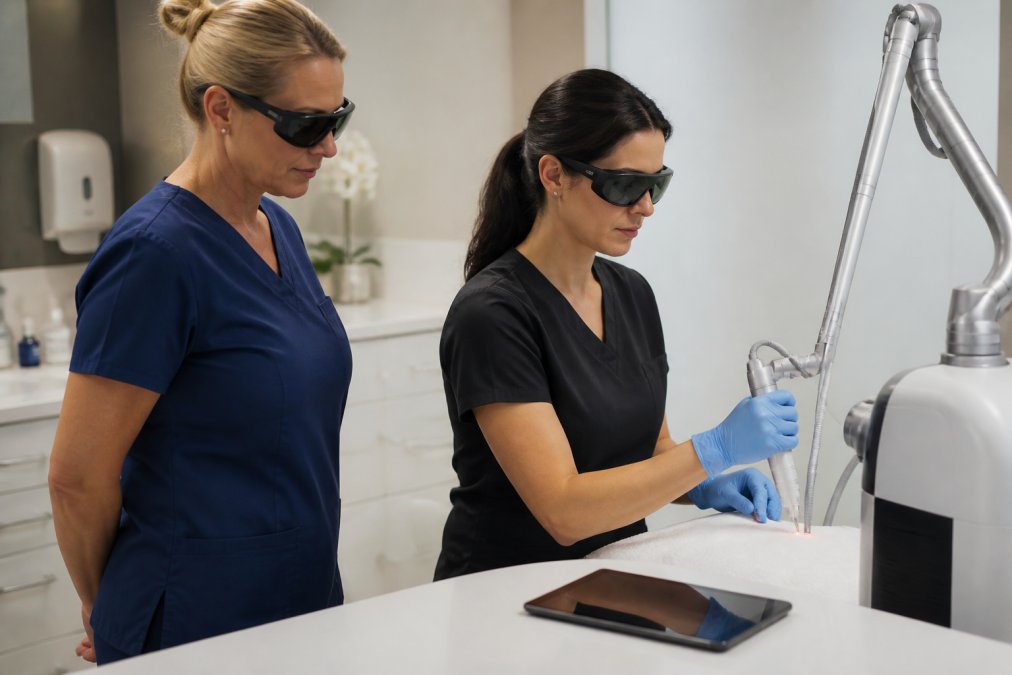
Build yours around observable behaviours:
- Correctly identifies the device classification and wavelength
- Selects appropriate protective eyewear and confirms optical density for the wavelength
- Verifies controlled area signage and access before treatment
- Confirms patient skin phototype against the Fitzpatrick scale and adjusts fluence accordingly
- Demonstrates correct handpiece positioning and beam divergence control
- Recognises clinical endpoints and stops before thermal damage occurs
- Responds correctly to a simulated incident, including shutdown and reporting
- Completes the treatment log with settings, fluence and pulse duration
Two assessors signing the same checklist on different days is a stronger record than one signature. It also catches drift, because operators develop habits that a single assessor may not notice.
Do not sign off competency on a colleague’s behalf. If an incident occurs and the training record is found to be inaccurate, the clinic’s defence collapses and the assessor carries personal exposure.
Clinical Laser Training Best Practices for Busy Clinics
Scheduling is where most training plans die. A full-day workshop sounds efficient until three patients need rescheduling.
The clinics that maintain strong clinical laser training best practices do three things differently. They train in short blocks, they train on real workflows, and they rehearse failure.
Short blocks mean 90-minute sessions built into quieter booking periods, covering one topic each. Rehearsal means running incident drills: what happens when the foot pedal sticks, when the plume extractor fails, when a patient reports unexpected discomfort. And training on real workflows means practising the full sequence, from consent and eyewear check through to the treatment log, not just the laser firing.
What most guides miss is the human side. A laser incident affects the operator, not just the patient. Staff who have been involved in a near miss often become hesitant, and hesitation in a treatment room creates its own risk. A short debrief after any incident, focused on process rather than blame, keeps operators confident and honest about reporting.
Step 4: Maintain Skills, Logs and a Culture of Safety
Training decays. Settings change when software updates land, protocols shift as evidence develops, and new staff join with varying backgrounds. Most guides stop at “review annually” and leave you to invent the rest. This section gives you the practical scaffolding, the part competitors miss.
Device maintenance and calibration logs
Keep one log per device, not one per clinic. A workable structure records:
- Daily: visual inspection of handpiece, fibre or articulated arm; lens and tip condition; cooling system function; emergency stop test; eyewear present and undamaged
- Weekly: output verification against the device’s reference reading where the platform supports it; plume extraction filter check; controlled area signage and door interlocks
- Per service interval: calibration certificate, software version, parts replaced, technician name and date
- After any fault or software update: re-verification of output and a note in the risk assessment review
A log that only records “serviced” is not a log. The value is in the trend; a slow drift in output or a recurring fault is a signal that the risk assessment needs revisiting.
Competency refreshers with a defined trigger
Annual reassessment is the baseline, but the triggers that matter more are event-driven:
- Any device software change that alters settings, menus or output
- Introduction of a new modality or handpiece
- Return from extended leave
- After any incident or near miss involving that operator or that device
- When a new clinical protocol is adopted
Reassessment should use the same observable-behaviour checklist as initial sign-off, so the record is comparable over time.
Post-training competency assessment for internal audits
Employers need a way to verify knowledge without booking an external assessor every time. A simple internal audit pack works:
- Knowledge check, short written questions on classification, eyewear optical density and controlled area rules for your specific devices
- Observed practical, the competency checklist completed by a second assessor
- Documentation review, the operator’s treatment logs sampled for completeness and consistency
- Incident scenario, a verbal walkthrough of what they would do if the foot pedal stuck or a patient reported unexpected discomfort
Run this pack annually and after any trigger event. Keep the completed packs with the training records so the three audit artefacts, risk assessments, training records and incident log, align and are dated.
The human side of safety culture
A laser incident affects the operator, not just the patient. Staff involved in a near miss often become hesitant, and hesitation in a treatment room creates its own risk. A short debrief after any incident, focused on process rather than blame, keeps operators confident and honest about reporting. Near misses logged without fear are the cheapest safety data a clinic will ever collect.
Do not treat a signed checklist as the end of the process. If the same operator fails the same item at two consecutive reassessments, the issue is usually the training method or the device workflow, not the person. Fix the system before you re-test the individual.
A compliance audit will ask for three things: your risk assessments, your training records, and your incident log. If those three align and are dated, the audit is straightforward. If they do not, no amount of device specification will cover the gap.
Frequently Asked Questions
Where can I find laser safety officer training in Australia?
Laser safety officer training is offered by registered training organisations (RTOs) that deliver nationally recognised units of competency. Before enrolling, confirm the provider is accredited and that the course covers the specific wavelengths and device classes used in your clinic. Check with your state or territory radiation regulator for any local licensing or notification requirements, because these differ across jurisdictions and may affect who can act as your laser safety officer.
What documentation is required for laser device competency assessments?
Keep a signed competency assessment checklist for each operator, listing the specific device, wavelength and treatment parameters they are approved to use. Add training certificates, supervised practice logs, incident reports and a record of refresher dates. Store these with your standard operating procedures and device maintenance logs so a compliance audit can trace who was trained, when, and on which equipment.
How often should laser device training be refreshed for staff?
Refresh competency whenever a new device, wavelength or treatment protocol is introduced, and at least annually for existing operators. After any incident or near miss, retrain the staff involved before they resume laser work. Shorter, frequent sessions tend to hold skills better than one long annual workshop, particularly in clinics where multiple practitioners share the same platform.
What is the difference between laser safety officer training and clinical device training?
Laser safety officer training covers hazard identification, controlled areas, maximum permissible exposure, protective eyewear selection and regulatory compliance. Clinical device training focuses on how to operate a specific platform safely and effectively, including settings, skin phototype assessment and treatment endpoints. A comprehensive staff training program for laser devices needs both, and they are usually delivered by different providers.
Laser safety is not a certificate on a wall; it is a set of habits that hold up on a busy Tuesday afternoon. DermTech Devices supplies the platforms and the technical documentation that make those habits easier to build, with multi-modality laser systems designed for reliability and precision-engineered skin analysis to support treatment planning. Partner with us to equip your clinic with technology that performs consistently, and a training framework that keeps it that way.