Blog Details
Table of Contents
- What Makes Laser Equipment Reliable for Dermatology Clinics
- Quick Comparison: 7 Reliable Laser Equipment Options
- 1. DermTech Devices: Multi-Modality Platforms Built for Practice Growth
- Cons:
- 2. Candela GentleMax Pro Plus: Dual-Wavelength Workhorse for High-Volume Clinics
- 3. Lumenis UltraPulse: The Gold Standard for Ablative Resurfacing
- 4. DEKA SmartXide: Customisable CO2 for Anti-Ageing and Scar Treatment
- 5. Candela VBeam Prima: Specialised Pulsed Dye Laser for Vascular Lesions
- 6. Lutronic Genius: Intelligent RF Microneedling with Real-Time Feedback
- Dermatology Laser Maintenance and Safety: Protecting Your Investment
- Laser Equipment Financing for Clinics: Making the Numbers Work
- Frequently Asked Questions
Last Updated: September 14, 2026
What Makes Laser Equipment Reliable for Dermatology Clinics
Reliability in laser equipment for dermatology comes down to two things: consistent clinical results and minimal downtime. A device that produces excellent outcomes but breaks down monthly costs more than it earns.
The real question isn’t which laser has the best specs on a brochure. It’s which one still performs to specification after 500 treatment hours, and whether the supplier answers the phone when something goes wrong.
Clinical Efficacy and Wavelength Precision
Clinical efficacy depends on matching wavelength to target chromophore. A 595 nm pulsed dye laser absorbs optimally in haemoglobin, making it the right choice for vascular lesions. A 1064 nm Nd:YAG penetrates deeper for darker skin types.
Wavelength precision matters because thermal damage to surrounding tissue causes complications. Devices with stable pulse durations and accurate fluence delivery produce predictable outcomes across Fitzpatrick skin types.
The Therapeutic Goods Administration’s medical device guidance sets the regulatory baseline for devices supplied in Australia. Any platform worth considering should carry the appropriate TGA inclusion.
Build Quality and Uptime Track Record
Build quality separates platforms that last a decade from those that need replacing in three years. Look for solid-state components, sealed cooling systems, and manufacturers with documented service networks.
Uptime track record is harder to verify than spec sheets suggest. Ask suppliers for references from clinics with similar patient volumes. A device that performs flawlessly at 10 treatments weekly may struggle at 60.
Quick Comparison: 7 Reliable Laser Equipment Options
| Device | Technology | Best For | Key Consideration |
|---|---|---|---|
| DermTech Devices | Multi-modality platforms | Practices wanting versatility | Full-service support model |
| Candela GentleMax Pro Plus | 755 nm + 1064 nm dual-wavelength | High-volume hair removal | Significant capital outlay |
| Lumenis UltraPulse | Pulsed CO2 | Ablative resurfacing | Requires trained operators |
| DEKA SmartXide | CO2 with PSD technology | Anti-ageing and scars | Higher maintenance costs |
| Candela VBeam Prima | 595 nm pulsed dye | Vascular lesions | Specialised use only |
| Lutronic Genius | RF microneedling | Skin tightening | Consumable tip costs |
| UltraClear Laser | Cold fibre laser | Low-downtime resurfacing | Newer, fewer long-term studies |
1. DermTech Devices: Multi-Modality Platforms Built for Practice Growth
DermTech Devices supplies medical-grade treatment systems designed for dermatology and aesthetic practices that need reliable technology without enterprise-level pricing. The company was founded by a Registered Nurse with over 19 years of experience, which shapes how they approach equipment support.
What sets them apart is the multi-modality approach. Rather than locking a clinic into a single-wavelength device, their platforms combine multiple technologies so practitioners can offer hair removal, pigmentation treatment, skin rejuvenation, and vascular work from one system.
The collaboration with globally recognised medical technology brands means the underlying engineering meets established standards. DermTech Devices handles the local supply, training, and ongoing support side.
Pros:
- Multi-modality platforms reduce the need for multiple device purchases
- Founded and led by someone who understands clinical workflow from the inside
- Focus on affordable pricing without compromising medical-grade quality
- Skin analysis systems support objective treatment planning
Cons:
Private practices and multi-practitioner clinics wanting versatile, medical-grade laser platforms with responsive local support.
2. Candela GentleMax Pro Plus: Dual-Wavelength Workhorse for High-Volume Clinics
The GentleMax Pro Plus combines 755 nm Alexandrite and 1064 nm Nd:YAG wavelengths in one platform. That dual capability handles the full spectrum of Fitzpatrick skin types, which matters when your patient base is diverse.
It’s built for throughput. The integrated Dynamic Cooling Device protects the epidermis during treatment, reducing discomfort and letting practitioners move faster between patients.
The honest limitation: this is a significant capital investment. It suits established clinics with consistent hair removal and vascular demand, not startups testing the waters.
3. Lumenis UltraPulse: The Gold Standard for Ablative Resurfacing
Lumenis UltraPulse remains the reference point for deep ablative CO2 resurfacing. Its short pulse duration minimises thermal damage while achieving meaningful ablation depth for scar revision and severe photodamage.
Customisable scan patterns give operators control over treatment density and depth. That precision is why dermatological surgeons keep returning to it for complex cases.
The catch is operator skill. This platform rewards experience and punishes carelessness. Clinics without a trained laser surgeon on staff should think carefully before investing.

4. DEKA SmartXide: Customisable CO2 for Anti-Ageing and Scar Treatment
DEKA’s SmartXide uses Pulse Shape Design technology to vary pulse characteristics, letting practitioners dial in the balance between ablation and thermal stimulation. That flexibility serves both superficial rejuvenation and deeper scar work.
Fractional scanning modes speed recovery compared to fully ablative approaches. The integrated cooling systems add a layer of patient safety during longer sessions.
Where it falls short is maintenance cost. CO2 platforms demand regular servicing, and DEKA’s parts and consumables sit at the higher end.
5. Candela VBeam Prima: Specialised Pulsed Dye Laser for Vascular Lesions
The VBeam Prima delivers 595 nm wavelength energy tuned specifically for vascular absorption. For rosacea, port-wine stains, and other vascular anomalies, it produces results that broader-spectrum platforms struggle to match.
Multiple spot sizes let practitioners scale treatment from small facial lesions to larger areas. Integrated cooling protects the epidermis, keeping downtime minimal for most patients.
The trade-off is narrow applicability. If vascular work isn’t a core part of your service mix, this device won’t earn its place in the treatment room. (Source: Statista’s 2023 report on the global aesthetic devices market)
6. Lutronic Genius: Intelligent RF Microneedling with Real-Time Feedback
Lutronic Genius pairs radiofrequency energy with microneedling, using real-time impedance monitoring to adjust delivery as tissue resistance changes. That feedback loop produces more consistent results than fixed-energy systems.
Insulated needles protect the epidermis while delivering energy at depth, which makes the platform suitable across all skin types. Customisable depth and energy settings let practitioners tailor treatments to specific concerns.
Consumable tip costs add up per treatment, so factor that into your per-patient economics before committing.
Dermatology Laser Maintenance and Safety: Protecting Your Investment
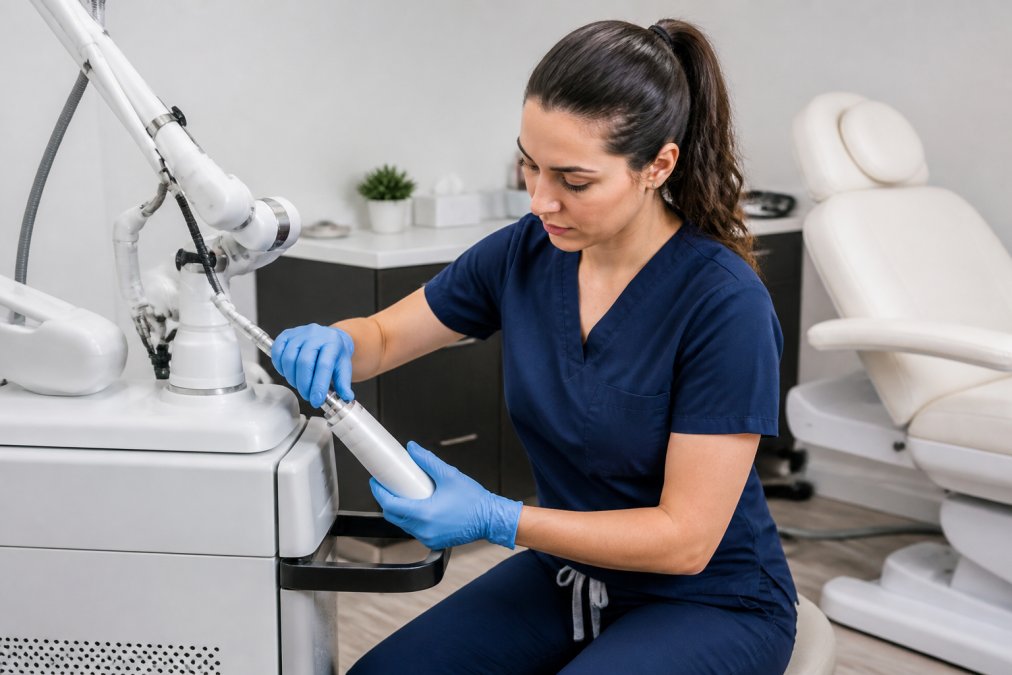
Dermatology laser maintenance and safety is the difference between a platform that serves your clinic for a decade and one that becomes a liability within three years. Regular servicing, staff training, and documented safety protocols protect both patients and your capital, but the financial mechanics of that protection are what most buyers underestimate.
The real cost of unplanned downtime
A single day of cancelled laser appointments in a busy clinic typically costs more than a year of scheduled servicing. When a platform goes down unexpectedly, you lose the treatment revenue, you absorb the rescheduling admin, and you risk losing the patient to a competitor who can see them this week. Most clinic owners find that a preventive maintenance contract pays for itself the first time it prevents a mid-week failure.
A practical maintenance schedule
- Daily: handpiece inspection, lens and fibre checks, cooling system visual check, treatment log entry.
- Weekly: calibration verification against manufacturer specifications, coolant level check, error-log review.
- Monthly: full optical path inspection, filter condition check, software and firmware updates.
- Annually: manufacturer-certified service, coolant replacement, fluence output verification, safety interlock testing.
Safety compliance obligations
Safety compliance requires adherence to ARPANSA radiation protection standards for laser devices, alongside state and territory radiation health requirements that vary by jurisdiction. Clinics should maintain treatment logs, incident records, current operator certifications, and a laser safety officer nomination where required. Wavelength-specific eyewear, controlled treatment rooms, and documented consent processes are baseline expectations, not optional extras. Rigorous clinical protocols ensure patient protection during professional procedures, yet the same principles of safety and efficacy remain equally relevant when considering the appropriate application of anti-aging beauty devices for home use.
Operator certification is not transferable between all platforms. A practitioner competent on a 595 nm pulsed dye laser is not automatically competent on a fractional CO2 system. Budget for re-training every time you add a modality.
Equipment lifecycle and depreciation, the gap most guides ignore
Most buying guides stop at purchase. The harder question is what the platform is worth in year five. A common pattern in aesthetic practices is that a flagship device loses the majority of its resale value within five to seven years, and the resale market for older platforms is thin. That means the true cost of ownership is not the purchase price, it is purchase price minus resale value, plus servicing, consumables, and training across the ownership period.
Plan the replacement cycle before you buy. If you intend to keep a platform for seven years, model the servicing costs in years five, six, and seven, not just the warranty period. If you intend to upgrade every three years, leasing may suit better than ownership because it shifts residual-value risk to the financier.
Treat every laser platform as a depreciating asset with a defined productive life, not a permanent fixture. Clinics that plan the exit at the same time as the entry consistently make better equipment decisions.
Integration with practice management software
A maintenance issue that competitors rarely mention: modern laser platforms increasingly log treatment parameters digitally, and some export that data to practice management or electronic patient record systems. If your platform cannot integrate, your team will re-key treatment settings into patient files manually, a workflow tax that compounds across hundreds of sessions. Ask suppliers directly whether the device exports treatment data, in what format, and whether it connects to the software your clinic already runs. This is a B2B pain point that almost no buying guide addresses, and it affects both compliance record-keeping and staff efficiency.
Laser Equipment Financing for Clinics: Making the Numbers Work
Laser equipment financing for clinics typically involves outright purchase, equipment finance (chattel mortgage or hire purchase), or device leasing arrangements. The right structure depends on your cash flow, patient volume projections, and how long you intend to keep the platform, but the structure matters less than the total cost of ownership model underneath it.
Comparing the three structures honestly
- Outright purchase: lowest total cost if you keep the device past the finance term, but ties up working capital and leaves you holding the residual-value risk.
- Equipment finance: spreads cost across the device’s productive years, preserves working capital, and the asset appears on the balance sheet. Interest is generally tax-deductible as a business expense.
- Leasing: predictable monthly cost, easier upgrade cycle, but you never own the asset and total payments across multiple lease terms usually exceed a single purchase.
Building a total cost of ownership model
Before signing anything, model every line item across the ownership period:
- Purchase price or total lease payments
- Scheduled servicing and any extended warranty
- Consumables (coolant, filters, handpiece tips, RF microneedling tips)
- Operator training and re-certification
- Insurance and any state-based device registration
- Electricity, high-energy ablative and dual-wavelength platforms draw meaningfully more power than non-ablative systems, and this shows up on the quarterly bill
- Downtime allowance (assume at least a few days per year even on reliable platforms)
Then divide by realistic annual treatment volume to get a per-treatment cost. A platform that costs more upfront but requires less servicing and fewer consumables often wins over five years, but only if your patient volume is high enough to amortise the fixed costs.
Ask the supplier for a written five-year servicing estimate, not just the purchase quote. Suppliers who hesitate to provide one are telling you something about the maintenance profile of the device.
Sustainability and energy efficiency, an angle most guides miss
High-energy laser platforms are not trivial electricity consumers. A busy clinic running ablative CO2 and dual-wavelength hair removal sessions all day will see a measurable difference in power draw between an older platform and a current-generation, energy-efficient model. Beyond the electricity bill, newer platforms often use sealed cooling systems that require less coolant replacement and generate less heat load on the treatment room’s air conditioning, a secondary saving that rarely appears in equipment comparisons.
If your practice is working toward green practice standards or sustainability accreditation, power consumption per treatment is a legitimate selection criterion. Ask suppliers for standby and active power draw figures, and factor them into the five-year model alongside the purchase price.
Tax and depreciation treatment
Speak with your accountant about how Australian Taxation Office guidance on depreciation applies to your specific equipment purchase, as treatment varies by business structure and by whether the device qualifies for any instant asset write-off provisions in the year of purchase. The ATO’s depreciation rules interact with your choice of finance structure, a leased asset is treated differently from an owned one, so the financing decision and the tax decision should be made together, not sequentially.
The financing question is not “which structure is cheapest?” It is “which structure matches the productive life of the asset to my cash flow and my upgrade intentions?” Answer that, and the structure usually chooses itself.
Frequently Asked Questions
What regulatory standards must dermatology laser equipment meet in Australia?
Laser equipment for dermatology must be listed on the Australian Register of Therapeutic Goods (ARTG) before it can be legally supplied. The Therapeutic Goods Administration (TGA) classifies medical devices by risk level, and lasers used for skin resurfacing or hair removal typically fall into higher-risk categories requiring conformity assessment. Before purchasing, ask the supplier for the ARTG number and verify it on the TGA website. Equipment that is not TGA-approved may not meet Australian electrical safety and performance standards, leaving your clinic exposed to compliance issues and potential liability.
How does multi-modality laser equipment improve clinic efficiency?
A single multi-modality platform can handle hair removal, vascular lesions, pigmentation, and skin rejuvenation, reducing the need to buy and maintain separate devices. This saves treatment room space and lets practitioners switch between applications without moving patients between rooms. Clinics using one platform for multiple services also simplify staff training because practitioners learn one interface rather than several. The result is higher patient throughput and better return on the capital invested in reliable laser equipment.
What are the key maintenance requirements for reliable dermatology lasers?
Dermatology laser maintenance and safety depend on a preventive schedule. This typically includes daily checks of cooling systems and handpieces, regular calibration of energy output, filter replacement, and annual servicing by a qualified technician. Keep a log of all maintenance activities for compliance and warranty purposes. Neglecting maintenance shortens the equipment’s lifespan, increases the risk of thermal damage to patients, and can void manufacturer warranties. Ask your supplier about their service response times and whether they provide loan units during repairs.
What should be considered when financing medical-grade laser systems?
Laser equipment financing for clinics usually involves comparing equipment loans, chattel mortgages, and operating leases. Consider the total cost of ownership over five years, including interest, maintenance contracts, consumables, and training. A chattel mortgage may suit clinics that want to own the asset and claim depreciation, while a lease can preserve cash flow. Speak with an accountant about tax implications. Always request a written breakdown of all fees before committing, and confirm what happens if the equipment needs replacement mid-term.
How do I verify if a laser device is TGA-approved for clinical use?
Every TGA-approved aesthetic laser device has an ARTG identification number. Ask the supplier for this number and search it on the TGA’s online ARTG database. The listing will show the device name, manufacturer, sponsor, and the intended purpose. Check that the intended purpose matches how you plan to use it. If a supplier cannot provide an ARTG number or the listing does not cover your intended treatments, the device is not approved for clinical use in Australia. Verifying this before purchase protects your patients and your practice.