
Blog Details
Table of Contents
- Why Subjective Assessment Falls Short in Modern Clinics
- How Objective Skin Analysis Works: From Imaging to Biometric Data
- Measuring Skin Health Metrics That Drive Treatment Decisions
- Aesthetic Consultation Best Practices with Objective Data
- Best Skin Analysis Systems 2026: What to Look For
- Data Privacy, Ethics and Regulatory Considerations in Australia
- Making the Business Case: ROI and Post-Treatment Tracking
- Conclusion: Standardising Your Path to Better Outcomes
- Frequently Asked Questions
Last Updated: September 8, 2026
Why Subjective Assessment Falls Short in Modern Clinics
Most aesthetic consultations still rely on what the eye can see under a standard examination lamp. Subjective assessment is inherently limited by lighting conditions, clinician fatigue, and the tendency to compare a patient’s skin against the last patient seen, not an objective baseline. In a data-driven field, this variability compromises both diagnostic accuracy and treatment efficacy.
Objective skin analysis for aesthetic clinics replaces guesswork with repeatable measurements. Instead of describing pigmentation as “moderate,” a device records a precise value tracked over time. Clinical decisions about laser settings, chemical peel depths, and topical protocols depend on this accurate baseline data.
The shift is not merely technological; it is a change in how clinics document outcomes. When a patient questions whether a treatment worked, a clinician with longitudinal data can show measurable change rather than offer an opinion.
How Objective Skin Analysis Works: From Imaging to Biometric Data
Objective skin analysis is the process of capturing standardised images of the skin and translating them into quantifiable biometric data that guides clinical decisions. Systems combine multiple imaging modalities with software algorithms to produce metrics repeatable across consultations and between operators.
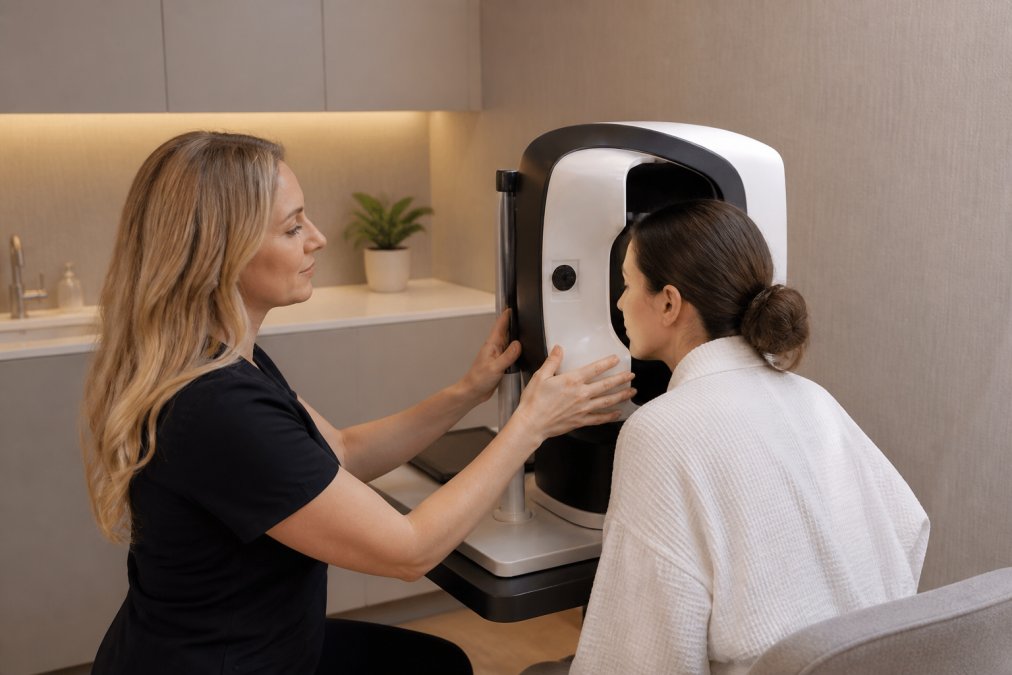
A typical capture session takes minutes. The patient positions their face within an imaging device that controls lighting, distance, and angle, ensuring every scan is comparable to the last.
Key Modalities: Standardised Lighting, UV and Polarised Light
Different light sources reveal different layers of the skin. Standardised white light documents surface-level concerns like texture and pore size, while cross-polarised light penetrates slightly deeper to assess vascularity and redness. UV fluorescence exposes pigmentation and sun damage that is invisible under normal lighting (peer-reviewed research).
Translating Images into Repeatable Clinical Metrics
The imaging hardware captures the raw data, but software does the analytical work. Advanced algorithms segment the face, identify regions of concern, and assign numerical values to key metrics. This transforms a subjective visual impression into objective data that can be filed, compared, and tracked across treatment cycles.
Measuring Skin Health Metrics That Drive Treatment Decisions
The value of objective analysis lies in the specific metrics it generates. Hydration levels, sebum levels, pigmentation density, pore size, and skin texture all provide actionable data points, informing everything from product selection to laser parameter choices.
A patient presenting with high sebum levels and enlarged pores requires a different protocol than one with dehydration and fine lines. Without measurement, these distinctions blur; with objective data, the personalised treatment plan writes itself.
The clinical workflow improves because every practitioner in a multi-provider clinic reads the same numbers. Standardized protocols become possible when decisions rest on shared data rather than individual perception, particularly valuable where patient expectations are high and outcomes must be demonstrable.
Aesthetic Consultation Best Practices with Objective Data
Integrating objective skin analysis into consultations shifts the dynamic from a subjective discussion to a collaborative review of visible, measurable evidence. Patients see their own skin data on screen, making the rationale for recommended treatments tangible.
Using Data to Boost Patient Compliance and Trust
Patients are more likely to follow a treatment plan when they understand the reasoning behind it. Showing a baseline hydration reading, then re-measuring after treatment, provides proof of progress that builds trust and encourages adherence to home-care regimens.
A common mistake is presenting raw data without interpretation. The clinician must translate numbers into plain-language recommendations. “Your hydration levels are twenty percent below the optimal range for your skin biotype” means little to a patient; “your skin is dehydrated, which is why we are starting with a hydrating protocol” means everything.
Ask every new patient the same set of questions about their current skincare routine before scanning. Recording this anamnesis alongside the biometric data creates a complete clinical picture that pure imaging cannot provide.
Best Skin Analysis Systems 2026: What to Look For
Selecting an imaging system is a significant capital decision. Beyond marketing claims, technical specifications determine what you can objectively measure and how you can use that data clinically. A focused evaluation of hardware capabilities separates systems that support clinical growth from those that become expensive shelf-ware.
Comparative Analysis of Imaging Modalities
A critical differentiator between systems is the number and quality of imaging modalities they offer. Most top-tier devices include at least three:
- Standardised White Light: Captures surface texture, fine lines, and pore size under controlled, reproducible illumination. This is your baseline for tracking overall skin surface changes.
- Cross-Polarised Light: This modality eliminates surface glare to visualise subsurface conditions like erythema (redness), vascular lesions, and inflammation. It is essential for conditions like rosacea or post-procedure assessment.
- UV Fluorescence: Illuminates porphyrins (bacterial activity) and deeper pigmentation that is invisible to the naked eye. This is the primary tool for pre-cancerous lesion screening and sun damage assessment.
Some advanced systems add a fourth modality, parallel-polarised light, to assess sebum distribution and textural irregularities. When comparing systems, do not just count modalities; ask for sample images of the same subject taken with each system. Compare the clarity of the UV capture, a common weakness in lower-cost devices is a blurry or under-exposed UV image that is diagnostically useless.
Hardware Specifications That Matter
Beyond the light source, scrutinise the hardware:
- Sensor Resolution: A higher-resolution sensor captures finer detail, which is crucial for tracking subtle changes in texture or pigmentation over time. Look for sensors that are medical-grade, not repurposed consumer camera sensors.
- Lens Quality and Fixed Focus: The lens must be distortion-free and the focus fixed to ensure every capture is identical, regardless of the operator. A system with manual focus introduces operator error and compromises the repeatability of your data.
- Patient Positioning System: The chin rest and forehead guide must be robust and adjustable to ensure the patient’s face is in the exact same position for every scan. This is the foundation of longitudinal data; a poor positioning system makes your before-and-after comparisons unreliable.
The Vendor’s Clinical and Business Commitment
Your relationship with the vendor extends far beyond the initial sale. Evaluate their commitment to your practice’s success:
- Training and Onboarding: Does the vendor provide comprehensive training for all your clinicians and front-desk staff? A system is only as good as the people using it. Look for vendors who offer on-site training and refresher sessions.
- Software Updates and Algorithm Validation: Skin analysis algorithms improve over time. Ask about the vendor’s roadmap for software updates and whether these are included in the purchase price or require a subscription. Inquire if their algorithms have been validated in peer-reviewed studies or against established clinical standards.
- Data Export and Interoperability: Your imaging data is a valuable asset. Ensure the system allows you to export raw, high-resolution images and data in a standard format (e.g., DICOM or CSV). This prevents vendor lock-in and allows you to integrate your data with other clinical software or share it with referring practitioners.
Beware of systems that lock you into a proprietary ecosystem. If you cannot export your patient’s imaging data, you do not truly own your clinical records. This is a critical consideration for data privacy and practice portability.
::: clinical skincare.
Clinics often focus solely on upfront hardware cost, but total cost of ownership includes software licensing, maintenance contracts, and consumables. A slightly more expensive system with superior software and a clear upgrade path often delivers a better return on investment than a cheaper, static system.
Data Privacy, Ethics and Regulatory Considerations in Australia
Skin imaging captures sensitive biometric data, and Australian clinics must handle this information with care. The Privacy Act 1988 (Cth) governs how personal information is collected, stored, and used; biometric data, including facial images used for analysis, falls within the definition of sensitive information, requiring higher standards of consent and security (oaic.gov.au).
Before implementing any system, review your privacy obligations with a qualified advisor. Patients must give informed consent for their images to be captured, stored, and used in treatment planning. Your practice should have clear policies on data retention, access, and deletion, consistent with guidance from the Office of the Australian Information Commissioner.
Ethical considerations extend beyond legal compliance. Be transparent with patients about what the data will be used for, and never share images for research or marketing without explicit opt-in consent.
Making the Business Case: ROI and Post-Treatment Tracking
The return on investment (ROI) for an objective skin analysis system is built into the daily workflow of a successful clinic. The capital expenditure is justified by three revenue streams: increased case acceptance, higher-value treatment plans, and improved patient retention, each driven by how you use the data, not just by owning the device.
Increasing Treatment Conversion Rates
The consultation is where the system proves its worth. Instead of telling a patient they have pigmentation, you show them a high-resolution UV image with clearly demarcated areas of concern. This visual evidence transforms a recommendation into a diagnosis the patient can see and understand.
A common pattern is to use the scan data to anchor the treatment plan. If the analysis shows a hydration level of 30% (against a normal range of 50-70%), the clinician can immediately link that data point to a specific hydrating treatment or product. This evidence-based pathway from diagnosis to treatment typically increases acceptance rates for recommended procedures, as the patient’s perceived need is elevated by seeing their own objective data.
Driving Higher-Value Treatment Plans
Objective data allows you to move beyond single, simple treatments. A patient may come in for a single anti-wrinkle injection, but the skin analysis might reveal significant photoaging, uneven texture, and erythema, supporting a more comprehensive, multi-modal treatment plan that addresses root causes, not just the symptom they noticed.
Instead of a single service, you can propose a package that includes a course of laser toning for pigmentation, a medical-grade skincare regimen for hydration, and a series of peels for texture. The data justifies the higher price point because the treatment is no longer elective; it is a targeted solution to a documented problem.
Building a Post-Treatment Tracking Protocol
The most powerful, yet under-utilised, feature of objective analysis is longitudinal tracking, not just a ‘before’ and ‘after’ photo, but a structured protocol that proves treatment efficacy over time.
A Standardised Tracking Protocol:
- Baseline Capture: At the initial consultation, capture a full set of images and metrics. This is your reference point.
- Mid-Treatment Review: For a course of treatments (e.g., a series of three peels), capture a scan halfway through. This allows you to show the patient early progress, which is a powerful motivator to continue with the full course.
- Final Outcome Assessment: Capture a scan 4-6 weeks after the final treatment. This is the definitive proof of the outcome.
- Maintenance Monitoring: Re-scan the patient at their 6-month or 12-month maintenance visit. This data shows the longevity of your work and helps you recommend future touch-up treatments.
This protocol turns the imaging system into a patient retention tool. When a patient sees a 40% reduction in pigmentation density or a 20% improvement in hydration levels on a graph, they are far more likely to book their next session and refer friends. The data provides the ‘hard evidence’ that word-of-mouth marketing is built on.
Measuring Your Return on Investment
To track your ROI, monitor these key performance indicators (KPIs) in the first six months after implementation:
- Treatment Acceptance Rate: Compare the percentage of consultations that result in a booked treatment before and after using the system.
- Average Transaction Value (ATV): Track the average value of a patient visit. An increase here indicates you are successfully recommending higher-value, data-driven treatment plans.
- Patient Retention Rate: Measure the percentage of patients who return for a second or third treatment within a 12-month period.
A system that is used only for initial consultations is a diagnostic tool. A system used for baseline, mid-treatment, and post-treatment reviews is a business growth engine. The difference is in the protocol you establish, not the hardware you buy.
The clinics that grow fastest treat skin analysis as a business tool, not just a diagnostic one. Objective data drives case acceptance, supports premium pricing, and creates a documented record of outcomes that differentiates your practice in a competitive market.
Conclusion: Standardising Your Path to Better Outcomes
The move to objective skin analysis is a move toward clinical consistency and defensible outcomes. It removes the variability of subjective judgement, gives patients confidence in their treatment plans, and provides the documentation needed to prove results.
Implementing this technology requires a partner who understands both the clinical and business sides of your practice. DermTech Devices was founded by a Registered Nurse with over 19 years of experience, bridging the gap between clinical excellence and accessibility. We offer medical-grade systems at affordable prices, with the training and ongoing support your team needs to use them confidently.
Partner with us to bring objective, reliable skin analysis to your clinic and standardise your path to better patient outcomes.
Frequently Asked Questions
What is the difference between subjective and objective skin analysis?
Subjective analysis relies on visual inspection under standard room lighting and the practitioner’s experience, which can vary between clinicians. Objective skin analysis uses calibrated imaging devices to capture standardized data under consistent lighting, including UV and polarized light. These systems measure metrics like pigmentation, vascularity, pore size, and skin texture, producing repeatable, biometric data. This removes guesswork, supports clinical decision-making, and provides a baseline for tracking treatment efficacy over time.
What clinical metrics should an aesthetic clinic track using skin analysis systems?
Start with the metrics that directly influence your treatment protocols: skin hydration, sebum levels, pigmentation, vascularity, pore size, and skin texture. Track these consistently at baseline, mid-treatment, and post-treatment to quantify progress. Measuring skin health metrics objectively gives you longitudinal data to adjust plans and demonstrate results to patients. For specific advice on which metrics matter for your services, consult with the device manufacturer or a qualified professional.
How does objective data influence aesthetic treatment plans?
Objective data replaces anecdotal observation with a clear picture of the skin’s condition. For example, identifying the depth and type of pigmentation under UV fluorescence helps select the right laser wavelength, while tracking sebum levels guides product recommendations. This leads to more personalized treatment plans, better diagnostic accuracy, and improved outcomes. Reviewing data during the patient consultation also helps set realistic expectations and improves compliance, as patients can see their own progress.
Are there TGA requirements for skin analysis imaging devices?
In Australia, the Therapeutic Goods Administration (TGA) regulates medical devices based on their intended purpose. If a skin analysis system is marketed for diagnosing, preventing, monitoring, or treating a disease or condition, it is likely a medical device and must be included in the Australian Register of Therapeutic Goods (ARTG). Systems intended only for cosmetic assessment may fall outside this scope. Check the TGA website or consult the manufacturer to confirm a device’s regulatory status.