Blog Details
Table of Contents
- Understanding Laser Safety Standards in Australia
- Laser Classification Systems and Hazard Levels
- AS/NZS IEC 60825.1 Compliance: What Your Clinic Must Do
- Clinical Laser Risk Assessment: A Step-by-Step Approach
- Laser Safety Officer Training Requirements and Responsibilities
- Engineering and Administrative Controls for Laser Safety
- Practical Compliance Checklist for Clinics
- Conclusion
- Frequently Asked Questions
Last Updated: September 24, 2026
Understanding Laser Safety Standards in Australia
Laser equipment safety standards in Australia are built around AS/NZS IEC 60825.1, which sets classification limits, labelling rules and exposure criteria for every laser sold or operated in the country. DermTech Devices supplies multi-modality laser platforms to dermatology and aesthetic clinics. (Source: Safe Work Australia’s guidance on non-ionising radiation)
The Role of AS/NZS IEC 60825.1
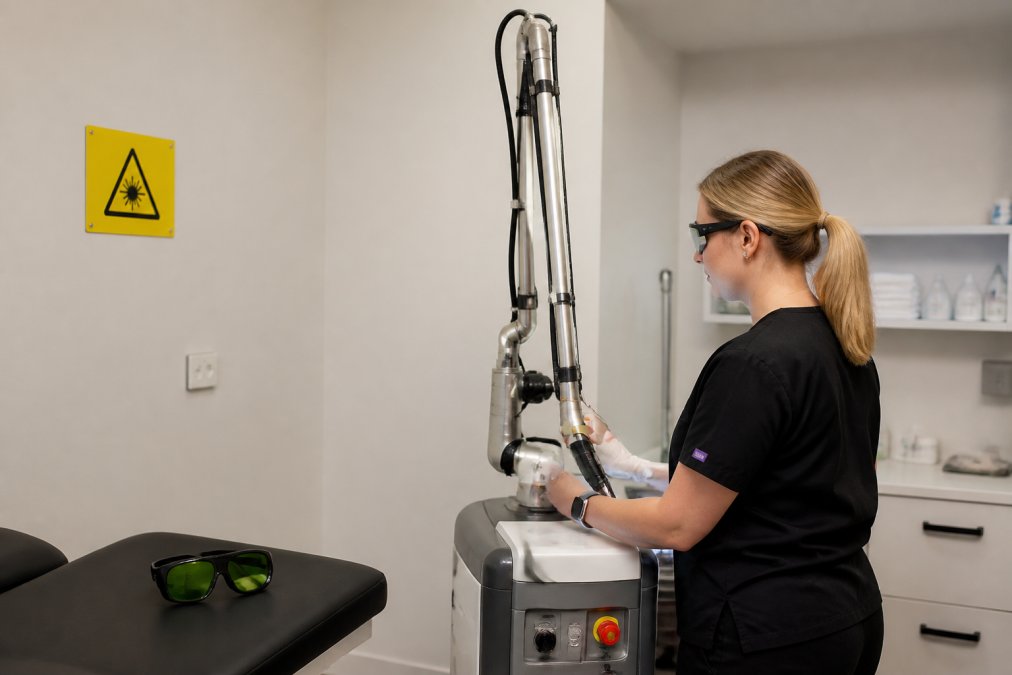
AS/NZS IEC 60825.1 is the adopted Australian and New Zealand standard covering safety of laser products, and it is the document your equipment, signage and training should align with. It defines laser classes, sets maximum permissible exposure levels, and specifies the labelling and information requirements manufacturers must meet. The standard is published through Standards Australia, and it mirrors the international IEC 60825-1 framework, which matters when you buy equipment sourced from overseas suppliers.
State and Territory Regulations
Work health and safety law is state and territory based, though all jurisdictions work from the model WHS laws, and each regulator enforces the general duty to manage risks from plant and radiation-emitting equipment. Specific laser licensing or notification requirements vary, so check the rules where your clinic is located rather than assuming a national standard.
Laser Classification Systems and Hazard Levels
Laser classification groups laser products by the risk their radiation poses to eyes and skin. Class 1 is safe under normal operating conditions; Class 2 covers visible low-power lasers where the blink reflex offers some protection; Class 3R and 3B carry increasing eye-injury risk; and Class 4 lasers, including most clinical and aesthetic treatment platforms, can injure eyes and skin and present a fire hazard.
| Class | Typical Risk | Common Clinical Use | Core Control |
|---|---|---|---|
| Class 1 | No hazard under normal use | Enclosed diagnostic systems | Engineering enclosure |
| Class 2 | Low, blink reflex limits exposure | Alignment and aiming beams | Administrative controls |
| Class 3R | Low to moderate eye risk | Some diagnostic devices | Eyewear and controlled area |
| Class 3B | Moderate eye risk | Targeted treatment devices | Eyewear, interlocks, signage |
| Class 4 | Eye and skin injury, fire risk | Aesthetic and surgical laser platforms | Full controlled area and LSO oversight |
AS/NZS IEC 60825.1 Compliance: What Your Clinic Must Do
AS/NZS IEC 60825.1 compliance means confirming equipment is correctly classified and labelled, a laser safety officer is appointed where required, exposure stays below maximum permissible exposure levels, and controls are documented and reviewed, connecting to your risk assessment, standard operating procedures and staff training records.
The Evidence Set an Auditor Expects
A laser compliance review is an evidence exercise. These are the documents a clinic should be able to produce on the spot:
- Equipment register, every laser device, its class, wavelength, serial number, supplier and date of purchase.
- Classification and labelling evidence, the supplier’s classification documentation and a photograph or record of the label as installed.
- Risk assessment, one per device and per room, signed and dated, with a review date.
- Laser safety officer appointment, written, with the scope of the role and the training that supports it.
- Standard operating procedures, current, accessible at the point of use, and version-controlled.
- Training records, who was trained, on which devices, by whom, and when.
- Maintenance and calibration log, service dates, calibration results and any faults or repairs.
- Incident register, near misses as well as actual exposures, with the corrective action taken.
- Controlled area records, signage, interlocks and warning-light test results.
Mapping Imported Equipment to the Standard
Equipment sourced from overseas is where compliance most often slips: a device may carry an IEC 60825-1 classification label without the AS/NZS adoption being confirmed, and labelling, warning text and information requirements can differ. Before commissioning, confirm the classification is stated against AS/NZS IEC 60825.1, the label and safety information meet the adopted standard’s requirements, and the supplier can provide classification documentation in writing.
A Compliance Sequence for Small Clinics
For a clinic without a dedicated safety function, follow a fixed order:
- Build the equipment register first, everything else references it.
- Confirm classification and labelling for each device, including imported units.
- Write the risk assessment per device and per room.
- Appoint the laser safety officer and record the appointment.
- Write or update the standard operating procedures.
- Train staff and file the records.
- Set the maintenance and calibration schedule.
- Diarise the review date and the signage and interlock checks.
When you buy a laser platform, ask the supplier for the classification documentation and the safety information that ships with the product. Clinics that skip this step often discover a labelling gap only when an auditor or insurer asks for it.
Compliance is a document set, not a feeling. If the equipment register, risk assessment, training records and maintenance log cannot be produced on request, the clinic is not compliant regardless of how the room looks.
Clinical Laser Risk Assessment: A Step-by-Step Approach
Clinical laser risk assessment identifies every hazard a laser presents in your specific rooms, then decides what controls reduce each risk to an acceptable level. A generic template is not enough; the assessment must reflect your equipment, layout and staff.
- Identify the laser class and wavelength of every device in the clinic.
- Map the beam path, including where the beam terminates and where stray reflections could occur.
- Identify who could be exposed: practitioners, assistants, patients and anyone entering the room.
- Assess specular and diffuse reflections, since shiny surfaces and instruments can redirect a beam.
- Set the maximum permissible exposure and nominal ocular hazard distance for each device.
- Choose controls in this order: eliminate, substitute, engineering, administrative, then personal protective equipment.
- Document the assessment, assign responsibilities, and set a review date.
Laser Safety Officer Training Requirements and Responsibilities
Laser safety officer training requirements depend on the class of lasers in use and your workplace’s risk profile. There is no single national certificate; the LSO must have sufficient knowledge to assess and manage the hazards, and that competence must be demonstrable. For Class 3B and Class 4 equipment, an appointed LSO with formal training is standard practice.
Engineering and Administrative Controls for Laser Safety
Engineering controls are the physical measures built into the room and equipment: key control, beam shutters, door interlocks, warning lights, and non-reflective surfaces in the beam path. They come before administrative controls because they reduce risk without relying on human behaviour. Administrative controls cover the operating procedures, signage, restricted access, training and supervision governing day-to-day laser use.
Maintenance and Calibration: The Control Most Clinics Neglect
A laser that drifts out of calibration can deliver more or less energy than intended, both a safety and a clinical outcome issue. Maintenance and calibration keep the built-in protections working, but are usually managed as a schedule rather than a physical device.
- Daily or before each session, visual check of the device, the delivery system, the key control and the warning light; confirm the correct eyewear is present.
- Weekly, test door interlocks and the emergency stop; check signage is legible and in place.
- Monthly, inspect the delivery fibre or arm for damage, check the beam shutter operates freely, and confirm the controlled area markings are intact.
- Annually, or per the manufacturer’s interval, full calibration and performance verification against the manufacturer’s specification, with the result recorded.
- After any repair, relocation or fault, recalibration and a repeat of the relevant safety checks before the device returns to clinical use.
Choosing Between Control Types
The order of control reflects how reliably each measure works when people are busy or distracted. Elimination and substitution remove the hazard but are rarely available for a clinical laser. Engineering controls work without human input, which is why interlocks and shutters are preferred over signs and procedures. Administrative controls depend on people following them, so they need training, supervision and review.
A common and costly mistake is buying one set of laser eyewear for the whole clinic. Optical density is wavelength-specific, so eyewear that protects against one device may offer almost no protection against another. Match every pair to the device it will be used with.
Controls are only as good as their maintenance. An interlock that is not tested, a shutter that sticks and a device that is out of calibration are all failures of the control system, even when the paperwork says the controls are in place.
Practical Compliance Checklist for Clinics
This checklist covers the items that come up most often in a laser compliance audit.
- Every laser is correctly classified and labelled
- A laser safety officer is appointed where required
- A written risk assessment exists for each device and room
- The controlled area is defined and marked
- Safety signage, warning lights and interlocks are in place and tested
- Key control and beam shutters are operational
- Protective eyewear matches each device’s wavelength and optical density
- Standard operating procedures are current and accessible
- Staff training records are up to date
- Maintenance and calibration records are retained
- The risk assessment is reviewed on a set schedule
Compliance is a paper trail as much as a set of physical controls. If you cannot produce the risk assessment, the training records and the maintenance log on request, you are not compliant, regardless of how safe the room looks.
Conclusion
Laser safety compliance is not a one-off purchase decision; it is an ongoing operational discipline many clinics underestimate until an audit forces the issue. DermTech Devices supplies medical-grade multi-modality laser platforms and next-generation skin analysis systems built for performance, reliability and safe clinical use, with training and support. If you are expanding your treatment offering or upgrading existing equipment, partner with us and get a platform that supports both your patients and your compliance obligations.
Frequently Asked Questions
What are the main safety standards for laser equipment in Australia?
The primary standard is AS/NZS IEC 60825.1, which sets out laser classification, maximum permissible exposure limits, and safety controls. It is supported by state and territory work health and safety regulations that require risk assessments, training, and engineering controls. For clinical settings, additional guidance comes from the Australian Radiation Protection and Nuclear Safety Agency (ARPANSA) and professional bodies. Compliance involves meeting all applicable requirements, not just one standard.
How does AS/NZS IEC 60825.1 apply to aesthetic laser devices?
AS/NZS IEC 60825.1 applies to all laser products, including aesthetic devices. It requires manufacturers to classify lasers (e.g., Class 3B or 4) and provide safety information. Clinics must use the classification to determine appropriate controls: for Class 3B and 4, this includes a Laser Safety Officer, controlled areas, protective eyewear, and interlock systems. The standard also sets maximum permissible exposure levels to prevent eye and skin injury.
What are the responsibilities of a Laser Safety Officer (LSO) in a clinical setting?
An LSO is responsible for implementing and overseeing the laser safety program. Key duties include conducting risk assessments, ensuring compliance with AS/NZS IEC 60825.1, providing training, maintaining records, and investigating incidents. The LSO also verifies engineering controls (e.g., beam shutters, warning lights) and administrative controls (e.g., standard operating procedures). They act as the point of contact for safety audits and must stay updated on regulatory changes.
What documentation is required to prove compliance with laser safety standards?
Clinics should maintain a laser safety manual, risk assessments, equipment maintenance and calibration records, training logs, standard operating procedures, and incident reports. Also keep records of safety audits and any corrective actions. This documentation demonstrates due diligence and is often requested by work health and safety regulators. Regular reviews and updates are essential to show ongoing compliance.
Laser safety standards in Australia reward clinics that treat compliance as part of buying and running equipment, not as an administrative burden bolted on afterwards. DermTech Devices provides advanced multi-modality laser platforms and precision skin analysis systems, backed by collaboration with globally recognised medical technology brands and ongoing support for your team. Get started with DermTech Devices and build a treatment offering that is safe, consistent and built to grow.