Blog Details
Table of Contents
- Building a Scalable Technology Foundation for Your Dermatology Practice
- Aesthetic Clinic Growth Strategies 2026: Technology That Drives Patient Demand
- TGA Medical Device Compliance for Clinics: What You Must Verify
- Teledermatology Workflow Integration: Connecting Virtual Care to Your Practice
- AI Skin Analysis Technology ROI: Measuring the Return on Diagnostic Tools
- Revenue Cycle Management and Practice Management Software Optimisation
- Frequently Asked Questions
Last Updated: September 27, 2026
Building a Scalable Technology Foundation for Your Dermatology Practice
Scaling how to scale dermatology practice technology starts with one hard truth: most practices bolt on new tools before the core systems can talk to each other. According to the Australian Digital Health Agency’s digital health strategy, connected, standards-based systems are the foundation of safe, efficient clinical care. That matters because fragmented records and manual double-entry create the bottlenecks that stall growth long before patient demand does.
Core Systems Every Growing Practice Needs
Five systems form the backbone of a practice that can add practitioners without adding chaos:
- Electronic health records (EHR) with dermatology-specific templates and mobile-accessible records
- Digital imaging with consistent capture protocols for skin lesion documentation
- Appointment scheduling that supports multi-practitioner and multi-room allocation
- Revenue cycle management linked directly to clinical documentation
- Patient portal for results, reminders, and secure communication
Interoperability and API Integration: The Missing Piece
Interoperability is the capability of separate systems to exchange and use clinical data without manual re-entry. Fast Healthcare Interoperability Resources (FHIR) is the international standard most modern platforms now support, and it is what makes genuine integration possible.
Buying a scheduling or imaging tool that cannot exchange data via an API means staff re-enter patient details by hand. That duplication is where transcription errors and lost appointment slots originate.
Aesthetic Clinic Growth Strategies 2026: Technology That Drives Patient Demand
Technology drives patient demand when it shortens the path from enquiry to treatment. For aesthetic clinic growth strategies 2026, the practices gaining ground are those that automate the administrative layer so clinicians spend their time on care, not coordination.
Patient Engagement and Retention Through Digital Tools
Automated appointment reminders, secure messaging, and self-service rebooking reduce no-shows and keep patients returning. A patient portal that lets people view treatment history and upcoming appointments does more for patient retention than any loyalty scheme.
- Booking and triage in one flow. Online booking captures the reason for the visit, flags whether it suits a virtual or in-person consult, and writes directly to the schedule. No phone tag, no manual re-entry.
- Reminders that adapt. A first-time patient gets preparation instructions and a location link; a returning patient gets a short confirmation. Both pull from the clinical record, so the message matches the appointment type.
- Recall and review prompts. After a treatment, the system schedules a follow-up reminder and a review request at clinically appropriate intervals. This is where repeat bookings and word-of-mouth referrals come from.
- Secure two-way messaging. Patients send photos or questions through the portal rather than personal email or social media, keeping the exchange inside your privacy perimeter.
Test any engagement feature against a single question: does it reduce a manual step for staff or a friction point for the patient? Features that do neither add cost without adding demand.
Cost-Benefit Analysis Framework for New Equipment
Run every equipment decision through a five-year total cost of ownership model, not the sticker price. Use this framework:
| Cost Category | What to Include | Why It Matters |
|---|---|---|
| Acquisition | Purchase or lease, installation | Upfront capital commitment |
| Training | Initial and refresher sessions | Idle equipment wastes the whole investment |
| Maintenance | Service contracts, parts, calibration | Predictable or it becomes a surprise |
| Consumables | Per-treatment materials | Scales directly with patient volume |
| Downtime | Expected service days per year | Lost bookings are the hidden cost |
Ask for references from practices of a similar size and modality mix. A platform that performs well in a single-room clinic may behave differently across a multi-practitioner centre.
Turning Engagement Data into Growth Decisions
Once booking, reminders, and messaging run through integrated systems, you accumulate data that most practices never use: which treatments drive repeat visits, which referral sources convert, and where patients drop out of the journey. Reviewing this monthly turns engagement from a cost centre into a planning tool. A practice that knows its no-show pattern by day and treatment type can staff and schedule around it rather than reacting to it.
TGA Medical Device Compliance for Clinics: What You Must Verify
TGA medical device compliance for clinics means verifying that every device you use is included on the Australian Register of Therapeutic Goods (ARTG) for its intended purpose. The Therapeutic Goods Administration regulates medical devices in Australia, and the TGA’s guidance on medical device regulation sets out the obligations that apply to suppliers and users.
Before purchase, confirm three things:
- The device holds current ARTG inclusion
- The intended purpose on the ARTG matches how you will use it
- The supplier provides documentation and post-market support (Source: Fast Healthcare Interoperability Resources (FHIR))
Cybersecurity and Privacy Act Obligations for Small-to-Mid Practices
The Privacy Act 1988 and the Australian Privacy Principles govern how you handle patient information, and the Notifiable Data Breaches scheme requires you to report eligible breaches to affected individuals and the Office of the Australian Information Commissioner. Scaling changes your risk profile: more devices, more cloud accounts, more staff logins, and more data moving between systems. Each addition is a new door.
Access and identity
- Multi-factor authentication on every clinical, email, and administrative account, no exceptions for convenience.
- Role-based access so staff see only the records they need for their role, reviewed when people change roles or leave.
- A leaver process that disables accounts and revokes device access on the last day, not weeks later.
Data protection
- Encryption at rest and in transit for clinical records, imaging, and backups.
- Backups tested by actually restoring one, not just confirming the job ran.
- A clear rule on where patient data may and may not be stored, no clinical photos on personal phones or unmanaged cloud drives.
Devices and network
- An inventory of every device connected to the clinical network, including imaging hardware and any internet-connected equipment.
- Automatic patching where the vendor supports it, and a manual schedule where it does not.
- A separate network for guest and patient Wi-Fi so it never touches clinical systems.
People and process
- A written incident response plan that names who does what in the first hour of a suspected breach.
- Annual privacy and security training that covers phishing, because email remains a common entry point.
- A vendor assessment before any new tool touches patient data: where is it hosted, who can access it, and what happens to the data if you leave?
The Notifiable Data Breaches scheme has time expectations. A practice that discovers a breach and has no plan loses days deciding who to tell and what to say. Draft the plan before you need it.
Building Security into Procurement
Security is cheapest when it is a purchasing criterion rather than a retrofit. When evaluating a new imaging, scheduling, or records platform, ask for its data hosting location, its access control model, and how it supports your obligations under the Privacy Act. A vendor that cannot answer clearly is a vendor that will become your problem later. Documenting these answers at purchase also gives you a defensible record if a question ever arises.
Teledermatology Workflow Integration: Connecting Virtual Care to Your Practice
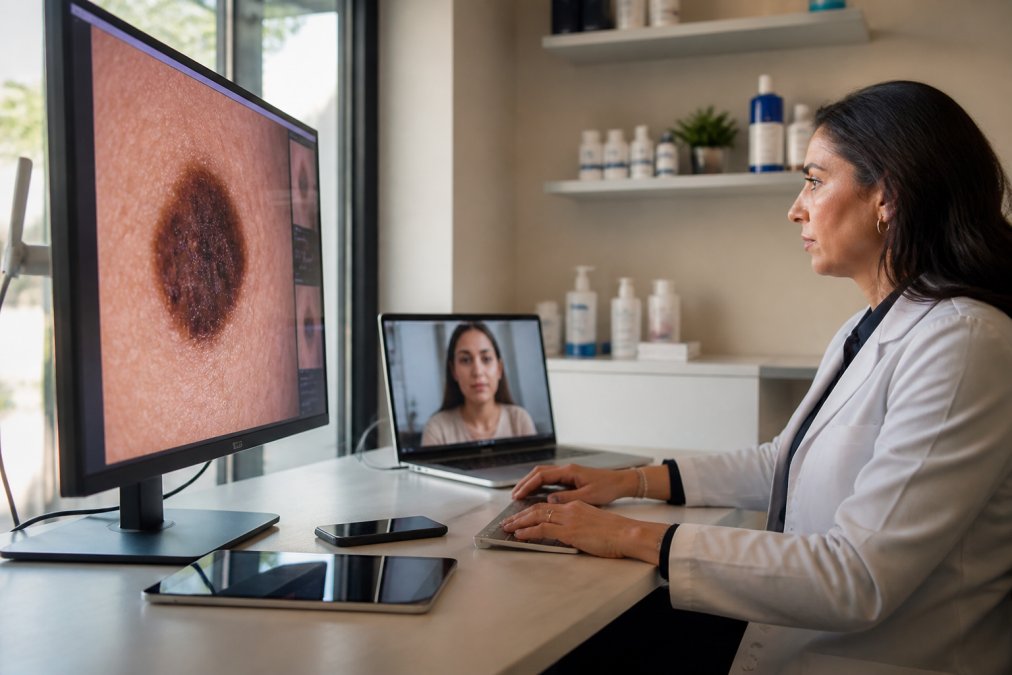
Teledermatology workflow integration means embedding virtual consultations into the same clinical record, scheduling, and imaging systems your in-person care already uses. When telehealth runs as a separate silo, clinicians duplicate documentation and patients fall through the gaps.
Digital Imaging and Skin Lesion Documentation Standards
Digital imaging and skin lesion documentation standards require consistent lighting, scale reference, and anatomical labelling for every capture. Consistency is what makes images comparable over time, and comparability is what makes them clinically useful.
AI Skin Analysis Technology ROI: Measuring the Return on Diagnostic Tools
AI skin analysis technology ROI is measured by comparing the cost of the tool against the revenue and efficiency it generates, not by its novelty. The calculation has three inputs: additional billable procedures enabled, time saved per consultation, and improved treatment planning accuracy that reduces repeat visits.
AI-Driven Diagnostic Assistance and Clinical Decision Support
AI-driven diagnostic assistance supports, but does not replace, clinical judgement. Clinical decision support tools flag patterns and prioritise cases for review; the dermatologist makes the diagnosis. Be sceptical of any vendor implying otherwise, because the regulatory and professional accountability sits with the clinician, not the algorithm.
Revenue Cycle Management and Practice Management Software Optimisation
Revenue cycle management and practice management software optimisation is where most practices find money they did not know they were losing. Claims rejected for documentation gaps, missed billing codes, and slow payment cycles quietly erode margin.
Cloud-Based Solutions and Mobile-Accessible Records
Cloud-based solutions and mobile-accessible records let practitioners document at the point of care and access history from any consult room. For multi-practitioner centres, cloud infrastructure removes the on-site server maintenance burden and supports scalability as you add rooms and staff. Centralizing these digital workflows ensures that data remains protected while scaling multi-site operations across your expanding network.
Scalable dermatology technology is an integration problem before it is a purchasing problem. Fix interoperability, compliance, and security first, then add capability.
Frequently Asked Questions
What are the TGA requirements for medical-grade laser equipment in clinics?
Medical-grade laser devices must be listed on the Australian Register of Therapeutic Goods (ARTG) before they can be lawfully supplied in Australia. The sponsor is responsible for ensuring the device meets the Essential Principles and that appropriate conformity assessment procedures have been completed. Clinics should verify the ARTG listing number directly with the supplier and confirm the device is included for its intended purpose. Keep records of the listing and any conditions of inclusion on file.
How does teledermatology workflow integration impact patient throughput?
Integrating teledermatology into your existing clinical workflow can reduce the number of in-person visits required for triage, follow-up and low-complexity reviews. When booking, imaging and documentation systems connect properly, administrative staff spend less time re-entering data and more time managing appointments. The result is typically shorter wait times for urgent cases and better use of specialist hours. The actual throughput gain depends on how well your practice management software handles scheduling, imaging and patient records in one place.
What digital security standards must dermatology practices meet under the Privacy Act 1988?
Under the Privacy Act 1988 and the Australian Privacy Principles, practices must take reasonable steps to protect personal information, including health records, from misuse, interference, loss and unauthorised access. This applies to cloud-based practice management software, patient portals and any device storing clinical images. Practical measures include access controls, encryption, staff training and written data breach response procedures. The Notifiable Data Breaches scheme requires you to notify affected individuals and the OAIC for eligible data breaches.
How can AI-driven skin analysis systems improve clinical outcomes?
AI-driven skin analysis systems provide objective measurements of skin features such as lesion size, colour variation and texture changes over time. This supports clinical decision support by giving dermatologists consistent baseline data to compare against future imaging. The technology does not replace clinical judgement; it adds a documented reference point that can help detect changes earlier. Better documentation also improves patient communication and supports consistent treatment planning across multiple practitioners in the same clinic.
What are the operational benefits of cloud-based practice management software?
Cloud-based practice management software allows scheduling, billing, clinical notes and imaging to be accessed from any authorised device, which supports multi-practitioner clinics and mobile-accessible records. Updates and backups are handled by the provider, reducing IT overhead for small-to-mid-sized practices. It also makes interoperability with teledermatology platforms and patient portals more straightforward. Before choosing a system, confirm it meets Australian Privacy Principle requirements and that your data is stored in compliance with applicable regulations.
How do I calculate the ROI of AI skin analysis technology for my practice?
Start by identifying the revenue and cost lines the technology affects: number of skin analysis procedures per week, average fee per procedure, staff time saved on manual documentation, and any reduction in repeat appointments caused by unclear baseline data. Compare the total five-year cost, including purchase, training, maintenance and software subscriptions, against the projected additional revenue and efficiency gains. Ask the supplier for a total cost of ownership breakdown and request references from practices of a similar size. Pricing varies, so get a written quote for your specific configuration.