Blog Details
Table of Contents
- What Clinical Skin Analysis Tools Do
- Professional Skin Analysis Systems: Device Types and Capabilities
- AI Skin Analysis for Clinicians: Accuracy and Reliability
- Skin Analysis Consultation Workflow: Integrating Data Into Patient Care
- AI Skin Analysis Accuracy: What Practitioners Need to Know
- Selecting the Right Clinical Skin Analysis Tool for Your Practice
- Frequently Asked Questions
Last Updated: October 8, 2026
What Clinical Skin Analysis Tools Do
Clinical skin analysis tools provide objective, measurable data about skin health. Using advanced imaging and sensor technology, they quantify hydration, sebum production, texture, pigmentation, and signs of damage, transforming how practitioners approach treatment planning and patient communication.
The shift from subjective observation to objective measurement changes everything: patients see their own data, progress becomes trackable, and recommendations feel evidence-based. For practitioners, this means faster consultations, more confident decisions, and stronger patient buy-in.
How skin analysis works in clinical settings
Professional skin analysis combines multiple technologies. Facial imaging captures high-resolution photographs under standardized lighting, while multispectral imaging adds wavelengths that reveal subsurface UV damage, vascular activity, and melanin distribution invisible to the naked eye. Sensor-based systems measure hydration and sebum directly, and AI algorithms process the data into actionable insights.
The workflow is straightforward: the patient sits for imaging, the system acquires data across modalities, software generates a report, and the practitioner reviews findings with the patient. Most systems complete a full analysis in 5-10 minutes, outputting visual maps, numerical scores, and treatment recommendations tied to the patient’s profile.
Skin concerns assessed by professional tools
Clinical skin analysis systems evaluate a consistent set of measurable parameters. Hydration levels determine whether skin needs moisture support or barrier repair. Sebum measurement identifies oily zones prone to congestion. Texture analysis quantifies fine lines, roughness, and pore prominence. Pigmentation mapping shows uneven tone, sun damage, and melasma distribution. Wrinkle depth and elasticity metrics track ageing signs. Some systems also assess redness, sensitivity markers, and acne-prone areas.
Each metric translates directly into treatment selection: high T-zone sebum suggests oil-control protocols, low cheek hydration indicates barrier-focused skincare, and uneven pigmentation guides laser or light-based therapies. This specificity reduces guesswork and lets practitioners address actual skin needs rather than assumed concerns.
Professional Skin Analysis Systems: Device Types and Capabilities
Skin analysis systems fall into distinct categories based on their technology and clinical application. Understanding these differences helps practitioners match tools to their workflow and patient population.
Facial imaging and multispectral analysis
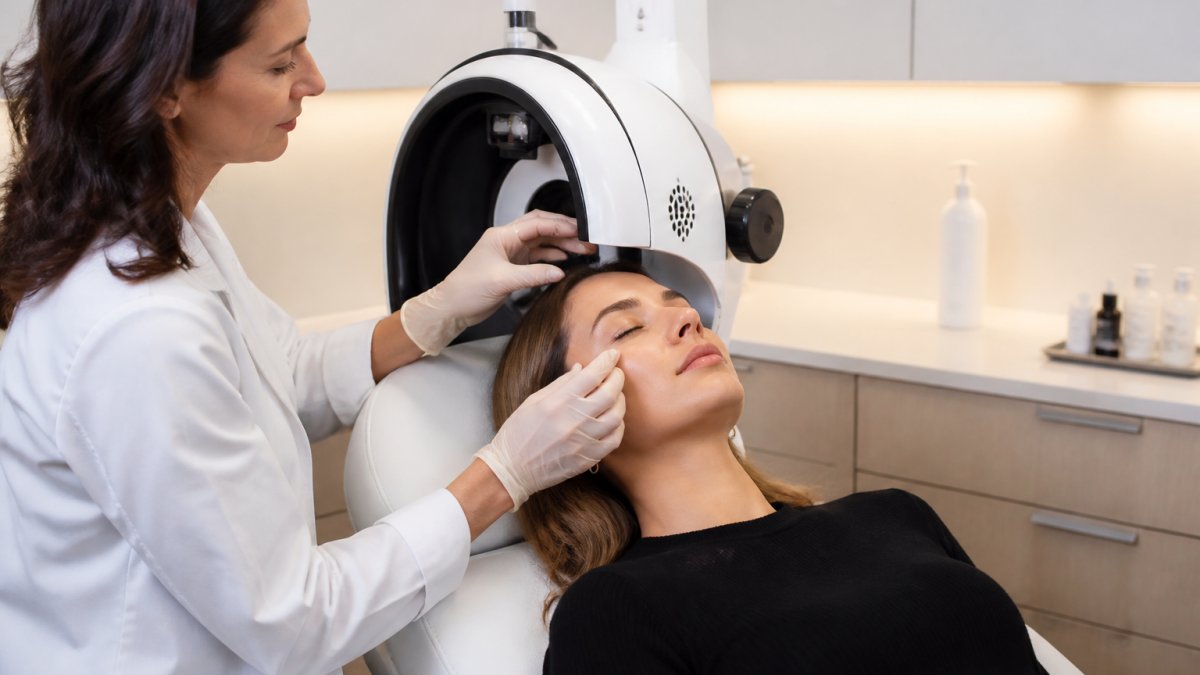
Facial imaging systems use high-resolution cameras and controlled lighting to capture standardized photographs. Multispectral variants add visible, infrared, and ultraviolet wavelengths to penetrate different skin layers and reveal hidden damage, with software mapping pigmentation, vascular patterns, and texture.
The advantage of multispectral imaging is depth: it reveals subsurface sun damage, melanin concentration, and vascular activity that standard photography misses. This lets practitioners identify problems before they become clinically obvious and track improvement in deeper layers. The technology is non-invasive and produces repeatable, comparable results across visits.
Hydration, sebum, and texture measurement
Sensor-based systems quantify skin’s physical properties directly: hydration probes measure stratum corneum moisture via electrical conductivity, sebum sensors detect oil via light reflectance, and texture software calculates roughness, pore size, and fine-line depth from high-magnification imaging. These produce numerical scores practitioners can track over time.
The clinical value lies in objectivity. A patient asking “Is my skin getting better?” can see their hydration score improve from 35 to 52 over eight weeks, and a practitioner can demonstrate a protocol is working through measurable change. This removes ambiguity and builds confidence in both diagnosis and treatment plan.
AI Skin Analysis for Clinicians: Accuracy and Reliability
Artificial intelligence has become central to modern skin analysis systems. Machine learning algorithms process imaging data, identify patterns, and generate treatment recommendations. The quality and reliability of these systems depends on how they were trained and validated.
How machine learning improves diagnostic consistency
AI systems trained on large datasets of skin images can identify patterns humans miss or inconsistently recognize, applying the same diagnostic criteria to every image and eliminating observer bias. This consistency is valuable where multiple practitioners assess the same patient or where judgement varies with fatigue or experience.
However, consistency is not accuracy. An AI system can be consistently wrong if trained on biased or limited data. The real question is whether its recommendations align with clinical outcomes and expert assessment, where validation studies matter, and where many commercial systems fall short of transparent evidence.
Evidence quality and validation limitations
Most skin analysis systems lack peer-reviewed validation studies demonstrating accuracy against clinical gold standards. Manufacturers often cite internal testing or small proprietary studies, leaving a gap between marketing claims and clinical proof.
Practitioners should ask: Has the system been tested against dermatologist assessment? Do independent studies support the accuracy claims? What is the false-positive rate? Were validation studies conducted on diverse skin types and tones, or primarily lighter skin?
The practical implication: treat AI-generated recommendations as decision support, not definitive diagnosis. Use the data to inform your clinical judgement, not replace it, and validate recommendations against your own experience and patient outcomes before full integration.
Skin Analysis Consultation Workflow: Integrating Data Into Patient Care
The real value of clinical skin analysis emerges in how you present and use the data with patients.
Presenting results and building patient confidence
A well-designed report transforms raw data into a compelling patient conversation. Visual maps, numerical scores, and before-and-after comparisons give patients concrete evidence, shifting the consultation from “I think you need this treatment” to “Your data shows this specific concern.”
Patients respond to objectivity. When a practitioner shows hydration scores, pigmentation maps, and texture measurements, recommendations feel evidence-based rather than sales-driven, building trust and increasing treatment acceptance.
Present the data in simple terms, avoid jargon, and show patients their images. Connect each finding to a specific treatment option, making the link between data and recommendation explicit.
Tracking progress and adjusting treatment plans
Repeating skin analysis at key intervals, typically 4-8 weeks depending on protocol, creates a measurable progress record. Patients see hydration improve, pigmentation fade, or texture refine, and practitioners can adjust treatments based on actual response rather than guesswork.
This feedback loop is powerful: if hydration plateaus after six weeks, you can shift approach; if texture improves but pigmentation stalls, you can add a targeted treatment. Data-driven adjustments increase efficacy and reduce wasted time on ineffective protocols. (Source: Therapeutic Goods Administration (TGA) guidelines for medical devices)
Document measurements consistently. Over time, you build outcome data showing which treatments work best for which skin types and concerns in your patient population, a competitive advantage built on refining protocols from real results.
AI Skin Analysis Accuracy: What Practitioners Need to Know
Clinical validation matters more than marketing claims. Before investing in a skin analysis system, understand what evidence actually supports its recommendations.
Most systems generate treatment suggestions via pattern recognition, recommending therapies that worked for similar profiles in their training data. This is useful only if the training data is diverse, outcomes were properly documented, and the algorithm was tested against independent validation sets.
Red flags include manufacturers claiming their system is “clinically proven” without citing peer-reviewed studies, systems tested only on their own patient populations, or tools lacking transparent accuracy documentation.
Consider also that skin analysis tools excel at quantifying visible features, texture, hydration, pigmentation, but cannot diagnose underlying conditions.
Privacy, consent, and image governance in clinical practice
High-resolution facial images are sensitive data. Storing, processing, and retaining these images creates privacy obligations. In Australia, the Privacy Act 1988 (Cth) and Australian Privacy Principles govern how you collect, use, and store personal information, including images (Privacy Act 1988).
Obtain explicit informed consent before capturing skin analysis images.
If your system is cloud-based, clarify where images are stored and processed. Some transmit images to overseas servers for AI analysis, triggering additional privacy considerations depending on jurisdiction and data security. Review the data processing agreement and privacy policy carefully.
Patients increasingly expect transparency about how their biometric data is used. Clear governance around image storage and AI processing builds trust and reduces liability risk.
Selecting the Right Clinical Skin Analysis Tool for Your Practice
Choosing a skin analysis system requires matching capability to your practice’s size, service scope, and clinical priorities.
Matching tool capability to practice size and service scope
A solo practitioner running a small aesthetic clinic has different needs than a multi-practitioner dermatology centre. Solo practitioners benefit from systems that are quick to operate, generate clear patient-facing reports, and integrate with simple record-keeping.
Consider your service focus: for laser and light-based therapies, prioritise pigmentation and vascular assessment; for skincare and injectables, emphasise hydration, texture, and wrinkle mapping; for acne, ensure reliable sebum and follicular detection. Match the tool’s strengths to your clinical priorities.
Evaluate ease of use. If training takes weeks or the system is cumbersome, it will sit idle.
Total cost of ownership and return on investment
Purchase price is only part of the cost. Factor in software licensing, maintenance, staff training, and ongoing support, some systems charge annual subscriptions, per-scan fees, or fees for updates and cloud storage. Get a complete cost breakdown before committing.
ROI is harder to quantify but worth considering. Systems that increase patient confidence may improve treatment acceptance and reduce cancellations, while faster consultations can increase throughput.
Start with a realistic assessment: will this tool meaningfully change how you practice? If you already have strong patient relationships and high treatment acceptance, ROI may be modest; if you struggle with buy-in or want to differentiate, it is higher.
Support, training, and long-term reliability
Equipment breaks, software needs updates, and staff turn over. Choose vendors with reliable, responsive support. Ask about their track record: local or offshore support staff?
Long-term reliability matters more than initial features.
DermTech Devices, founded by a Registered Nurse with over 19 years of experience, understands these practitioner concerns.
When you partner with DermTech Devices, you’re choosing a vendor who understands clinical practice from the inside.
Selecting a clinical skin analysis tool is a significant investment.
Prioritise systems backed by transparent validation evidence, designed for your specific practice workflow, and supported by vendors committed to your success.
Frequently Asked Questions
What tools do practitioners use for clinical skin analysis?
Practitioners use professional skin analysis systems that combine facial imaging, multispectral analysis, and AI-assisted measurement. These tools assess hydration levels, sebum production, pore size, pigmentation, texture irregularities, and signs of UV damage. Systems range from handheld imaging devices to stationary platforms integrated into treatment workflows. Medical-grade systems provide objective data that supports diagnosis, treatment planning, and progress documentation. Tool selection depends on practice size, service scope, and whether the system needs to integrate with existing laser or aesthetic treatment platforms.
How does AI skin analysis work in a clinical setting?
AI skin analysis for clinicians uses machine learning algorithms trained on clinical image datasets to identify skin characteristics and concerns from facial photographs or multispectral scans. The system compares captured images against reference data to measure hydration, sebum levels, wrinkles, spots, and texture. AI improves consistency by reducing observer bias and enabling standardised measurements across multiple consultations. In practice, the practitioner captures an image, the system processes it in seconds, and generates a report with objective metrics and recommendations. This accelerates assessment, improves documentation, and helps patients understand their skin condition visually.
How accurate are AI skin analysis systems?
AI skin analysis accuracy depends on the system’s clinical validation, training dataset quality, and how well the algorithm matches your patient population. Validated systems show strong correlation with professional assessment for hydration and sebum measurement, but accuracy varies for subjective measures like wrinkle severity or pigmentation grading. Limitations exist: lighting conditions, skin tone variations, and image quality affect results. No AI system replaces clinical judgment, it provides objective supporting data. Practitioners should verify that any system they adopt has published clinical validation studies and clear documentation of what it can and cannot reliably measure.
What should practitioners look for in a skin analysis system?
Prioritise clinical validation, ease of integration into your workflow, and long-term support. Check whether the system has published accuracy data for the specific concerns you treat most often. Assess whether it works with your existing treatment equipment and patient management software. Evaluate training requirements, systems that are complex to use sit idle. Consider total cost of ownership, including maintenance, calibration, and software updates over five years. Verify that the supplier offers reliable technical support and staff training. For multi-practitioner clinics, reliability is critical; request references from similar-sized practices to confirm consistent performance over time.