Blog Details
Table of Contents
- Quick Comparison: Device Consulting vs Australian Aesthetic Systems
- What Device Consulting and Direct Suppliers Actually Offer
- TGA Medical Device Compliance for Aesthetic Clinics
- Using an Aesthetic Laser Equipment ROI Calculator
- Clinical Support Services for Aesthetic Practices
- Where Each Option Wins: Scenario-Based Recommendations
- Conclusion
- Frequently Asked Questions
Last Updated: September 29, 2026
Quick Comparison: Device Consulting vs Australian Aesthetic Systems
Device consulting is a procurement and advisory service that helps clinics select, source and manage aesthetic equipment, while Australian aesthetic systems are the TGA-approved hardware and treatment platforms themselves. Most practices need both, but the order matters more than the vendor.
| Factor | Device Consulting | Direct Aesthetic Systems |
|---|---|---|
| What you get | Advice, procurement, project management | Hardware, training, ongoing service |
| Best for | Clinics unsure of their specification | Clinics with a defined treatment plan |
| Regulatory burden | Shared with the consultant | Sits with the supplier and you |
| Ongoing support | Varies by engagement | Typically included |
| Cost model | Fee-based or commission | Quote-based capital purchase |
| Speed to first treatment | Slower, more discovery | Faster once specified |
The deciding question isn’t consultant versus supplier. It’s whether you can write the specification yourself. If you can, a direct supplier removes a layer of cost and delay.
What Device Consulting and Direct Suppliers Actually Offer
Device consulting covers the advisory work around capital equipment: needs analysis, specification writing, tender management and installation oversight. Direct suppliers deliver the physical platform, the clinical training and the maintenance pathway.
The consultant model: advice, procurement and project management
A consultant’s real value is neutrality. They aren’t tied to one manufacturer’s catalogue, so they can compare energy-based devices across platforms and match output specifications to your patient mix.
The direct supplier model: hardware, training and ongoing service
Buying direct means dealing with the party who built or imported the platform. That matters for traceability, spare parts and software updates.
TGA Medical Device Compliance for Aesthetic Clinics
TGA medical device compliance for aesthetic clinics means every device you buy must be included on the Australian Register of Therapeutic Goods, or covered by a valid exemption, before it can be supplied and used on patients. The Therapeutic Goods Administration regulates this under the Therapeutic Goods Act 1989 and the Therapeutic Goods (Medical Devices) Regulations 2002.
How global ISO standards map to TGA obligations
Most buying guides stop at “check the ARTG number”. That is the entry ticket, not the compliance picture. The TGA does not require manufacturers to hold ISO certification as a standalone condition, but the conformity assessment procedures under the Medical Devices Regulations draw on the same quality management and risk management frameworks. In practice, a manufacturer’s ISO 13485 certification is the evidence base a TGA conformity assessment relies on.
- The ARTG inclusion number and the manufacturer’s name as it appears on the register
- The Australian sponsor’s details, since the sponsor holds the regulatory obligations in Australia
- Evidence of the manufacturer’s quality management system certification
- The intended purpose statement, because a device included for one indication is not automatically cleared for another
- The current status of the inclusion, since entries can be suspended or cancelled
The obligations that sit with you, not the supplier
A common misconception is that TGA compliance is entirely the supplier’s problem. It isn’t. Once a device is in your clinic, you carry obligations as the user.
- Use within intended purpose. Using a device for an indication outside its ARTG inclusion is your risk, not the supplier’s.
- Adverse event reporting. Serious adverse events and device malfunctions must be reported. The sponsor usually manages this, but you need a clear internal process to capture and escalate them.
- Record keeping. Keep the ARTG certificate, the instruction manual, training records and service history on file. These are the first documents requested in any complaint or audit.
- Advertising compliance. Claims made in your marketing must match the device’s intended purpose. Overstated claims can attract regulatory attention independently of the device itself.
Buying a device that isn’t ARTG-included exposes your clinic to enforcement action and voids your professional indemnity cover for treatments performed with it. The saving on the purchase price is never worth the exposure.
Where the consultant and the supplier differ on compliance
A consultant can help you verify inclusion, compare intended purposes across platforms and document your compliance position. A direct supplier or Australian sponsor holds the regulatory relationship with the TGA and is the party you go to when a question, a complaint or a recall arises.
Using an Aesthetic Laser Equipment ROI Calculator
An aesthetic laser equipment ROI calculator estimates how many treatments you need to perform before a platform covers its purchase and running costs. The inputs are treatment price, consumables, session time, utilisation rate and maintenance.
Here’s a workable structure:
- Capital cost: purchase price plus installation and initial training
- Recurring cost: consumables, service contract, software subscriptions, insurance
- Revenue per treatment: your fee minus consumable cost per session
- Break-even treatments: total annual cost divided by revenue per treatment
- Payback period: break-even treatments divided by realistic monthly volume
The comparison most calculators ignore: consultant fee versus direct purchase
- Acquisition cost. A consultant may negotiate a lower capital price through competitive tender, but you pay a fee or commission on top. A direct supplier typically quotes a single capital figure with training bundled. Compare the all-in figure, not the sticker price.
- Specification risk. A mis-specified platform is the most expensive outcome in aesthetic equipment. If the device doesn’t match your patient mix, you carry a capital asset you can’t fully utilise. A consultant’s value here is avoiding that loss, not shaving the price.
- Consumables and service. These are the costs that compound. Ask for a five-year consumable and service schedule in writing from both paths. A cheaper platform with high consumable costs can overtake a premium platform within three years.
- Downtime. Every day a platform is out of service is lost revenue. A service-level agreement with a defined response time and a loan unit is worth more than a small discount on the purchase price.
- Residual value. Some platforms hold resale value better than others. Ask what the trade-in or resale position looks like at year three, particularly if you plan to add modalities.
A consultant who saves you 10 per cent on the purchase price but leaves you with a mis-specified platform has cost you money. A direct supplier who charges full price but gets the specification and support right has saved you money. Compare cost per treatment, not purchase price.
Ask any supplier for their own worked example. A partner who can’t show you the maths is selling, not advising.
Clinical Support Services for Aesthetic Practices
Clinical support services for aesthetic practices cover the training, protocols and troubleshooting that keep a platform performing after installation. This is where direct suppliers and consultants diverge most sharply.
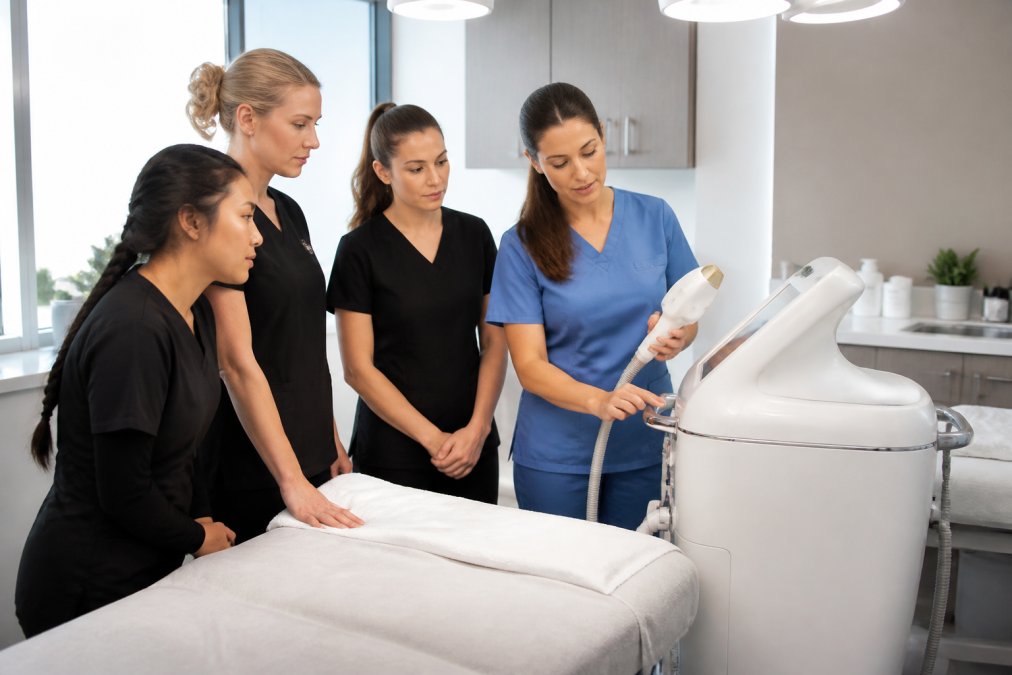
Benchmark any support package against these questions:
- Is training delivered on-site or remotely, and how many sessions are included?
- Who answers clinical questions outside business hours?
- What’s the response time for a technical fault, and is a loan unit provided?
- Are protocols updated when manufacturer guidance changes?
- Is there a named contact, or a general support queue?
Where Each Option Wins: Scenario-Based Recommendations
Neither model wins universally. The right choice depends on how clearly you can define what you need and how much internal expertise you have.
Choose device consulting when:
- You’re opening a new clinic and haven’t settled on a treatment menu
- You need to compare multiple platforms against a formal specification
- Your purchase requires board or investor approval and needs documented analysis
- You want an independent view before committing capital
Choose a direct supplier when:
- You know the modalities you need and the throughput you’re targeting
- You want training, service and parts from one accountable party
- Speed to first treatment matters more than exhaustive comparison
- You’d rather deal with the party who holds the manufacturer relationship
Consider both when:
- The capital commitment is significant and you want external validation
- Your team lacks the technical background to write a specification
- You’re adding a second or third platform and want to avoid duplicating capability
Ask every supplier for two references from practices of a similar size and specialty. Then ask those references one question: how quickly did they get a technician on site the last time something broke. The answer tells you more than any specification sheet.
Conclusion
The harder question isn’t which model to choose. It’s whether you can define your specification, verify TGA inclusion, and support the platform for its full service life.
Frequently Asked Questions
What should aesthetic clinics look for when choosing a device supplier?
Start with TGA compliance. Any aesthetic device supplied for clinical use must be included on the Australian Register of Therapeutic Goods, so ask for the ARTG number and verify it yourself. Then assess what happens after installation: clinical training, response times for faults, spare parts availability and whether the supplier services equipment locally. Finally, model the numbers. A five-year view of purchase price, consumables, servicing and training usually separates a genuine partner from a one-off seller.
What is the difference between a device consultant and a direct system supplier?
A device consultant typically advises on equipment selection, negotiates procurement and may project-manage installation, but they rarely own the hardware or carry the service obligation. A direct supplier sells the platform itself and usually carries responsibility for delivery, clinical training, warranty and ongoing maintenance. The practical difference shows up after purchase: with a consultant, you may need to chase the manufacturer for support. With a direct supplier, one relationship covers the equipment and its upkeep.
How do TGA regulations impact the selection of aesthetic medical devices?
The Therapeutic Goods Administration regulates medical devices supplied in Australia, including most energy-based platforms used for skin resurfacing, pulsed light and laser treatments. Devices must be included on the Australian Register of Therapeutic Goods before lawful supply, and the manufacturer must hold appropriate conformity assessment evidence. For clinics, this means checking the ARTG listing, confirming the intended purpose matches how you plan to use the device, and keeping records of your equipment and its maintenance.
How do I build a realistic aesthetic laser equipment ROI calculator?
List every cost first: purchase price or finance repayments, consumables, servicing, insurance, staff training and any room fit-out. Then estimate revenue per treatment and how many treatments you can realistically deliver each week, allowing for slower early months. Divide total five-year costs by your expected patient volume to get a break-even price per treatment. If that figure sits comfortably below your market rate, the platform is viable. Review the model quarterly, because utilisation changes as your marketing matures.
What support services are essential when investing in new aesthetic technology?
At minimum, you need structured clinical training that goes beyond a single induction day, a clear fault-reporting process with defined response times, access to replacement parts, and periodic servicing to keep the device performing to specification. Ask whether training covers protocols, parameter settings and complication management, and whether refresher sessions are available when you hire new staff. Reliable clinical support services for aesthetic practices protect both patient outcomes and the working life of the equipment.
Most clinics can answer the first two. The third is where equipment quietly underperforms, and it’s the one worth solving before you sign. DermTech Devices supplies medical-grade multi-modality laser platforms and next-generation skin analysis systems, backed by training and ongoing support from a team founded by a Registered Nurse. If you want a partner who stays past installation, get started with DermTech Devices and build a treatment room that performs for years, not weeks.