Blog Details
Table of Contents
- Why Clinics Are Reconsidering Device Consulting Models
- Device Consulting Alternative: Direct Supplier Partnerships vs Third-Party Consultants
- What to Look for in Medical Laser Supplier Support
- Medical Laser Supplier Support Comparison: Key Questions to Ask
- TGA Medical Device Compliance for Clinics: Who Owns It?
- Aesthetic Practice Equipment Procurement: A Step-by-Step Checklist
- Stage 1: Define the Clinical Need and Business Case (Week 1-2)
- Stage 2: Shortlist Suppliers Based on Clinical Credibility (Week 3-4)
- Stage 3: Conduct a Structured Demonstration and Hands-On Trial (Week 5-6)
- Stage 4: Model the Total Cost of Ownership (Week 7-8)
- Stage 5: Negotiate the Service Agreement (Week 9-10)
- Stage 6: Plan the Implementation and Training Schedule (Week 11-12)
- Conclusion: Choosing a Partner for Long-Term Growth
- Frequently Asked Questions
Last Updated: September 9, 2026
Why Clinics Are Reconsidering Device Consulting Models
The traditional third-party consulting model for acquiring dermatology systems often leaves clinics with paperwork and a device they barely understand. A growing number of Australian practices are discovering that the consultant’s departure marks the end of genuine support, not the beginning of a partnership.
This is where the search for a true device consulting alternative begins. Paying a middleman to broker a deal adds cost without clinical value. The core problem is structural: consultants earn their fee at the point of sale, so their incentive to ensure long-term operational success is limited. A clinic signs a contract based on a glossy brochure, receives the hardware, and then discovers that training, maintenance, and regulatory guidance are separate paid extras. The total cost of ownership balloons far beyond the initial quote.
Device Consulting Alternative: Direct Supplier Partnerships vs Third-Party Consultants
A direct supplier partnership is a device consulting alternative that removes the intermediary and puts the clinic in direct contact with the people who know the equipment best. Third-party consultants position themselves as neutral advisors, but their revenue depends on completed sales, creating an inherent bias toward closing deals rather than finding the right fit.
The distinction matters most after installation. A direct supplier has a continuing interest in your clinical outcomes because repeat business and referrals depend on it. A consultant who has already been paid has no such stake. For dermatology practices, where equipment utilisation directly affects revenue, this difference is decisive.
Where Traditional Consultants Add Value
Consultants serve a purpose in specific situations. Large multi-practitioner centres expanding across multiple sites may benefit from a consultant’s market overview and ability to coordinate complex procurement across several vendors. Their value is largely transactional, they excel at the initial comparison and negotiation phase, but their expertise rarely extends into the clinical integration and staff competency development that determines whether a device actually improves patient outcomes.
The Gaps Clinics Hit After the Consultant Leaves
The most common complaint from practices is the silence after installation. Equipment sits idle because nobody trained the nurses properly. A fault occurs, and the clinic discovers the consultant has no service agreement with the manufacturer. Regulatory questions about TGA compliance go unanswered. These gaps are expensive: idle equipment does not generate revenue, and unresolved technical issues erode staff confidence.
What to Look for in Medical Laser Supplier Support
Strong medical laser supplier support is the difference between a device that enhances your practice and one that gathers dust. The most critical factor is the supplier’s clinical credibility. A supplier founded by clinicians brings an understanding of patient safety and treatment protocols that a purely commercial operation lacks.
Look for comprehensive onboarding, not a single rushed demonstration. Ask about the trainer’s qualifications and whether training is delivered by someone with clinical experience or by a sales representative reading from a script. Ongoing technical support, responsive repair logistics, and a clear pathway for regulatory questions are non-negotiable.
Medical Laser Supplier Support Comparison: Key Questions to Ask
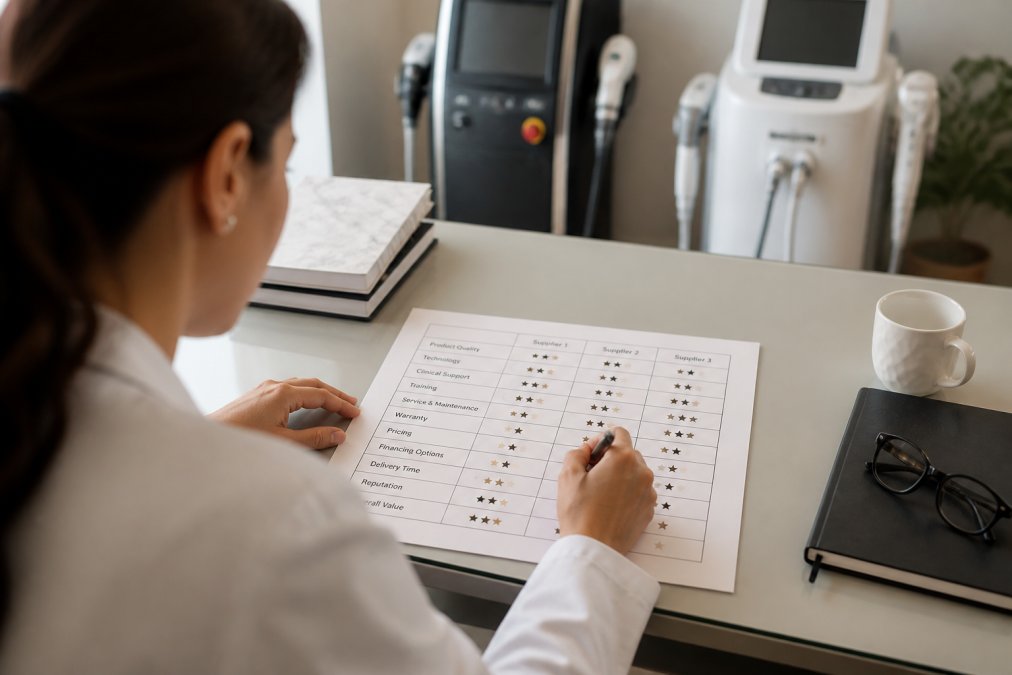
The table below is designed as a scoring rubric. For each criterion, assign a score from 1 to 5 based on the supplier’s response, then weight the scores according to your clinic’s priorities.
| Evaluation Area | What to Ask | What a Weak Answer Sounds Like | What a Strong Answer Sounds Like | Weighting Guide |
|---|---|---|---|---|
| Training depth | Who delivers training and for how long? Is it competency-assessed? | “Our trainer will spend an afternoon with your team.” | “A clinically qualified trainer will run a two-day program, followed by a half-day refresher at 30 days. We assess each nurse’s competency before sign-off.” | Critical for staff adoption, weight 25% |
| Response times | What is the guaranteed response window for faults? Is it in the service contract? | “We usually get back to people within a few days.” | “Our service level agreement guarantees a phone response within 2 business hours and an on-site visit within 1 business day for metro areas. This is written into the contract.” | Critical for revenue protection, weight 20% |
| Repair logistics | Is a loan unit provided during repairs? Who covers shipping? | “We’ll do our best to get it fixed quickly.” | “We maintain a pool of loan units. If your device is out of action for more than 5 business days, we ship a replacement at our cost.” | Important for high-utilisation practices, weight 15% |
| Regulatory support | Who handles TGA compliance questions? Do you provide post-market surveillance support? | “You’ll need to contact the TGA yourself for that.” | “Our compliance officer will walk you through adverse event reporting and provide all necessary documentation for your records. We manage the post-market surveillance obligations.” | Critical for legal safety, weight 20% |
| Post-purchase contact | Is there a dedicated support contact? What is their clinical background? | “You can call our general support line.” | “You’ll be assigned a dedicated account manager who is also a trained clinician. They know your device history and can answer clinical questions directly.” | Important for relationship quality, weight 10% |
| Consumables & service costs | Are consumables and calibration costs itemised for 5 years? | “We can discuss that after you decide.” | “Here is a full breakdown of consumables, calibration, and preventive maintenance costs for the first 5 years, with no hidden fees.” | Critical for total cost of ownership, weight 10% |
A supplier who cannot or will not provide written guarantees on response times and loan units is signalling that their after-sales support is not a priority. Treat verbal assurances with suspicion, if it’s not in the contract, it doesn’t exist.
The Unique Angle: Scoring the Supplier’s Clinical Credibility
Assess whether the supplier understands your clinical workflow. Ask the trainer or account manager to describe how they would handle a specific complication scenario, for example, a patient with Fitzpatrick skin type IV who experiences post-inflammatory hyperpigmentation after a laser session (peer-reviewed research). A supplier with genuine clinical depth will discuss parameter adjustments, cooling protocols, and follow-up care. A purely commercial supplier will defer to the device manual. This single question often reveals more about the supplier’s practical value than any other.
Turning the Rubric into a Decision Matrix
Once you have scored each supplier, create a simple decision matrix. List your top three suppliers, multiply each score by the weighting, and total the results. This process forces you to be honest about trade-offs. A supplier with a slightly higher purchase price but a perfect score on training and regulatory support will often beat a cheaper competitor on total value.
TGA Medical Device Compliance for Clinics: Who Owns It?
TGA medical device compliance for clinics is a shared responsibility that many practices misunderstand. The Therapeutic Goods Administration regulates the importation, supply, and advertising of medical devices in Australia. The legal obligations sit with the supplier who brings the device into the country, but the clinic bears responsibility for ensuring the device is used in accordance with its intended purpose and that staff are adequately trained. legacy system integration.
A reputable supplier will provide evidence of TGA inclusion and maintain post-market surveillance obligations. Your clinic’s obligation is to document training, follow the manufacturer’s instructions for use, and report any adverse events. The Therapeutic Goods Administration’s regulatory framework for medical devices outlines these obligations clearly, and your supplier should be able to walk you through the relevant sections.
The practical question is whether your supplier actively supports your compliance burden or simply hands you a certificate and walks away. A supplier that provides guidance on adverse event reporting, recalls, and documentation demonstrates a genuine commitment to regulatory partnership.
Aesthetic Practice Equipment Procurement: A Step-by-Step Checklist
Most procurement advice stops at “compare features and price.” That’s where the real decision process begins. The checklist below is structured as a staged timeline, designed to take you from initial research to a signed contract with full visibility on total cost and supplier capability.
Stage 1: Define the Clinical Need and Business Case (Week 1-2)
Before speaking to any supplier, document the specific clinical gap you are trying to fill. Are you adding a new treatment to attract patients, or replacing an existing device that is underperforming? Build a simple business case that projects patient volume, average treatment price, and expected utilisation rate. For example, if you are considering a vascular laser and refer 10 patients per month at $350 per treatment, that’s $42,000 in annual revenue you are losing. This number becomes your baseline for evaluating the device’s revenue potential.
Stage 2: Shortlist Suppliers Based on Clinical Credibility (Week 3-4)
Do not shortlist based on brand recognition alone. Research the leadership team of each supplier. A supplier founded by a Registered Nurse or dermatologist brings a different perspective than one founded by a sales executive. Look for evidence of ongoing clinical education, do they publish treatment protocols, host webinars for practitioners, or employ a clinical educator on staff?
Request the supplier’s TGA inclusion certificate for the specific device model. Verify that the device is included in the Australian Register of Therapeutic Goods (ARTG) for the intended indication.
Stage 3: Conduct a Structured Demonstration and Hands-On Trial (Week 5-6)
A demonstration in a conference room is not sufficient. Insist on a hands-on trial in your clinic with your own staff. This is the only way to assess real-world usability, patient comfort, and workflow integration. Ask the supplier to bring a clinical trainer, not just a sales representative. Observe how the trainer interacts with your nurses. During the trial, test the device on a range of skin types and treatment areas. Document any issues with handpiece ergonomics, cooling efficiency, or treatment speed.
Stage 4: Model the Total Cost of Ownership (Week 7-8)
Request a written, itemised quotation that includes the device price plus:
- Consumables (cooling gel, disposable tips, handpiece replacement schedule)
- Preventive maintenance and calibration costs for the first 5 years
- Training costs for initial and ongoing staff turnover
- Extended warranty or service plan pricing
- Estimated shipping, installation, and electrical work costs
Create a simple 5-year cost model. A device priced at $80,000 with $5,000 per year in consumables and $3,000 per year in maintenance costs $120,000 over 5 years (edu.au). A competitor device priced at $95,000 with $2,000 per year in consumables and $1,500 per year in maintenance costs $112,500 over the same period. The more expensive device is actually the better financial choice.
Ask each supplier to complete a standardised cost template that you provide. This ensures you are comparing like-for-like and prevents suppliers from hiding costs in different line items.
Stage 5: Negotiate the Service Agreement (Week 9-10)
The service agreement determines the real value of the partnership. Negotiate the following terms in writing:
- Response time guarantees (e.g., 2 business hours for phone support)
- On-site repair timeframes (e.g., 1 business day for metro areas)
- Loan unit provision during repairs longer than 5 business days
- Annual training refreshers included in the service fee
- A dedicated support contact with clinical qualifications
- A clear process for handling TGA adverse event reporting
Do not accept a service agreement that is separate from the device purchase contract. The service terms should be part of the main contract, with clear penalties for non-performance.
Stage 6: Plan the Implementation and Training Schedule (Week 11-12)
Before the device arrives, agree on a detailed implementation plan including delivery and installation date, electrical and space preparation requirements, initial training schedule with trainer qualifications, competency assessment process for your staff, and a go-live date. A supplier who cannot commit to a specific implementation timeline is a red flag. Delays translate directly into lost revenue and staff frustration.
Conclusion: Choosing a Partner for Long-Term Growth
The right partner for your practice is one who stays engaged long after installation is complete. A direct supplier relationship, built on clinical credibility and responsive support, delivers better outcomes than a transactional consulting arrangement that ends at the point of sale.
DermTech Devices was founded by a Registered Nurse with over 19 years of experience precisely because the industry needed a supplier that understood clinical realities. Our multi-modality laser platforms and next-generation skin analysis systems come with the training, support, and regulatory guidance. We collaborate with globally recognised medical technology brands to bring you precision-engineered solutions at accessible prices, supporting safe, consistent clinical results.
Partner with us to build a technology foundation that supports your practice for the long term.
Frequently Asked Questions
What is the difference between a device consultant and a direct equipment supplier?
A third-party device consultant typically assesses your clinic’s needs and recommends equipment from various brands, often for a fee or commission. A direct supplier like DermTech Devices partners with you end-to-end: they supply the medical-grade system, handle TGA compliance documentation, provide hands-on training, and remain accountable for ongoing support and maintenance. The direct model removes the middle layer, so the team that sold you the system is the same team that supports it after installation.
How do I ensure my dermatology equipment complies with TGA regulations?
In Australia, therapeutic goods, including most medical laser and IPL devices, must be included on the Australian Register of Therapeutic Goods (ARTG) before supply. Your supplier should provide the ARTG inclusion number and technical documentation as part of the procurement process. A clinical-led supplier with regulatory affairs experience will guide you through the compliance checks and ensure your documentation supports safe use, adverse event reporting, and any state-based radiation safety requirements.
What should I look for when selecting a medical laser supplier?
Prioritise clinical expertise, not just product specifications. Ask who trains your staff and whether that person has hands-on patient care experience. Inquire about response times for technical faults, loan machine availability during repairs, and the cost of annual servicing. Verify that the supplier can reference practices of a similar size and scope. A supplier founded by a Registered Nurse brings a clinical perspective to equipment selection and training that a purely sales-driven vendor often lacks.
How do I evaluate the ongoing support services of a medical technology supplier?
Ask for a written support agreement that specifies response times, service level expectations, and the training schedule. Confirm whether ongoing education is included or billed separately. Check that the supplier has local technicians or a clear repair logistics plan. Evaluate their approach to post-market surveillance and software updates, since these affect both compliance and device longevity. The goal is a partner who remains accessible as your practice grows, not a supplier who disappears after the sale.
What are the benefits of working with a clinical-led device provider?
A clinical-led provider understands treatment workflows, patient safety, and the practical realities of running a practice. This translates into more relevant equipment recommendations, training that actually prepares your staff for real patient consultations, and realistic advice on integrating new technology into your service offerings. For aesthetic practices, this clinical perspective helps avoid purchasing over-specified systems that sit idle because staff lack the confidence or skill to use them effectively.
Choosing between a consultant and a direct supplier partnership comes down to one question: who will be there when the device needs support? The answer determines your staff’s confidence, your patients’ outcomes, and your practice’s bottom line. DermTech Devices offers the training depth, responsive service, and clinical expertise that turn a capital investment into a lasting practice asset. Get started with DermTech Devices and secure a partner committed to your clinical and commercial success.