
Blog Details
Last Updated: November 21, 2026
Quick Summary
Laser calibration adjusts a device so its measured output matches its displayed setting within a defined tolerance, while safety testing checks interlocks, eyewear, signage, emergency stop and electrical safety. Most clinics set a fixed annual service as a floor, but you should also retest after handpiece or fibre replacement, device relocation, repairs, software updates or unexpected clinical responses.
- Calibration adjusts the device, performance verification measures it, and safety testing protects people and the room.
- Measure baseline output at the power, pulse duration, frequency and spot size the clinic actually uses.
- A certificate should record measurement uncertainty, tolerance applied and pass/fail for every test.
- A marginal result means the value is inside the band but the uncertainty margin crosses the limit.
- Take a device out of clinical use when results fall outside tolerance until the cause is corrected.
Table of Contents
- Why Laser Calibration and Safety Testing Decide Treatment Outcomes
- Calibration, Performance Verification and Safety Testing: What Each One Covers
- Laser Output Power Measurement: Instruments, Methods and Uncertainty
- A Step-by-Step Calibration and Safety-Testing Workflow
- Medical Laser Service Intervals and Event-Based Retesting
- Your Medical Laser Maintenance Checklist for the Treatment Room
- What a Laser Calibration Certificate Should Record
- Choosing a Service Partner for Your Laser Platform
- Frequently Asked Questions
Why Laser Calibration and Safety Testing Decide Treatment Outcomes
A medical laser delivers a set dose of energy to skin. A treatment planned at one fluence can arrive at another, and the result shifts with it. (Source: ARPANSA radiation protection guidance)
This is why medical laser calibration and safety testing sits at the centre of clinical consistency.
Calibration confirms the device delivers what the settings say. Safety testing confirms it does so without harm. Get either wrong and you lose control of the variables that make a treatment repeatable.
Below, we break down what each test covers, how to run a proper workflow, and what a certificate should actually record.
ARPANSA radiation protection guidance
Calibration, Performance Verification and Safety Testing: What Each One Covers
Laser calibration is the adjustment of a device so its measured output matches its displayed setting within a defined tolerance. Performance verification is the measurement that confirms it still does. Safety testing checks the non-clinical systems: interlocks, eyewear, signage, emergency stop and electrical safety.
The three are related but not interchangeable.
- Calibration adjusts. It is an intervention.
- Performance verification measures. It produces evidence.
- Safety testing protects. It covers people and the room.
Where clinics commonly blur the three
A common mistake is treating a service visit as proof of all three. A technician adjusts the device, hands over a report, and the clinic assumes everything is covered.
In practice, the adjustment and the independent measurement should be separate steps. Otherwise you are grading your own work.
Laser Output Power Measurement: Instruments, Methods and Uncertainty
Power measurement uses a calibrated sensor that absorbs the beam and converts it to a reading. For pulsed devices you also need energy per pulse, plus pulse duration and frequency to calculate fluence.
What most guides miss is uncertainty. Every measurement carries a margin of error. A reading that sits close to the tolerance limit may pass or fail depending on that margin.
Reading a measurement result properly
Check three things before you accept a number:
- The instrument’s calibration is current and traceable.
- The stated uncertainty is recorded alongside the reading.
- The test conditions match clinical use, including the handpiece and delivery system.
A result with no uncertainty figure is not a complete result.
A Step-by-Step Calibration and Safety-Testing Workflow
Run the workflow in the same order every time. Consistency is what makes results comparable across visits, and it lets a second technician reproduce your findings.
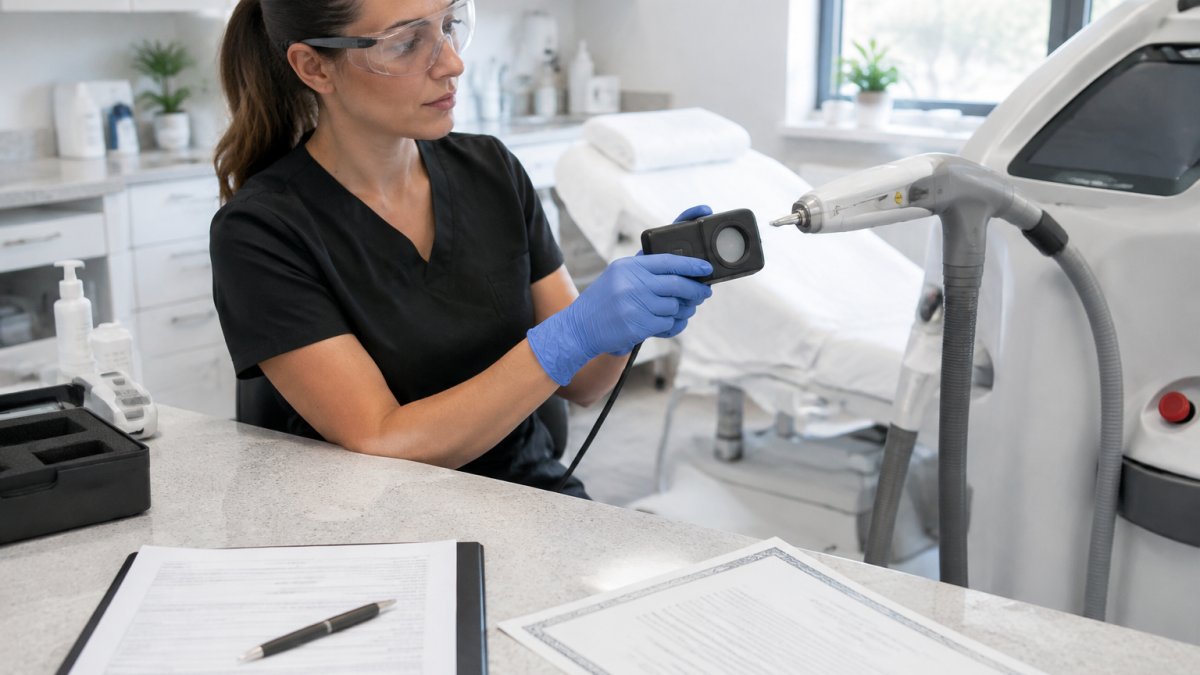
Before you start
Confirm the device is clean, charged and at operating temperature. Most manufacturers specify a warm-up period, and measuring cold can produce readings that do not reflect clinical use. Check your device’s manual for the required warm-up time. Have the manufacturer’s tolerance specification and the previous test record to hand so you can compare like with like.
The workflow
- Inspect the delivery system first. Check the handpiece, fibre and any articulated arm for cracks, kinks, discolouration or connector damage. A damaged fibre can attenuate output before the sensor ever sees it, so a low reading may be a delivery problem rather than a device fault.
- Measure baseline output at clinically used settings. Test at the power, pulse duration, frequency and spot size the clinic actually uses, not just at a single reference setting. For pulsed devices, record energy per pulse as well as average power.
- Compare against the manufacturer’s tolerance. Most medical laser specifications state a tolerance band. The exact figure is device-specific, so use the value in your manufacturer’s documentation. Record the tolerance you applied.
- Adjust only where the manufacturer’s procedure allows. Some devices permit field adjustment; others must be returned to the manufacturer or an authorised service centre. Adjusting a sealed or software-locked system invalidates the service record.
- Re-measure after any adjustment and record both values. The before-and-after pair is the evidence that the adjustment worked.
- Test the safety systems. Confirm interlocks, emergency stop, audible and visual emission indicators, and remote interlock functionality. For class 4 devices, verify the door interlock and signage.
- Test electrical safety to the applicable Australian standard for medical electrical equipment, covering protective earth continuity, insulation resistance and leakage current. Confirm the current standard with your technician or the official source.
- Check protective eyewear for the correct wavelength, optical density and physical condition. Eyewear rated for one wavelength does not protect against another.
- Sign, date and file the results with the device record, including instrument serial numbers and calibration due dates.
Device-specific differences worth knowing
Not every platform tests the same way. A few common patterns:
- Diode and IPL systems are sensitive to handpiece and filter condition; test with the delivery system attached as used clinically.
- Pulsed dye and Nd:YAG lasers require energy-per-pulse measurement plus pulse duration, because fluence depends on both.
- Fractional and scanned systems need spot size and pattern verification, not just total power, because the delivered dose per unit area changes with pattern density.
Expected result: a signed record showing measured output, tolerance, uncertainty and pass/fail for every test, with device-specific notes where the delivery system affects the reading.
Measuring only at a single reference setting can miss drift that appears only at the power levels used in treatment.
Medical Laser Service Intervals and Event-Based Retesting
Most clinics set a fixed annual service. That is a floor, not a ceiling. Event-based retesting matters just as much.
Retest after any of these:
- A handpiece, fibre or delivery system is replaced.
- The device is moved between rooms or sites.
- Output drift appears during routine checks.
A calendar interval helps with compliance, but event-based retesting helps keep results accurate. If you want to see how a structured program handles both, read our guide to preventative medical laser maintenance programs.
Your Medical Laser Maintenance Checklist for the Treatment Room
Daily habits catch drift before it reaches a patient. Keep the checklist at the device, not in a folder.
- Wipe down the handpiece and fibre before each list
- Check the delivery system for cracks, kinks or discolouration
- Confirm eyewear is present, correct for the wavelength, and undamaged
Pair this with our aesthetic clinic equipment maintenance tips for the wider room setup.
What a Laser Calibration Certificate Should Record
A certificate is only useful if it lets a second person reach the same conclusion. If you cannot tell what was measured, how, and against what tolerance, the document is decoration.
It should record:
- Device make, model and serial number
- Date of test and name of the technician
- Instrument used, its serial number and calibration due date
Interpreting the result: pass, marginal or fail
A reading is not simply pass or fail. Compare the measured value, the tolerance band and the measurement uncertainty together:
- Pass, the measured value sits inside the tolerance band with the uncertainty margin still inside the band.
- Marginal, the measured value is inside the band but the uncertainty margin crosses the limit. Treat this as a flag: retest sooner, and check whether the instrument or the device is contributing the uncertainty.
- Fail, the measured value sits outside the tolerance band. The device should not be used clinically until the cause is identified and corrected.
This three-way reading is the part most certificates leave the clinic to work out alone. A certificate that reports only “pass” without the uncertainty figure does not let you make that judgement.
When results fall outside tolerance
A failed result is not a paperwork problem. Take the device out of clinical use until it is resolved. Then document:
- The failed reading and the tolerance it breached.
- The suspected cause, delivery system, sensor, device drift or test condition.
- The corrective action taken, including any parts replaced.
- The re-test result after correction.
- The name and role of the person who authorised return to service.
Continuing to treat on a device that has failed output verification risks unpredictable dosing and leaves the clinic without a defensible record if a treatment outcome is questioned.
What to do with the certificate afterwards
File the certificate with the device record, not in a general folder. The next test should be compared against it, and an auditor or manufacturer’s representative will ask for the previous result when investigating a fault. If your service provider issues a certificate without instrument traceability or uncertainty, ask for a corrected version before you accept it.
Choosing a Service Partner for Your Laser Platform
The right partner gives you traceable measurements, clear certificates and a plan for event-based retesting. Ask for those three things before anything else.
Criteria worth scoring:
| What to ask | Why it matters | Red flag |
|---|---|---|
| Which instruments do you use? | Measurement accuracy depends on the sensor | No named instruments |
| How is traceability shown? | Ties readings to a known standard | No calibration dates |
| Do you record uncertainty? | Determines if a result truly passes | Blank uncertainty field |
| How do you handle failures? | Defines corrective action and re-testing | Verbal-only fixes |
| What is the retest policy? | Covers drift and events, not just dates | Annual visit only |
DermTech Devices was founded by a Registered Nurse with over 19 years of experience, and works with globally recognised medical technology brands. For criteria on comparing contracts, see our guide to evaluating medical laser equipment maintenance contracts, and for the standards behind the tests, our laser equipment safety standards guide. You can also contact our team to discuss your platform.
Getting calibration and safety testing right is not a compliance chore. It is the difference between a treatment that works the same way every time and one that quietly drifts. DermTech Devices supplies medical-grade multi-modality laser platforms and skin analysis systems, backed by precision engineering and a focus on safe, consistent clinical results.
Frequently Asked Questions
How often should a medical laser be calibrated?
Most platforms are calibrated and performance-verified annually, with output checks at shorter intervals depending on how heavily the device is used and what the manufacturer specifies. Event-based retesting is just as important: after a repair, a handpiece or fibre replacement, a relocation, or any treatment where output seems weaker than expected. Record the date of every check so the next one is scheduled from evidence rather than memory, and follow the service interval stated in your own device’s manual.
What does medical laser calibration involve?
Calibration adjusts the device so delivered laser output matches the settings shown on screen. It typically involves measuring output power and energy against a traceable reference instrument, checking pulse duration and frequency, confirming the beam delivery system and handpieces are transmitting correctly, and documenting the results against pass/fail criteria. It is not the same as safety testing, which covers electrical safety, interlocks, emergency stop function, protective eyewear condition and treatment-room controls. Ask for both, and ask which one each invoice line refers to.
What records should a clinic keep after laser servicing?
Keep the laser calibration certificate, the electrical safety test result, the service report listing any parts replaced, and the technician’s credentials and training records. Add your own internal log of daily and pre-treatment checks, plus any adverse events or output concerns raised by practitioners. Store these with your laser safety manual and risk assessment so an audit can be answered from one folder. Records also help you spot output drift over time, which is far easier to act on than a single out-of-tolerance reading discovered mid-treatment.
Who is qualified to calibrate and safety-test medical laser equipment?
Look for technicians with specific laser and medical device experience, access to traceable reference instruments, and familiarity with the standards your device is tested against. General biomedical experience is not the same as laser-specific competence. Ask for calibration certificates for the test equipment itself, not just the report on your laser. Your supplier should also be able to explain what happens if a result fails, including repair and servicing options and how quickly they can attend.