
Blog Details
Table of Contents
- What You’ll Need Before You Start
- Daily and Weekly Laser Equipment Maintenance Routines
- Monthly and Quarterly Deep Maintenance Tasks
- How AS/NZS IEC 60825.1 Laser Safety Standards Shape Your Maintenance Plan
- Laser Equipment Service Logs: What to Record and Why It Matters
- Post-Maintenance Calibration and Beam Alignment Verification
- Common Mistakes to Avoid in Laser Equipment Maintenance
- Conclusion
- Frequently Asked Questions
Last Updated: September 21, 2026
What You’ll Need Before You Start
Good laser equipment maintenance starts with the right kit, records and safety habits.
Before you begin any service task, gather these items:
- Manufacturer’s service manual for your exact model
- Lint-free lens tissue and isopropyl alcohol
- Non-abrasive cleaning swabs
- Distilled or deionised water for the chiller
- Powder-free nitrile gloves and safety glasses
- A torch for inspecting rails and bellows
- Your service log book or digital maintenance record
Never service a laser while it is energised. Isolate the power, wait for the capacitors to discharge, and confirm the interlock circuit is working before you start. A live beam path can cause serious eye injury in under a second.
Daily and Weekly Laser Equipment Maintenance Routines
Daily and weekly tasks are short, simple and non-negotiable, most take under ten minutes and prevent the costliest failures. But “daily” and “weekly” are starting points that shift with your environment, case mix and laser type.
Set your interval from the room, not the calendar
Two clinics running identical platforms can need very different service frequencies. The biggest variables are:
- Ambient dust and humidity. Rooms near construction, loading docks or open street frontage pull more particulate onto optics, while high humidity accelerates condensation on chilled optics and microbial growth in coolant reservoirs.
- Case mix. Ablative and fractional treatments generate far more plume and char debris than non-ablative or vascular work, so back-to-back ablative sessions can contaminate a focus lens in a day that a lighter schedule takes a week to reach.
- Air handling. Rooms with positive-pressure, HEPA-filtered supply and dedicated smoke evacuation stay cleaner than rooms relying on general building air conditioning.
- Laser technology. CO2 systems with articulated arms and external optics collect debris at every mirror and joint; fibre-delivered systems keep the beam enclosed, shifting focus to the delivery fibre connector, handpiece tip and chiller; diode systems sit between the two. Your manual’s schedule assumes a nominal environment, adjust it for yours.
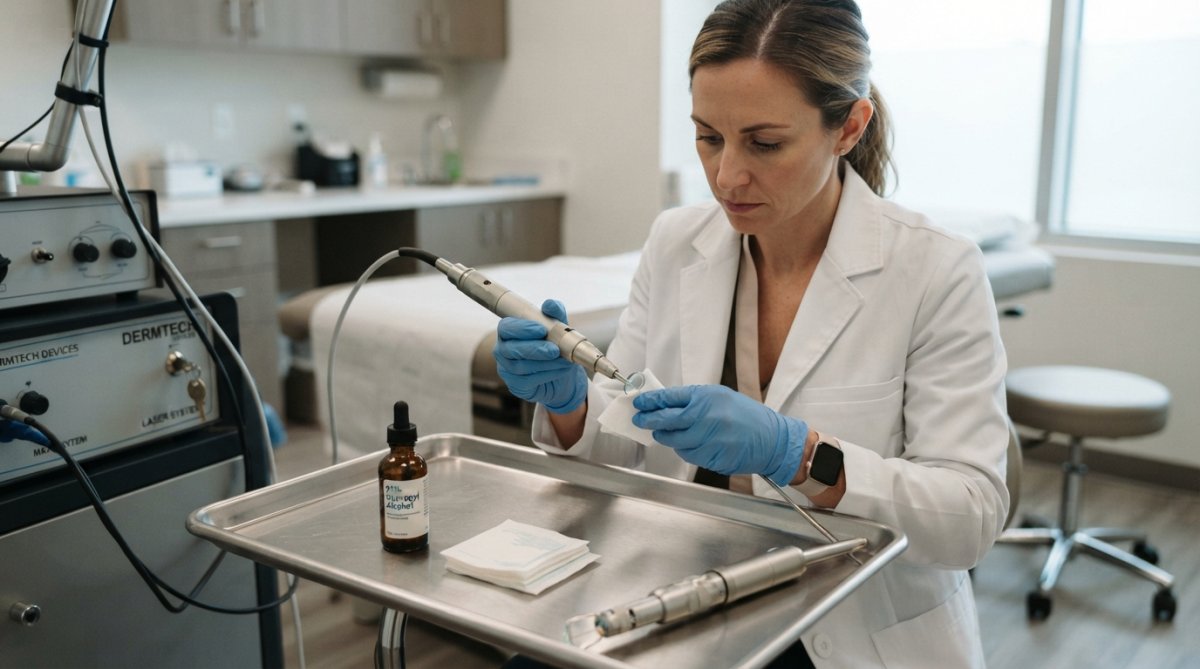
Optical path and focus lens cleaning
The focus lens and optical path collect dust, smoke residue and skin particles. Dirty optics reduce power at the tissue, forcing the laser to work harder, shortening source life and producing inconsistent clinical results.
Follow this routine:
- Power down and isolate the system.
- Remove the focus lens using the manufacturer’s tool.
- Blow off loose dust with clean, dry air or a bulb blower first, never start with a wipe.
- Inspect the lens under bright light at an angle. Look for haze, pitting, coating discolouration or a brown ring.
- Wipe the lens with lens tissue dampened with isopropyl alcohol, using a single pass and a fresh tissue each time.
- Never rub dry tissue across the coating, and never reuse a tissue.
- Inspect reflective mirrors and the output window for haze or pitting.
- Refit the lens, check the seal and confirm the lens is seated square.
Cooling system and chiller checks
Heat is the quiet killer of laser systems; the chiller and its coolant keep the laser source and delivery optics within safe thermal limits.
Check these points each week:
- Coolant level in the reservoir, against the marked range
- Coolant colour and clarity, cloudy or discoloured coolant is already degrading
- Chiller filter for dust build-up; clean or replace as the manual states
- Water temperature against the manual’s range, recorded in your log
- Hoses, fittings and quick-connects for weeping or crusting
- Fan operation, airflow and heat-exchanger fins for dust matting
- Condensation on chilled lines in humid rooms
Record chiller water temperature at the same point in every session. A slow upward drift over weeks is the earliest reliable signal that the cooling loop is losing efficiency, long before the laser faults.
Monthly and Quarterly Deep Maintenance Tasks
Monthly and quarterly work goes deeper than cleaning, protecting the moving parts that carry the beam.
Drive system, linear rails and bellows lubrication
The gantry, linear rails and servo motors move the cutting head thousands of times a day. Dry rails cause judder, misalignment and uneven treatment patterns.
Each month:
- Wipe rails with a lint-free cloth
- Apply the lubricant your manual specifies
- Check bellows for cracks, tears or trapped debris
- Confirm the gantry moves smoothly by hand
- Listen for grinding or squealing from servo motors
Photograph each rail and bellows during every service. Comparing photos month to month shows wear long before it shows up in treatment results.
Extraction and ventilation system checks
Fume extraction protects staff and patients from laser plume, and poor extraction lets smoke settle on optics, speeding up contamination.
Quarterly checks include:
- Replace or clean fume extraction filters
- Test airflow at the nozzle
- Inspect ducting for blockages or leaks
- Check the extraction efficiency against the manual’s spec
- Confirm nozzle alignment with the beam (Source: industry research on the financial impact of equipment downtime)
How AS/NZS IEC 60825.1 Laser Safety Standards Shape Your Maintenance Plan
Australian clinics work to AS/NZS IEC 60825.1, the joint standard for laser product safety. It shapes what your maintenance plan must include, not just how you clean, determining which tasks are mandatory, how often they must be verified, and what evidence you keep.
What the standard actually requires of a maintenance plan
The standard covers laser classes, labelling, safety interlocks, protective measures, key control and the laser safety officer’s role. For maintenance, the key point is that safety systems must be verified as functional, not assumed functional because the machine still fires.
- Safety interlocks on doors, covers and handpiece connections, test at every service and after any panel is opened.
- Emergency stop buttons, test at every service; confirm they cut emission, not just power to the display.
- Warning labels and signage, inspect monthly for legibility, correct class marking and correct placement.
- Key control and authorised access, confirm the key switch operates and that keys are accounted for.
- Protective eyewear, inspect for scratches, cracks and correct optical density for the wavelength in use; replace damaged eyewear immediately.
- Beam enclosure and delivery integrity, inspect for breaches, damaged bellows or exposed fibre.
The documentation the standard expects you to hold
A maintenance log is the evidence that your safety systems were verified. For each safety check, record:
| Record | Why it matters under the standard |
|---|---|
| Date and time of each safety verification | Proves the check was done on schedule |
| Interlock and e-stop test result | Demonstrates safety systems were functional |
| Eyewear inspection outcome | Shows protective measures were maintained |
| Name and role of the person testing | Establishes competence and accountability |
| Corrective action taken | Shows faults were rectified, not ignored |
| Next due date | Prevents a verification being missed |
Where the standard and your maintenance schedule intersect
The standard does not tell you how to clean a lens; it tells you what must be true about the machine when it returns to service. Safety verification therefore belongs at the end of every service task, not in a separate annual audit, if a service involves opening a panel, the interlock test is part of it. Proactive monitoring of subtle performance shifts remains the most reliable method for identifying service requirements before a critical failure necessitates a full system inspection.
A laser that cuts or treats well but fails an interlock test is not serviceable. Safety verification is part of maintenance, not an optional extra, and under the standard, the record of that verification is as important as the verification itself.
Laser Equipment Service Logs: What to Record and Why It Matters
A service log turns maintenance from a guess into a record of what was done, when and by whom.
Record these details for every task:
| Log Field | What to Record | Why It Matters |
|---|---|---|
| Date and time | Exact service date | Proves schedule compliance |
| Task performed | Cleaning, calibration, replacement | Tracks wear patterns |
| Parts used | Lens, filter, nozzle, coolant | Supports consumables planning |
| Readings | Power output, water temp | Spots drift early |
| Technician | Name and role | Assigns accountability |
| Follow-up | Next due date | Prevents missed services |
Post-Maintenance Calibration and Beam Alignment Verification
Never return a laser to clinical use straight after service. Calibration confirms the beam still lands where it should.
Run this sequence after every deep service:
- Check beam alignment with burn paper or a target card.
- Verify nozzle alignment with the beam path.
- Measure power output with a power meter.
- Compare readings against the baseline in your log.
- Run a test pattern on the appropriate medium.
- Confirm results before booking patients.
Common Mistakes to Avoid in Laser Equipment Maintenance
Most laser failures trace back to a handful of repeat mistakes. Fix these and you remove most unplanned downtime.
- Using abrasive cloths on optics. They scratch coatings and cut lens life.
- Topping up coolant instead of replacing it. Old coolant carries particles that damage the chiller.
- Skipping interlock tests. A failed interlock is a serious safety risk.
- Ignoring small leaks. A slow drip becomes a dead laser source.
- Servicing without logging. No record means no early warning of drift.
- Letting untrained staff open panels. The beam path is not a general maintenance area.
The most expensive mistake is delaying a service because the machine “still works”. Power drift and optic damage build slowly, then fail without warning during a booked patient session.
Conclusion
Laser equipment maintenance is a schedule, not a repair job. Daily cleaning, weekly chiller checks, monthly lubrication and quarterly extraction service keep a laser platform accurate and safe; add calibration verification and honest logs to protect both your patients and your investment.
Frequently Asked Questions
What are five safe practices to follow when using laser equipment?
Five core practices: wear appropriate wavelength-specific eye protection for everyone in the room; never bypass safety interlocks; use non-abrasive cleaning methods on optics to avoid scratches; keep the extraction system running during every treatment; and log each session in your laser equipment service logs. These habits reduce contamination, protect staff, and keep your system within AS/NZS IEC 60825.1 expectations.
What are the Australian standards for laser safety in clinical settings?
AS/NZS IEC 60825.1 sets out laser classification, labelling, and safety requirements for laser products. Clinical settings typically also follow state and territory radiation health regulations, which vary. Check your local health department’s requirements for registration, operator training, and controlled area rules. Your preventive maintenance schedule for aesthetic lasers should reference the standard as the baseline for safety checks, interlock testing, and documentation.
How often should medical-grade laser systems undergo professional calibration?
Most manufacturers recommend professional calibration at least annually, and more often for high-use systems or those in multi-practitioner clinics. If your output energy drifts, treatments feel inconsistent, or your power meter readings fall outside tolerance, book a service sooner. Post-maintenance calibration verification should always be documented so you can show a clear history of performance.
What documentation is required for laser equipment maintenance under Australian health regulations?
Requirements differ by state and territory, but most health departments expect records of equipment registration, operator training, safety checks, and maintenance. A practical baseline is to keep laser equipment service logs that capture date, task performed, parts replaced, calibration results, and the technician’s name. This supports compliance audits and helps you spot recurring faults before they cause downtime.