Blog Details
Table of Contents
- Why Technology Now Decides Patient Outcomes in Aesthetic Practice
- Medical-Grade Skin Analysis Systems: Turning Subjective Consults into Objective Data
- Multi-Modality Laser Platforms and Treatment Precision
- TGA Compliance for Medical Devices: What Your Clinic Must Verify
- Aesthetic Clinic Growth Strategies 2026: Technology That Pays for Itself
- Common Mistakes Clinics Make When Adopting New Technology
- Conclusion: Partnering for Long-Term Clinical Results
- Frequently Asked Questions
Last Updated: September 18, 2026
Why Technology Now Decides Patient Outcomes in Aesthetic Practice
Technology has moved from a nice-to-have to the backbone of clinical decision-making in aesthetic medicine. Practices that invest in the right systems see more consistent results, fewer revision treatments, and stronger patient retention. This guide from DermTech Devices explains how to choose technology that genuinely improves patient outcomes, not just adds a line to your equipment list. (Source: Australian Institute of Health and Welfare (AIHW) data)
The shift is simple to explain. Ten years ago, a skilled practitioner’s eye was the main diagnostic tool. Today, medical-grade skin analysis systems and multi-modality laser platforms give that same practitioner objective data to work from. The result: better treatment planning, safer settings, and outcomes patients can actually see.
For clinic owners, this matters commercially too. Patients who see measurable progress are more likely to rebook, refer, and commit to longer treatment plans. Technology that supports patient outcomes is, in practice, technology that supports practice growth.
Medical-Grade Skin Analysis Systems: Turning Subjective Consults into Objective Data
Medical-grade skin analysis systems are diagnostic devices that capture and measure skin characteristics such as pigmentation, vascularity, texture, and hydration using controlled imaging and multi-spectrum light. They replace guesswork with measurable baseline data. These objective metrics provide the necessary foundation for clinicians to determine how specific LED light therapy devices might effectively modulate cellular activity and improve long-term dermatological health.
That baseline changes everything that follows. Instead of describing what you think you see, you show the patient a captured image and a measured reading. The consultation becomes a shared decision rather than a one-way recommendation.
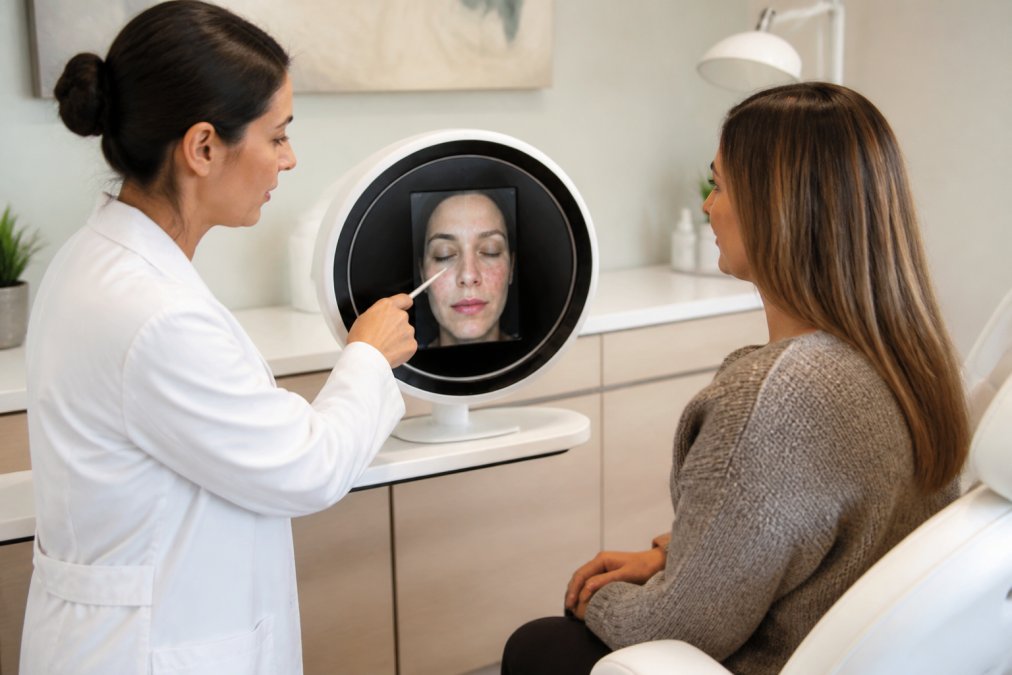
What Objective Skin Data Changes in the Consultation Room
Objective data changes three things in a typical consultation:
- Consent conversations. Patients understand the plan when they can see the concern mapped on their own skin.
- Treatment sequencing. You can prioritise the concern with the greatest clinical impact first.
- Progress tracking. Repeat imaging shows change over time, which supports retention.
A common mistake is treating analysis as a sales tool rather than a clinical one. When the data drives the plan, patients notice. That honesty builds trust faster than any before-and-after photo.
Multi-Modality Laser Platforms and Treatment Precision
Multi-modality laser platforms combine several wavelengths or applicators in one system, letting a single device treat a wider range of concerns with settings matched to each patient’s skin type and target.
The clinical benefit is precision. Different concerns respond to different wavelengths, and having them on one platform means you can adjust the plan without sending the patient elsewhere. For a busy clinic, that also means fewer devices competing for floor space and power.
What most guides miss is the training factor. A platform with ten capabilities is only as good as the practitioner’s confidence in using them. Before buying, ask how hands-on training is delivered, how long it runs, and what ongoing support looks like after installation. Equipment that sits idle because staff cannot use it properly helps no one.
Ask any supplier for a supervised hands-on session on your own device before you commit to a full treatment menu. If they cannot arrange that, treat it as a warning sign about their after-sales support.
TGA Compliance for Medical Devices: What Your Clinic Must Verify
TGA compliance for medical devices means the device is included on the Australian Register of Therapeutic Goods (ARTG) where required, and that its intended purpose matches how your clinic plans to use it. Verification is your responsibility as the purchaser.
Before you sign, confirm the following:
- The device’s ARTG inclusion status and the sponsor’s details
- That the intended purpose covers your planned treatments
- That the supplier provides documentation you can produce on request
- That any claims made in marketing match the device’s cleared intended purpose
The Therapeutic Goods Administration’s guidance on medical device regulation sets out how devices are classified and what inclusion requires. Rules differ by device class, so check the specific classification that applies to the equipment you are considering.
Do not rely on a supplier’s verbal assurance alone. Ask for the documentation in writing and keep it on file.
Aesthetic Clinic Growth Strategies 2026: Technology That Pays for Itself
The technology that pays for itself is the technology your team uses every day. That is the core principle behind aesthetic clinic growth strategies 2026, and it is where most equipment decisions go wrong.
Here is a simple way to assess any purchase:
| Question | What Good Looks Like | What to Avoid |
|---|---|---|
| Utilisation | Fits 3+ services you already offer | One niche treatment only |
| Training | Ongoing, hands-on, documented | One-day workshop, then silence |
| Support | Named contact, defined response times | No local support pathway |
| Compliance | ARTG documentation provided | Verbal assurances only |
| Total cost | Maintenance and training included in planning | Purchase price only |
Run every shortlisted device through this table before you commit. The answers tell you more than a spec sheet ever will.
Buying on purchase price alone is the most expensive mistake clinics make. A cheaper device with poor support often costs more over five years than a well-supported system, because idle equipment earns nothing.
Common Mistakes Clinics Make When Adopting New Technology
The biggest mistake is buying capability instead of capacity. A device with more features than your team can master creates frustration, not revenue.
Other frequent errors:
- Skipping a proper needs assessment before shortlisting devices
- Underestimating the time required for staff to become confident
- Failing to check ARTG status and intended purpose before purchase
- Choosing a supplier with no clear plan for repairs or replacement parts
- Rolling out every new service at once instead of phasing them
A phased rollout works better. Launch one or two treatments, get the team confident, then expand. Patients notice when a practitioner is unsure, and that uncertainty costs you referrals.
Conclusion: Partnering for Long-Term Clinical Results
Choosing technology that improves patient outcomes is a long-term decision, not a one-off purchase. The right partner helps you select equipment that fits your services, trains your team properly, and stays reachable when something needs attention.
DermTech Devices was founded by a Registered Nurse with more than 19 years of experience, and that clinical background shapes how we support practices. We offer advanced multi-modality laser platforms and next-generation skin analysis systems, working with globally recognised medical technology brands to deliver reliable, medical-grade equipment. Our focus is on safe, efficient, and consistent clinical results that support your practice over the long term.
Partner with us to build a technology plan that serves your patients and your clinic.
Frequently Asked Questions
How does medical technology improve patient safety in aesthetic clinics?
Medical-grade technology improves safety by standardising treatment parameters and reducing reliance on operator guesswork. Multi-modality laser platforms with built-in safety controls limit energy delivery to appropriate levels for each skin type, lowering the risk of burns or adverse reactions. Objective skin analysis systems also flag contraindications before treatment begins. Clinics should verify that any device carries appropriate TGA compliance for medical devices and that staff complete proper training before treating patients. No technology removes risk entirely, so informed consent and clinical judgement remain essential.
What are the benefits of integrating skin analysis systems into patient consultations?
Medical-grade skin analysis systems give practitioners objective baseline data rather than relying on visual assessment alone. This supports more accurate treatment planning, lets you track changes across sessions, and gives patients a clear visual record of their progress. In practice, that data can justify treatment recommendations and support realistic expectations about results. It also creates a natural starting point for conversations about ongoing care. Many clinics find that showing patients measurable change over time strengthens retention and encourages consistent attendance.
What regulatory standards must aesthetic technology meet in this market?
Medical devices supplied in Australia must be included on the Australian Register of Therapeutic Goods (ARTG) unless a specific exemption applies. The Therapeutic Goods Administration (TGA) sets the classification rules, and devices are grouped into classes based on risk level. Clinics should ask suppliers for evidence of ARTG inclusion and confirm the device’s intended purpose matches how you plan to use it. Requirements can change, so check the TGA website directly for current guidance rather than relying on supplier claims alone.
How does multi-modality laser technology enhance treatment precision?
Multi-modality platforms let you switch between wavelengths and treatment modes on one system, so you can match the setting to the specific concern rather than compromising with a single-wavelength device. That flexibility supports more targeted treatment of pigmentation, vascular concerns, and texture within the same session or treatment plan. Precision also depends on correct parameter selection and operator training. Before purchasing, ask about the training and ongoing support included, because even the best platform underperforms in untrained hands.