Blog Details
Table of Contents
- Start With Your Patients, Not the Machine
- Technical Specifications That Decide Clinical Versatility
- Single-Platform or Multi-Modality Aesthetic Laser Equipment?
- TGA Registration for Medical Devices: What to Verify
- Laser Equipment Financing for Clinics: Structuring the Purchase
- ROI Analysis for Cosmetic Laser Machines
- Maintenance, Training and Support: Ask Before You Sign
- Frequently Asked Questions
Last Updated: September 10, 2026
Start With Your Patients, Not the Machine
The most common mistake in buying aesthetic laser equipment is starting with the spec sheet. Practitioners fall in love with a wavelength count or wattage figure, then discover half the platform’s capability sits unused because their patient base never needed it. Choosing aesthetic laser equipment properly means working backwards: from the treatments your patients request, to the platform that delivers them, to the five-year cost of ownership. (Source: Fitzpatrick scale)
The ones that get it right audit their own patient data before taking a single demo.
Start by answering three questions honestly:
- What are the top five treatments your patients ask for by name?
- Which of those do you currently refer out, and what revenue walks out the door with them?
- What is your realistic weekly treatment volume, not your best week ever?
A clinic focused on skin rejuvenation and hair reduction has different needs from one fielding regular tattoo removal enquiries. Those needs decide your wavelength requirements before any sales conversation begins.
Buying for the treatment you wish you offered, rather than the one your patients request, is the fastest route to idle capital. Equipment that sits unused still depreciates, still needs servicing, and still appears on your balance sheet.
Technical Specifications That Decide Clinical Versatility
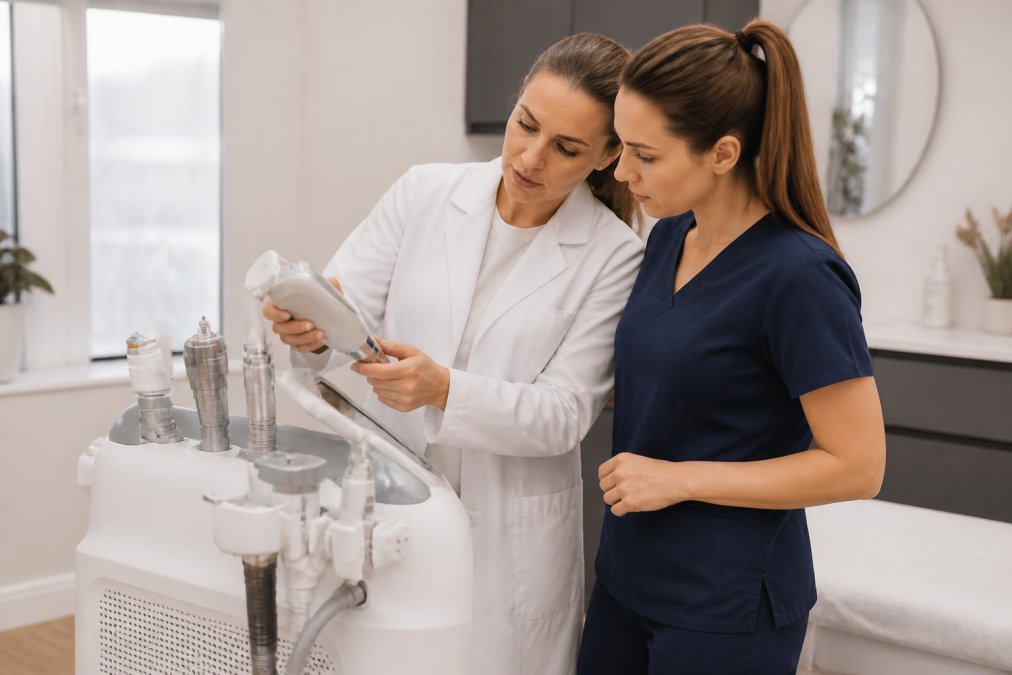
Four specifications determine what an aesthetic laser platform can treat: wavelength, pulse duration, spot size, and fluence. How they interact is the difference between a machine that handles three treatment categories and one that handles one.
Wavelength, Pulse Duration and Fluence
Wavelength is the colour of light the laser emits, determining which chromophore it targets: melanin for hair reduction, haemoglobin for vascular lesions, or tattoo ink pigment. Multiple wavelengths cover more treatment categories than a single-wavelength device.
Pulse duration is how long energy is delivered. Matching it to the target’s thermal relaxation time allows selective photothermolysis to damage the target without injuring surrounding tissue. Short pulses suit small targets; longer pulses suit larger ones.
Fluence, or energy density, is energy delivered per unit area. Higher fluence means more aggressive treatment and more risk, where clinical judgement matters more than marketing.
Ask for the pulse duration range, not just the minimum. A platform that only offers very short pulses limits your treatment versatility later, particularly if you expand into vascular work.
Fitzpatrick Skin Types and Safety Margins
The Fitzpatrick scale classifies skin by UV response, from Type I (always burns) to Type VI (never burns, deeply pigmented). Melanin absorbs laser energy, so darker skin types carry higher risk of burns, blistering, and post-inflammatory hyperpigmentation if settings aren’t adjusted correctly (PubMed).
Safety margins for darker skin types depend on wavelength choice and the ability to deliver longer pulse durations with adequate cooling. Ask the supplier: which Fitzpatrick types is this device indicated for, and what does the manufacturer’s guidance say about Types IV to VI?
The practical test: does the platform let you treat a broader demographic safely, or quietly limit you to lighter skin types? In a diverse patient population, that limitation costs revenue.
Single-Platform or Multi-Modality Aesthetic Laser Equipment?
A multi-modality platform consolidates several technologies into one console; standalone devices each perform a single function. The choice comes down to treatment breadth, floor space, and capital efficiency.
| Factor | Multi-Modality Platform | Standalone Devices |
|---|---|---|
| Treatment range | Multiple categories, one console | One category per unit |
| Upfront capital | Single larger outlay | Spread across purchases |
| Floor space | One footprint | One footprint per device |
| Training burden | One certification, one interface | Separate training per unit |
| Scalability | Add capability via handpieces | Buy another machine |
| Service contracts | One agreement | Multiple agreements |
For three or more treatment categories, multi-modality usually wins on space and servicing simplicity. For a practitioner doing one thing exceptionally well at high volume, a dedicated device can still make sense.
Clinics running two or more treatment categories, or planning to expand their service menu within 24 months. If you’re genuinely single-service and high-volume, a dedicated unit may serve you better.
TGA Registration for Medical Devices: What to Verify
TGA registration determines whether a medical device may lawfully be supplied in Australia. Aesthetic laser equipment is generally regulated as a medical device, and suppliers must hold appropriate inclusion on the Australian Register of Therapeutic Goods (ARTG) for legal supply.
Before you sign anything, verify the following:
- The device’s ARTG inclusion number, and confirm it matches the exact model
- The manufacturer’s conformity assessment documentation
- Whether the supplier is the sponsor of record on the ARTG entry
- The intended purpose stated on the ARTG, which defines what the device is cleared to do
- Any conditions or limitations attached to the inclusion
Check the ARTG entry yourself rather than accepting a certificate at face value. The Therapeutic Goods Administration’s medical device guidance explains how device classification and inclusion work, and the public ARTG register lets you search any inclusion number directly.
This is not paperwork for its own sake. If a device isn’t properly included, your professional indemnity cover and your clinic’s compliance position are both exposed.
A supplier showing you a CE mark or FDA clearance is not showing you Australian regulatory approval. Those are foreign frameworks. Ask specifically for the ARTG inclusion number for the model you’re buying.
Laser Equipment Financing for Clinics: Structuring the Purchase
Laser equipment financing for clinics typically takes one of four forms: outright purchase, chattel mortgage, equipment lease, or rental with an option to buy. Each shifts risk and tax treatment differently. The structure matters as much as the machine, a platform that fits your patient base but breaks your cash flow is still the wrong purchase.
The Four Structures Compared
Outright purchase gives the lowest total cost and full ownership, but ties up working capital and leaves you holding the depreciation. It suits established clinics with surplus cash and a clear five-year horizon.
Chattel mortgage lets you claim the asset while spreading payments, with the equipment securing the loan. Ownership transfers at settlement, so you can claim depreciation and, where eligible, instant asset write-off thresholds for small business entities. Because the lender holds security over the device, rates are often lower than unsecured finance.
Equipment lease keeps the asset off your balance sheet and preserves cash flow, at a cost over the term. Payments are generally a deductible operating expense rather than a capital purchase, suited to clinics preferring predictable outgoings over ownership. volume loss treatments.
Rental with an option to buy suits clinics testing a treatment category before committing. You pay a premium for optionality but avoid being locked into a platform your patients never take to. (Source: Australian Competition and Consumer Commission (ACCC) guidelines on consumer guarantees)
What Actually Decides the Structure
Three questions decide which structure fits:
- How long will you keep the device? Under three years, leasing or rental usually beats buying, because you avoid absorbing the steepest part of the depreciation curve.
- What does your cash flow look like in a slow quarter? Fixed repayments don’t pause. If your treatment volume is seasonal, and in most clinics it is, model the repayment against your worst month, not your best.
- Do you want the tax treatment of an asset you own, or the flexibility of one you don’t? This is a question for your accountant, not your equipment supplier.
The Australian Mechanics Most Buyers Miss
- GST and input tax credits. If your clinic is registered for GST, you can generally claim the GST component on a business-use asset, purchased outright or financed. On a six-figure platform that is a material cash-flow difference, factor it in before you sign.
- Business-use apportionment. If the device is used partly for private or non-commercial purposes, only the business-use percentage is claimable. Keep a usage log from day one.
- Instant asset write-off thresholds. Small business entities may immediately deduct eligible assets below the current threshold rather than depreciating over effective life (ato.gov.au). Thresholds change, confirm the current figure with your accountant or the ATO.
- Finance broker vs. vendor finance. Vendor finance is convenient but rarely the cheapest. An independent equipment finance broker who works across multiple lenders will usually beat the rate attached to the supplier’s preferred plan.
Get finance pre-approval before you shortlist machines. Knowing your borrowing ceiling stops you falling in love with a platform you cannot responsibly fund, and it strengthens your negotiating position on price.
Speak to your accountant before your equipment supplier. The financing structure should follow your practice’s financial position, not the vendor’s preferred payment plan.
ROI Analysis for Cosmetic Laser Machines
ROI analysis for cosmetic laser machines comes down to one equation: total revenue minus total cost of ownership, divided by total cost of ownership. Most buyers calculate the first half and guess at the second. The gap between a platform that looks affordable on the quote and one genuinely profitable over five years sits almost entirely in the costs nobody puts on the brochure.
The Revenue Side
Multiply realistic weekly treatment volume by average treatment price, then subtract consumables and practitioner time per treatment. Use actual booking data, not targets, clinics commonly overestimate first-year weekly volume by 30-50%, flattering the ROI and hiding a marginal purchase.
The Cost Side: Total Cost of Ownership
This is where buyers get caught. Price every line over a five-year horizon, not one:
- Capital cost or lease repayments
- Preventative maintenance and service contract fees
- Consumables (cooling gels, protective eyewear, handpiece components)
- Practitioner training and certification
- Insurance premium adjustments
- Downtime during repairs
- Software licensing or data-export fees
- End-of-life disposal or trade-in costs
A platform costing more upfront but carrying a comprehensive service level agreement and lower consumable costs can outperform a cheaper unit within two years. Run the numbers over five years, not one.
Cost-Per-Shot: The Number That Decides Profitability
The most useful figure in aesthetic laser economics is cost per shot, total consumable and maintenance cost divided by the shots a handpiece delivers before replacement. Two platforms with identical sticker prices can differ threefold on cost per shot, compounding across every treatment.
Ask the supplier directly:
- What is the rated shot count for each handpiece before replacement?
- What does a replacement handpiece cost, and is it proprietary?
- Are there any consumables that must be bought from the manufacturer only?
- What is the cost per treatment at your expected volume?
A low purchase price with a high cost per shot can be the most expensive machine in the room by year three. Most buyers never run this calculation, and it most reliably separates a profitable purchase from a regretted one.
Depreciation and Resale Value
Aesthetic laser platforms depreciate like any capital asset, and resale value depends on brand reputation, service history, and whether the manufacturer still supports the model. A device from a supplier with no local service presence can become effectively unsellable, not because it stopped working, but because no buyer will take on an unsupported platform.
Before you buy, ask:
- Does the manufacturer have an Australian service and parts presence?
- Is the model still in current production, or is it nearing end of life?
- What is the typical resale value of this platform after three and five years?
- Will the supplier buy it back or accept it as a trade-in?
A platform that holds 40% of its value after three years costs you far less to own than one that holds 10%, even if the second machine is cheaper on day one.
Software and Data Integration
Modern clinics run on practice management and patient record systems, and a laser platform that can’t talk to them creates hidden operational cost. If the device locks treatment data into a proprietary format, you face manual re-entry, duplicated records, and switching costs.
Ask whether the platform exports treatment data in a standard format, integrates with your practice management software, and whether integration carries a licence fee. Clean integration saves staff time daily, a real cost even when it doesn’t appear on an invoice.
Insurance and Liability
Confirm with your insurer how a new device class affects your professional indemnity and public liability cover, and whether they require evidence of training or qualifications before extending cover. Some insurers adjust premiums by device class and operator certification, so the insurance line in your ROI model depends on what you buy and who operates it.
Downtime Exposure
Ask what the guaranteed response time is under the service level agreement, and what loan equipment is available if yours is out of action. A platform that is down for three weeks costs you three weeks of revenue, and that figure belongs in your ROI model alongside the purchase price.
The cheapest machine is rarely the cheapest to own. Price the five-year total, including consumables, cost per shot, servicing, training, insurance, software and downtime, before you compare two platforms on sticker price alone. The number that matters is cost per treatment delivered, not cost per machine purchased.
Maintenance, Training and Support: Ask Before You Sign
Preventative maintenance, clinical training and ongoing support are where suppliers most often over-promise and under-deliver. Get the specifics in writing.
On maintenance, ask for the preventative schedule, what it includes, whether parts are covered, and the guaranteed breakdown response time. A service level agreement with defined response times beats a verbal “we’ll look after you.”
On training, distinguish a one-day installation workshop from genuine clinical training with certification. Ask who delivers it, whether it’s hands-on with your team, and whether refresher training is included when you add a practitioner.
On support, ask what happens when your experienced operator leaves. Will the supplier retrain a replacement? Is there a clinical hotline? Can you reach a real person during a treatment complication?
This is where a supplier’s track record matters more than its brochure. DermTech Devices was founded by a Registered Nurse with more than 19 years of experience, and that clinical background shapes its approach to training and after-sales support: the goal is a team that can use the platform confidently, not a certificate on the wall.
Choosing aesthetic laser equipment is a capital decision with clinical consequences, and the two can’t be separated. Get the patient audit right, verify the ARTG inclusion, structure finance around your cash flow, and price the full five-year cost of ownership before comparing machines on price.
DermTech Devices supplies medical-grade multi-modality laser platforms and next-generation skin analysis systems, backed by a team that understands clinical practice from the inside. For a straight conversation about which platform fits your patient base and budget, partner with us.
Frequently Asked Questions
What TGA regulatory requirements apply to aesthetic laser devices?
Aesthetic lasers and IPL systems are medical devices in Australia and must be included on the Australian Register of Therapeutic Goods before they can be lawfully supplied. Ask the supplier for the ARTG number and confirm the device’s intended purpose matches how you plan to use it. Registration sits with the manufacturer or sponsor, so check it covers the specific model and configuration you are buying, not just the brand. Also confirm who holds ongoing responsibility for reporting adverse events after installation.
How does laser equipment financing for clinics affect cash flow?
Financing spreads a large capital purchase into predictable monthly repayments, which keeps working capital free for staffing, consumables and marketing. Compare the total repayable amount across the term, not just the headline rate, and check whether the agreement is a chattel lease, hire purchase or equipment loan, because each affects tax treatment and ownership. Ask what happens if you want to upgrade mid-term. A shorter term usually costs more per month but reduces total interest and keeps resale flexibility open.
How do I evaluate the clinical versatility of a multi-modality laser platform?
Map the platform’s wavelengths and handpieces against the treatments you actually want to sell: hair reduction, skin rejuvenation, vascular lesions, pigmentation or tattoo removal. A multi-modality system earns its place when you can run several of those services from one console without switching devices or rooms. Check spot size range, pulse duration options and whether the handpieces suit different Fitzpatrick skin types safely. Ask for a demonstration using settings relevant to your patient mix, not a generic showcase.
What maintenance and service support should I expect from a laser supplier?
Ask for a written service level agreement covering response times, whether repairs are on-site or the unit must be shipped, and what loan equipment is available during downtime. Confirm whether preventative maintenance is included or billed separately, and how often it is scheduled. Training should not end at installation: ask about refresher sessions, protocol updates and access to a clinical contact. Get the terms in writing, including consumable pricing and calibration requirements, before you commit.