Blog Details
Table of Contents
- Why Medical Laser Supplier Support Defines Practice Risk
- Step 1: Verify Technical Specifications and Clinical Credentials
- Step 2: Assess Your Medical Laser Service Level Agreement
- Step 3: Confirm ARPANSA Laser Safety Compliance
- Step 4: Evaluate Aesthetic Laser Technical Support Response Time
- Step 5: Audit Training, Software Policies, and Device Lifecycle
- Step 6: Analyse Total Cost of Ownership and Exit Strategy
- Medical Laser Supplier Support Evaluation Checklist
- Frequently Asked Questions
Last Updated: September 1, 2026
Why Medical Laser Supplier Support Defines Practice Risk
Choosing the wrong [medical laser](/luminex-co2-resurface-pro/) supplier is one of the most expensive mistakes a clinic can make. Not because of upfront cost, but because of what happens six months after installation when a wavelength calibration drifts, a component fails, or your staff can’t reach anyone on the phone.
At DermTech Devices, we’ve worked with practitioners across dermatology and aesthetic medicine long enough to know that the supplier relationship doesn’t end at delivery. It defines whether your investment performs consistently over a five-year device lifecycle or becomes a source of clinical downtime and financial regret.
This guide walks you through a structured, six-step process for evaluating medical laser supplier support before you sign anything. The framework covers technical credentials, service level agreements, regulatory compliance, training quality, software policies, and total cost of ownership. By the end, you’ll have a clear audit checklist for your next supplier conversation.
A medical laser supplier is not just a vendor, they are a long-term operational partner whose quality assurance processes, escalation protocols, and post-sale technical support will directly affect your clinical outcomes and practice reputation.
Step 1: Verify Technical Specifications and Clinical Credentials
The biggest mistake practitioners make is accepting a brochure as evidence. What you need is documentation.
Wavelength Configuration and Beam Measurement Standards
Wavelength configuration is the single most clinically consequential specification on any aesthetic laser platform. It determines tissue absorption depth, chromophore targeting, and clinical efficacy across different skin types and treatment indications.
Ask every prospective supplier to provide beam measurement data from an independent calibration laboratory, not manufacturer self-reporting. Verify that the device’s wavelength output matches the stated specification within accepted tolerance ranges, and confirm how often recalibration is scheduled as part of the standard maintenance cycle. For multi-modality platforms, confirm that each wavelength module is independently validated.
Manufacturing Capabilities and Factory Audit Documentation
Request documentation of the manufacturer’s quality management system. For medical-grade devices supplied in Australia, look for evidence of compliance with the Therapeutic Goods Administration medical device regulatory framework, which governs the registration and post-market surveillance of Class IIa and above laser devices.
Ask whether the supplier can provide a factory audit report or third-party quality assurance certificate. Suppliers who manufacture to ISO 13485 standards carry substantially lower supply chain risk. Understand where components are sourced and whether the manufacturer has contingency arrangements for critical spare parts.
Ask for the device’s ARTG (Australian Register of Therapeutic Goods) entry number and verify it directly on the TGA’s public database before proceeding. This takes five minutes and immediately filters out non-compliant suppliers.
Step 2: Assess Your Medical Laser Service Level Agreement
A service level agreement is where supplier promises become contractual obligations. Most practitioners skim this document. That is a serious error.

A medical laser service level agreement is a binding contract that specifies the supplier’s obligations regarding response times, on-site repair, spare parts availability, and escalation protocols when those obligations are not met.
Response Time Commitments and Escalation Protocols
Response time is the metric that matters most when equipment is down and patients are booked. A vague commitment to “timely support” is commercially worthless. What you need in writing:
- Maximum response time for remote diagnostics after a fault is reported
- Maximum on-site response time for faults that cannot be resolved remotely
- Defined escalation protocol when first-line support cannot resolve the issue
- Named escalation contacts, not just a general support line
- Compensation or credit provisions if the supplier breaches the agreed response window
For a multi-practitioner centre where equipment downtime affects multiple revenue streams simultaneously, the difference between next-business-day and week-long response times is material.
Spare Parts Inventory and On-Site Repair Guarantees
Ask the supplier to confirm:
- Whether critical spare parts are held locally or must be imported
- The typical lead time for parts not held in local inventory
- Whether loan equipment is available during extended repairs
- How warranty terms interact with wear-and-tear components
A supplier who cannot confirm local spare parts inventory for your specific device model is asking you to absorb supply chain risk on their behalf.
A service level agreement that lacks specific response time figures and escalation protocols is not a service level agreement, it is a marketing document. Do not accept it as a substitute for contractual protection.
Step 3: Confirm ARPANSA Laser Safety Compliance
Regulatory compliance is non-negotiable for any medical laser operating in a clinical environment. The relevant national authority is the Australian Radiation Protection and Nuclear Safety Agency (ARPANSA), which publishes radiation safety standards applicable to laser devices used in medical and cosmetic settings.
Laser Safety Officer Requirements and Incident Register Obligations
ARPANSA laser safety compliance requires that facilities using Class 3B and Class 4 lasers implement formal radiation safety protocols. These typically include appointing a Laser Safety Officer, maintaining an incident register, conducting regular safety audits, and ensuring all operators have documented training appropriate to the device class.
Your supplier should provide documentation that their device meets applicable ARPANSA safety standards and offer guidance on establishing the clinical safety framework required to operate it legally. A supplier who cannot explain the radiation safety obligations associated with their own device is a red flag.
State-level workplace health and safety legislation also applies. Confirm with your state regulator which specific obligations apply to your practice type.
Step 4: Evaluate Aesthetic Laser Technical Support Response Time
Aesthetic laser technical support response time is the operational variable most likely to determine whether your investment delivers its projected return. (Source: ISO 13485 standards)
Before signing, run a structured pre-purchase support test:
- Call the technical support line at different times of day and record actual wait times
- Submit a written technical query and measure the time to a substantive response
- Ask for a reference from a practice of similar size and device configuration
- Request the name and direct contact of the technical specialist assigned to your region
- Confirm whether remote diagnostics capability is built into the device’s user interface
Many practitioners discover post-purchase that the support experience promised differs substantially from the support experience received. The pre-purchase test is the most reliable way to close that gap.
Step 5: Audit Training, Software Policies, and Device Lifecycle
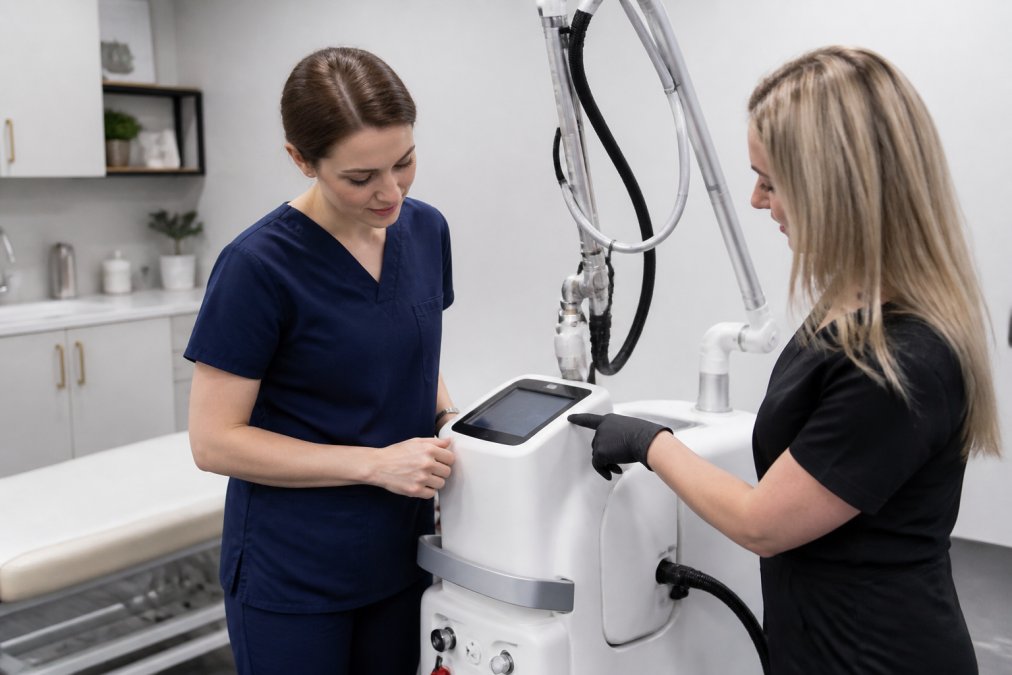
Training quality is the hidden variable in clinical outcomes. A device that is technically excellent but inadequately supported through training will underperform.
Clinical Training and Ongoing User Support
Ask every supplier to describe their training programme in specific terms. Adequate clinical training includes:
- Initial hands-on training covering device operation, safety protocols, and treatment protocols
- Competency assessment before independent clinical use
- Access to ongoing education as new treatment protocols are developed
- Clear process for training new staff members who join after initial installation
- Availability of clinical support when complex cases arise
Firmware Update Policies and Remote Diagnostics
Software and firmware update policies are often overlooked in evaluation frameworks. A device’s user interface and treatment algorithms are updated through firmware. Suppliers who provide regular, structured firmware updates extend the clinical life of the device and ensure it continues to reflect current evidence.
Ask the supplier:
- How frequently firmware updates are released
- Whether updates are provided free of charge or at additional cost
- Whether remote diagnostics allow the supplier to identify faults before they cause downtime
- What the end-of-life policy is for software support on the specific device model you are purchasing
Step 6: Analyse Total Cost of Ownership and Exit Strategy
Most practitioners calculate ROI based on treatment revenue against device cost. That calculation is incomplete without a full view of the five-year cost structure.
Five-Year ROI and Preventative Maintenance Costs
Total cost of ownership for a medical laser platform includes:
- Purchase price or finance costs
- Annual preventative maintenance contracts
- Calibration and certification costs
- Consumables and replacement components
- Staff training costs over the device lifecycle
- Potential downtime costs if the SLA is breached
Preventative maintenance is often underweighted in purchasing decisions. A device without a structured preventative maintenance schedule will typically experience more frequent unplanned failures and higher cumulative repair costs. Ask the supplier for a written preventative maintenance schedule and its annual cost.
Resale Value, Supply Chain Transparency, and Vendor Vetting
Exit strategy is the question nobody asks until they need to answer it. What happens to the device if you close the practice, upgrade to a newer platform, or change clinical direction?
Resale value is largely determined by brand recognition, device condition, and the availability of service documentation. Ask the supplier:
- Whether the manufacturer maintains a certified pre-owned programme
- What documentation they provide to support future resale
- Whether the device can be transferred to a new owner with full warranty continuity
A supplier who cannot demonstrate business continuity through references, years of operation, or financial stability indicators represents a risk to your long-term support access.
The exit strategy conversation is not pessimistic, it is professional. A supplier confident in their product and business will answer these questions without hesitation.
Medical Laser Supplier Support Evaluation Checklist
Use this checklist in every supplier evaluation conversation. A supplier who cannot answer these questions clearly should not advance to contract stage.
| Evaluation Area | Key Question | What Good Looks Like |
|---|---|---|
| Technical credentials | Is the device listed on the ARTG? | Confirmed ARTG entry, verifiable on TGA database |
| Wavelength validation | Is beam measurement data from an independent lab available? | Third-party calibration certificate provided |
| Manufacturing quality | Does the manufacturer hold ISO 13485 certification? | Documentation available on request |
| SLA response time | What is the maximum on-site response time in writing? | Specific hours/days committed contractually |
| Spare parts | Are critical parts held locally? | Local inventory confirmed for your device model |
| Radiation safety | Does the device meet ARPANSA laser safety standards? | Compliance documentation provided |
| Laser Safety Officer | Can the supplier advise on LSO obligations for your practice? | Structured guidance offered, not deflected |
| Clinical training | What does the training programme include post-installation? | Competency assessment and ongoing access confirmed |
| Firmware updates | Are software updates included and how frequently released? | Update schedule and cost structure documented |
| Remote diagnostics | Does the device support remote fault identification? | Confirmed capability with response protocol |
| Preventative maintenance | Is there a written annual maintenance schedule? | Itemised schedule with cost provided |
| Exit strategy | What documentation supports future resale? | Service history, transfer policy documented |
| Vendor stability | How long has the supplier operated in this market? | Verifiable references from comparable practices |
For additional guidance on evaluating medical technology procurement, the Medical Technology Association of Australia industry standards provides relevant frameworks for supplier assessment in the Australian healthcare context.
The difference between a supplier and a partner comes down to how they answer the hard questions before the sale is closed.
Evaluating a medical laser supplier is genuinely complex, and most practices don’t have a structured process for it until something goes wrong. DermTech Devices was founded by a Registered Nurse with over 19 years of clinical and cosmetic nursing experience specifically to address this gap: to give aesthetic practitioners access to medical-grade multi-modality laser platforms backed by the kind of clinical support and technical accountability this guide describes. Partner with us to discuss how our approach to device quality, training, and long-term practice support translates into consistent clinical results for your patients.
Frequently Asked Questions
What should be included in a medical laser service level agreement?
A thorough medical laser service level agreement should specify guaranteed response times for both remote and on-site support, clear escalation protocols when first-line support fails, spare parts availability commitments, scheduled preventative maintenance intervals, calibration standards, and equipment downtime compensation terms. It should also define who holds responsibility for regulatory compliance documentation, including calibration records required under state radiation safety legislation. Review the SLA before signing and request amendments if any of these elements are absent.
How do I verify a supplier’s compliance with ARPANSA radiation protection standards?
Ask the supplier for documentation showing the device meets the Australian Radiation Protection and Nuclear Safety Agency’s radiation protection series requirements. Request the device’s technical documentation, including beam measurement data and calibration certificates traceable to national standards. Confirm that the supplier can support your practice’s obligations under the relevant state or territory radiation safety legislation, including laser safety officer appointment and incident register maintenance. ARPANSA’s website lists current guidance documents you can cross-reference against what the supplier provides.
How does supplier support impact clinical downtime and practice revenue?
Equipment downtime directly removes treatment slots from your schedule, reducing revenue on days the aesthetic device cannot operate. A supplier with slow technical support response times or poor spare parts inventory can extend outages from hours to weeks. For a multi-practitioner centre, even a single day of unplanned downtime across one laser platform can represent a significant revenue gap. Evaluating response time commitments and on-site repair guarantees before purchase is one of the most financially consequential steps in the vendor vetting process.
What qualifications are required for a laser safety officer in Australia?
Requirements vary by state and territory under each jurisdiction’s radiation safety legislation. Generally, the appointed laser safety officer must have sufficient knowledge of radiation safety principles, the specific laser class in use, and the clinical environment. Some states require formal training or accreditation. Your medical laser supplier should be able to advise on the specific obligations in your jurisdiction and provide technical documentation that supports your laser safety officer’s responsibilities. Always verify current requirements directly with your state or territory radiation safety regulator.