Blog Details
Table of Contents
- Quick Comparison: Skin Analysis Systems for Aesthetic Nurses
- How We Evaluated the Best Skin Analysis Systems
- DermTech Devices: Multi-Modality Platforms and Skin Analysis
- VISIA Skin Analysis: Clinical Precision and Global Benchmarking
- OBSERV 520x: Visual Patient Education and Treatment Tracking
- Perfect Corp AI Skin Diagnostic: Scalable Software-Led Analysis
- Image Pro SUNLITE: Compact Multi-Spectral Imaging for Smaller Clinics
- Skinive AI: Mobile-First Diagnostics for Flexible Consultations
- What to Check Before You Buy
- Frequently Asked Questions
Last Updated: September 12, 2026
Quick Comparison: Skin Analysis Systems for Aesthetic Nurses
Choosing among the best skin analysis systems for aesthetic nurses comes down to one question: does the device fit your clinical workflow, or does your workflow bend around the device? This guide from DermTech Devices compares seven platforms on imaging technology, software integration, training and total cost of ownership.
Quick Picks:
- Best Overall: DermTech Devices, medical-grade multi-modality platforms backed by real clinical support
- Best for Clinical Benchmarking: VISIA Skin Analysis, quantitative reporting against a global database
- Best for Patient Education: OBSERV 520x, six observation modes with clear visual comparisons
- Best for Small Clinics: Image Pro SUNLITE, compact multi-spectral imaging
- Best for Mobile Consults: Skinive AI, app-based analysis anywhere
Skin analysis systems are the hardware and software combinations that capture, measure and document skin health metrics such as pigmentation, hydration, pore size, vascularity and topography. Aesthetic nurses use them to build a baseline assessment, guide treatment customization and demonstrate treatment efficacy over time.
| System | Technology | Pricing Model | Best For |
|---|---|---|---|
| DermTech Devices | Multi-modality platforms + multi-spectrum analysis | Contact for pricing | Nurses wanting clinical performance with ongoing support |
| VISIA | Multi-spectral facial imaging | One-time hardware purchase | High-precision diagnostic data |
| OBSERV 520x | Six-mode diagnostic imaging | One-time hardware purchase | Visual patient education |
| Perfect Corp AI | AI software, standard cameras | Subscription | Digital-first, contactless consults |
| Image Pro SUNLITE | Compact multi-spectral imaging | One-time hardware purchase | Space-limited clinics |
| Skinive AI | Mobile AI diagnostics | Subscription | Mobile and outreach clinics |
| Haut.AI | SaaS AI analysis | Subscription | Clinics building patient portals |
How We Evaluated the Best Skin Analysis Systems
We scored each platform on four criteria: diagnostic accuracy, consultation efficiency, integration with existing clinical software, and five-year cost of ownership.
A common mistake is judging these devices on image quality alone. The bottleneck is rarely the camera, it is the ten minutes a nurse spends exporting images into patient notes, or the training gap that leaves a device idle under a dust cover.
We weighted clinical validation and photographic documentation heavily, because objective skin health metrics only create value when captured consistently and stored where the whole team can find them.
DermTech Devices: Multi-Modality Platforms and Skin Analysis
DermTech Devices earns our top recommendation because it pairs medical-grade multi-modality platforms with multi-spectrum skin analysis, backed by support reflecting its origins: the company was founded by a Registered Nurse with over 19 years of experience, so training and after-sales are built around how clinics actually run.
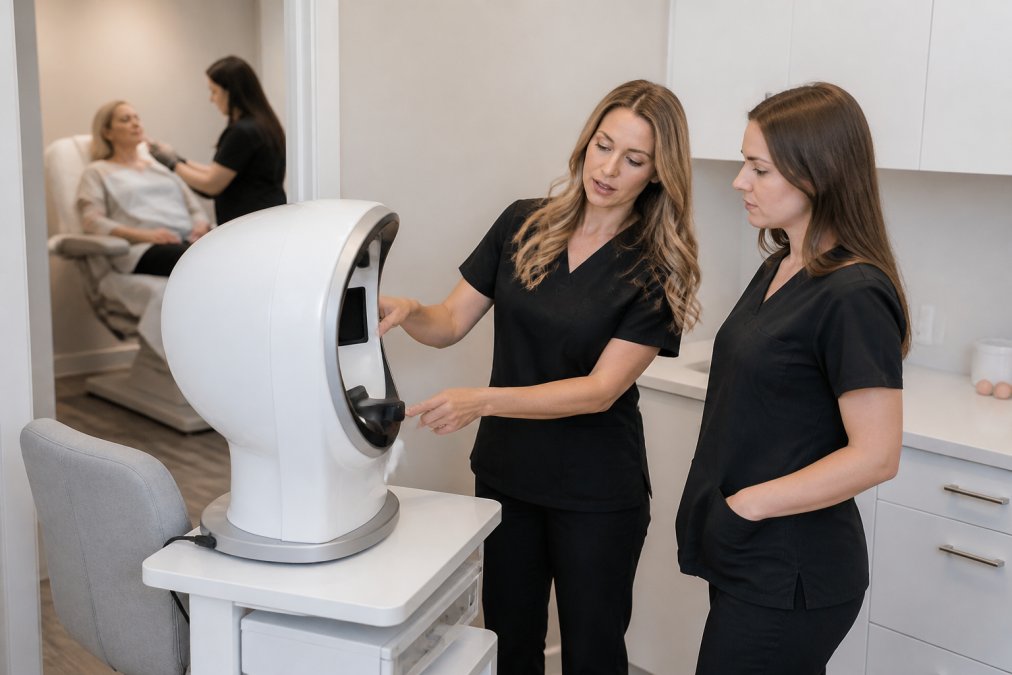
Integrating these sophisticated diagnostic tools into daily practice elevates the standard of care by providing objective data that informs every stage of professional skin analysis, which remains the cornerstone of effective treatment planning.
The practical difference shows up in treatment planning. Multi-spectrum analysis captures pigmentation, vascularity and surface texture in a single session, supporting optimized treatment planning and more consistent results across practitioners. DermTech Devices collaborates with globally recognised medical technology brands, so the engineering carries established reliability.
Pros:
- Multi-modality platforms that support both analysis and treatment planning
- Founded and led with clinical nursing experience, not just sales
- Focus on medical-grade technology at accessible price points
Cons:
- Pricing is quote-based, so budgeting requires a direct conversation rather than a published rate card
Ask any supplier for a five-year cost breakdown before signing: hardware, consumables, software licences, calibration and training. The purchase price is rarely the biggest line item.
VISIA Skin Analysis: Clinical Precision and Global Benchmarking
VISIA remains the reference point for quantitative clinical imaging. Its IntelliFlash technology captures cross-polarized and UV images, while RBX technology separates the colour signatures of red and brown skin components, giving nurses separate metrics for vascularity and pigmentation rather than one blended score (canfieldsci.com).
The global database comparison is the standout feature: you can show a patient how their sun damage or pore size ranks against peers of similar age and skin type, far more persuasive than a standalone photograph.
Pros: Detailed quantitative reporting; automated skin type classification; widely recognised by patients.
Cons: Significant capital investment; the depth of data can overwhelm patients without careful explanation.
OBSERV 520x: Visual Patient Education and Treatment Tracking
Where VISIA speaks in numbers, OBSERV 520x speaks in pictures. Six observation modes, including Daylight and True UV, reveal conditions at epidermal and dermal layers, and the patented face positioning system keeps images consistent enough for genuine before-and-after comparison.
That consistency is the feature nurses underrate. Side-by-side comparison tools turn a vague “your skin looks better” into documented progress, supporting retention and justifying ongoing treatment plans.
Pros: Excellent visual clarity; intuitive interface for clinical staff; cloud-based image management.
Cons: Requires dedicated clinical space for the unit.
Perfect Corp AI Skin Diagnostic: Scalable Software-Led Analysis
Perfect Corp takes the opposite approach to hardware-first systems: its AI skin diagnostic runs on standard camera hardware and detects more than 14 skin concerns in real time, with AR overlays that help patients visualise results before committing to treatment.
For telehealth or contactless consultations, this is the most scalable option on the list. The trade-off is dependence on reliable internet connectivity, and image quality that tracks your camera rather than a calibrated clinical sensor.
Pros: Hardware-agnostic; frequent AI updates; API availability for custom clinic apps.
Cons: Requires reliable internet connectivity.
Image Pro SUNLITE: Compact Multi-Spectral Imaging for Smaller Clinics
Smaller clinics often abandon imaging because floor-standing units demand a dedicated room. The Image Pro SUNLITE solves that with a compact, portable design that still delivers high-resolution multi-spectral imaging and automated analysis of wrinkles, pores and pigmentation.
The integrated patient database handles progress tracking without bolt-on software, which matters when running lean. It is the sensible middle ground: more clinical depth than a tablet app, without the footprint or capital outlay of a premium research unit.
Pros: Compact footprint; cost-effective compared to larger units; portable between rooms.
Cons: Fewer advanced research features than premium models.
Skinive AI: Mobile-First Diagnostics for Flexible Consultations
Skinive AI suits nurses who consult across multiple sites or offer outreach services. The mobile app runs AI-based risk assessment for skin lesions, manages patient records in the cloud and generates automated reports immediately after capture, no floor-standing unit to transport or return to base to process images.
Most guides treat mobile AI as a straight upgrade over hardware. It is a different tool for a different job, and the trade-off is capture consistency. (Source: five-year cost of ownership)
Where mobile-first wins.
- Multi-site and outreach work. No transport logistics, no dedicated room, no calibration rig to reassemble at each location.
- Low barrier to entry. Subscription pricing means no capital outlay, which matters for solo practitioners or clinics testing whether imaging changes their consult behaviour at all.
- Immediate reporting. Automated reports generated at the point of capture reduce the admin load between appointments.
- Cloud records. Patient history follows the nurse rather than living on one clinic’s server.
Where mobile-first struggles.
Mobile AI tools depend on camera quality, ambient lighting and lens-to-skin distance. Change any of those between visits and your before-and-after comparison measures the lighting, not the patient, so standardise your capture setup deliberately.
A workable protocol for outreach nurses:
- Fix the light source. Carry a small, consistent LED panel rather than relying on clinic or room lighting.
- Fix the distance. Use a physical guide or a marked stand-off so every image is captured from the same distance.
- Fix the angle. Front-facing, neutral expression, hair clear of the forehead, no makeup on the assessment area.
- Capture a reference image. Photograph a colour card or grey card in the same session so you can sanity-check colour balance across visits.
- Record conditions in the notes. Time of day, recent sun exposure and any active treatment all affect what the AI sees.
Mobile AI tools depend on camera quality and lighting. Inconsistent capture conditions undermine photographic documentation, so standardise your setup with a consistent light source and distance before trusting any trend data. A trend built on inconsistent images is worse than no trend at all, because it looks objective when it is not.
Data and privacy considerations. Because images are processed in the cloud, confirm where data is stored and how it is transmitted. Under the Privacy Act 1988 and the Australian Privacy Principles, you need a lawful basis for collecting and holding patient images, and must be able to tell a patient where their data lives and how to have it removed (oaic.gov.au). Ask the vendor for a data processing agreement and confirm whether images are used to train models unless you opt out.
When to choose mobile over hardware. If your caseload is predominantly in-clinic and you need quantitative metrics for treatment planning, a calibrated hardware system serves you better. If your caseload is distributed, episodic or outreach-based, and your goal is triage, risk flagging and documented follow-up, a mobile-first tool is more practical, provided you invest in the capture protocol above.
Pros: Highly portable; low barrier to entry; works on iOS and Android; immediate reporting at point of care.
Cons: Dependent on mobile camera quality; capture consistency requires a deliberate protocol; cloud processing raises data-handling questions to resolve before patient use.
What to Check Before You Buy
Two factors decide whether a system earns its place: integration and upkeep. Everything else, camera resolution, brand prestige, trade-show demos, is secondary to whether the device fits the way your clinic already runs.
Software integration. Ask whether the platform exports to your practice management or patient record system. If images live in a separate silo, your team will duplicate work, and duplicated work gets skipped on busy days. Questions to put to any supplier:
- What export formats does the system support (DICOM, PDF, JPEG with metadata, CSV for metrics)?
- Is there a documented API, or only a manual export button?
- Does the vendor charge for middleware or an integration licence?
- Where is patient data stored, and is it hosted in a way that satisfies your obligations under the Privacy Act 1988 and the Australian Privacy Principles?
Software-led options such as Perfect Corp and Haut.AI lead on API access, while DermTech Devices and Image Pro SUNLITE handle record-keeping natively. Hardware-first vendors often treat integration as a professional-services add-on, so budget for it explicitly.
Training and calibration. A one-day workshop is not training; it is an introduction. Confident image capture takes a handful of supervised sessions, but interpreting quantitative metrics, collagen density, hydration trends, porphyrin counts, takes considerably longer, often several months before a nurse can explain a report without the manual.
Ask three questions before signing:
- Who delivers the training, and is it clinical or sales-led?
- How many refresher sessions are included in year one, and what does a refresher cost thereafter?
- Who performs calibration, how often is it required, and is the calibration tool included or a consumable?
Some modalities carry a genuine ongoing commitment. Ultrasound-based systems, for example, require specialised training to interpret results correctly, a recurring cost, not a one-off. Factor calibration, consumables and refresher training into your five-year budget alongside the purchase price.
Ask any supplier for a five-year cost breakdown before signing: hardware, consumables, software licences, calibration, integration and training. The purchase price is rarely the biggest line item, and the line items that grow are usually the ones nobody quoted upfront.
Regulatory compliance. In Australia, medical devices including aesthetic imaging equipment are regulated by the Therapeutic Goods Administration, and devices supplied for clinical diagnostic use must appear on the Australian Register of Therapeutic Goods. Confirm the registration status of any system before purchase, and check current requirements directly with the Therapeutic Goods Administration.
Registration status is not a formality, it affects what you can legally claim about a device, how adverse events are reported, and whether your professional indemnity cover responds if something goes wrong. If a supplier cannot point you to an ARTG inclusion number, treat that as a red flag.
ROI and business justification. Nurses are often asked to justify the spend to a clinic owner, so the business case needs to be concrete. The return comes from three places:
- Higher treatment plan acceptance when patients see objective evidence of a concern they cannot see in a mirror, pigmentation under UV, vascularity under cross-polarised light, hydration deficits that a phone camera cannot capture.
- Improved retention through documented progress. A patient who can see a side-by-side comparison at week six is far less likely to drift away than one relying on memory.
- Consultation efficiency that frees appointment slots, provided the device does not add more time than it saves.
A useful way to frame the decision for an owner is cost-per-scan against revenue-per-plan. If a system costs a known amount over five years and is used for a known number of consultations, you can calculate a per-scan cost and compare it to the average value of an accepted treatment plan. A system that adds ten minutes per consult but lifts plan acceptance is often worth more than a faster device that changes nothing. Run that arithmetic before the demo.
The best skin analysis system is the one your whole team uses consistently, integrates with the records you already keep, and can be justified on a per-scan basis. Diagnostic accuracy means nothing if the device is only switched on for new-patient consultations.
Frequently Asked Questions
What features should aesthetic nurses look for in a skin analysis system?
Prioritise multi-spectral imaging for pigmentation and vascularity, high-resolution facial imaging for texture and pore size, and software that supports photographic documentation and baseline assessment. Check integration with your practice management or EMR system, TGA compliance for the device class, and whether training and calibration are included. Systems like VISIA and OBSERV 520x offer clinical depth, while AI platforms such as Perfect Corp provide scalability. Match features to your consultation workflow and patient education needs, not just the spec sheet.
Are skin analysis machines considered medical devices under TGA regulations?
Some skin analysis systems are regulated as medical devices by the Therapeutic Goods Administration (TGA) depending on their intended purpose and risk classification. Devices making diagnostic claims or used for clinical decision-making typically require TGA inclusion on the Australian Register of Therapeutic Goods (ARTG). Always verify the ARTG status and manufacturer’s intended use before purchasing. For guidance on your specific obligations, check the TGA website or consult a regulatory affairs professional.
How do 3D skin imaging systems improve patient treatment plans?
3D and multi-spectral systems capture skin surface topography, collagen density, and hydration levels that standard photography misses. This objective data supports treatment customisation, helps track treatment efficacy over time, and improves consultation efficiency by giving patients a visual baseline. Some systems use high-frequency ultrasound for cross-sectional imaging, while others like VISIA compare results against a global database. The result is more precise treatment planning and stronger patient retention through visible progress documentation.
How can skin analysis technology increase patient retention in aesthetic clinics?
Skin analysis systems create photographic documentation and skin health metrics that show patients measurable progress between visits. When patients see reduced pigmentation or improved hydration levels side by side, they understand the value of continuing treatment. This visual evidence supports treatment customisation and builds trust. Many systems also integrate with CRM platforms to automate follow-ups. Clinics using objective skin analysis often report stronger patient education outcomes and better aesthetic outcomes, which supports long-term retention.
What is the difference between multispectral and standard skin imaging?
Standard skin imaging uses visible light photography to capture surface appearance. Multispectral imaging uses additional light modes, such as cross-polarised and UV, to reveal subsurface details like sun damage, vascularity, and pigmentation depth. This matters for diagnostic accuracy and treatment planning. For example, VISIA uses IntelliFlash technology for cross-polarised and UV lighting, while OBSERV 520x offers six observation modes. Multispectral systems provide clinical validation data that standard photography cannot, making them better suited for medical-grade aesthetic consultations.