Blog Details
Table of Contents
- Step 1: Map the Standards and Regulators That Apply to Your Laser
- Step 2: Confirm Medical Laser Certification Requirements and Device Documentation
- Step 3: Build a Medical Laser Compliance Checklist for Your Clinic
- Step 4: Run a Laser Safety Audit Checklist Against Real Records
- Step 5: Check Laser Safety Glasses Markings Against the Actual Laser
- Step 6: Assign Accountability, Training and Competency Sign-Off
- Step 7: Reverification After Changes, Incidents and New Devices
- Frequently Asked Questions
Last Updated: October 20, 2026
Step 1: Map the Standards and Regulators That Apply to Your Laser
Verifying laser safety compliance starts with knowing exactly which rules apply to your device, your premises and your staff. In this market, that means working through several layers at once, because no single document covers every medical laser.
The first layer is the device itself. A therapeutic or light-based skin treatment laser supplied for clinical use is a medical device, and medical devices are regulated by the Therapeutic Goods Administration (TGA).
The second layer is the electrical and radiation safety framework. Lasers emit non-ionising radiation, and the work health and safety regulator in your state or territory expects you to manage that hazard like any other.
The third layer is the technical standards your equipment and eyewear are built to.
The fourth layer is professional and facility requirements. If your clinic operates as a day procedure facility, or you treat under sedation, additional accreditation rules may apply.
A common mistake is assuming a CE mark or FDA clearance makes a device compliant here. It does not. Foreign approvals are not a substitute for ARTG inclusion, and inspectors will ask for the Australian registration, not a European certificate.
Write all of this into a one-page standards register. List each instrument, who enforces it, and what evidence proves you meet it. That register becomes the spine of everything that follows.
Step 2: Confirm Medical Laser Certification Requirements and Device Documentation
Medical laser certification requirements come down to one question: can you produce, on demand, the paperwork that proves this exact device is lawfully supplied and safe to operate? If the answer is no, stop here and fix it.
Start with the device file. For every laser in the building, you should be able to pull a folder, physical or digital, and hand it to an inspector without hunting.
What the Device File Must Contain
- ARTG certificate or inclusion details matching the model and serial number
- Manufacturer’s declaration of conformity and the laser class label
- Instructions for use, in English, for the exact model
- Installation and commissioning report from the supplier
- Electrical safety test results and date of last test
- Service records, fault records and maintenance logs
- Supplier contact details and warranty terms
- Calibration certificates where the device requires them
- A record of who authorised the device for clinical use, and when
That last item is the one most clinics skip. Someone has to sign off that the device is fit for use in your setting. Put a name and a date against it.
This is where the supplier relationship matters more than most buyers expect. A device is only as verifiable as the documentation trail behind it. Our multi-modality platforms are supplied with the documentation set your compliance file needs, and our team stays reachable for the service records that follow.
Check the file against the physical device. Does the serial number on the certificate match the plate on the machine? Does the laser class on the label match the class stated in the manual? Mismatches are red flags, and they are surprisingly common on second-hand or grey-import equipment.
Step 3: Build a Medical Laser Compliance Checklist for Your Clinic
A medical laser compliance checklist turns a vague obligation into something you can actually tick off. Build it once, then audit against it. Keep it short enough that a busy practitioner will genuinely use it. Integrating these specific safety protocols into your broader operational framework helps to ensure site compliance while minimizing the risk of regulatory oversight.
Your checklist should cover five areas: the device, the room, the people, the paperwork and the patient pathway. Here is a working structure you can adapt.
| Area | What to check | Evidence to keep | How often |
|---|---|---|---|
| Device | ARTG inclusion, class label, service history | Device file, service records | On purchase, then annually |
| Room | Controlled area signage, door access, beam path | Photos, floor plan, signage log | On setup, then annually |
| People | Training records, competency sign-off, nominated safety role | Training register, signed competencies | On induction, then annually |
| Paperwork | Risk assessment, operating procedures, incident log | Safety file, signed procedures | Reviewed annually |
| Patient | Consent, eye protection offered, aftercare advice | Consent forms, treatment notes | Every treatment |
Risk Assessment and Hazard Identification
Risk assessment is the process of naming every way the laser could harm someone, then deciding what controls reduce that risk. Do it before the first treatment and repeat it whenever anything changes.
Hazard identification for a medical laser usually surfaces the same short list:
- Eye exposure to direct, reflected or scattered beam
- Skin burns from incorrect fluence or pulse settings
- Fire risk from flammable materials near the beam path
- Electrical hazards from the device and its power supply
- Fume and plume from tissue interaction
- Non-beam hazards such as cryogen, dyes or sharps
For each hazard, record the controls you have in place and who owns them. Then rate the residual risk. If the residual risk is still high, the control is not good enough.
Write your risk assessment around the actual treatment room, not a generic template. Walk the room with the laser on standby and trace the beam path. You will find hazards a template never mentions, like a mirrored trolley or a window that lets daylight hit the treatment couch.
Step 4: Run a Laser Safety Audit Checklist Against Real Records
A laser safety audit checklist is only worth the records you test it against. Do not audit your intentions. Audit your evidence.
Pick three recent treatment dates at random. For each, pull the treatment notes, the consent form, the device used and the staff member who operated it. Then ask:
- Was the operator’s competency sign-off current on that date?
- Was the device’s service record current on that date?
- Was the correct eyewear recorded for that wavelength?
- Was the room set up as a controlled area on that date?
- Was the patient given eye protection and aftercare advice?
If any answer is no, you have found a real gap, not a theoretical one. Log it, fix it, and record the corrective action.
Keep the audit itself on file. A dated audit with findings and fixes is strong evidence of a working safety program. A blank checklist with every box ticked proves nothing.
Run this audit at least annually, and always after a change of staff, device or room layout. If you want an independent view of what a strong audit trail looks like, the Australian Commission on Safety and Quality in Health Care standards set out the documentation expectations for clinical services, and the Safe Work Australia model WHS laws explain the duty to manage radiation hazards in the workplace.
Step 5: Check Laser Safety Glasses Markings Against the Actual Laser
Laser safety glasses markings must match the laser you are actually using. This is the single most common compliance gap we see, and it is easy to close.
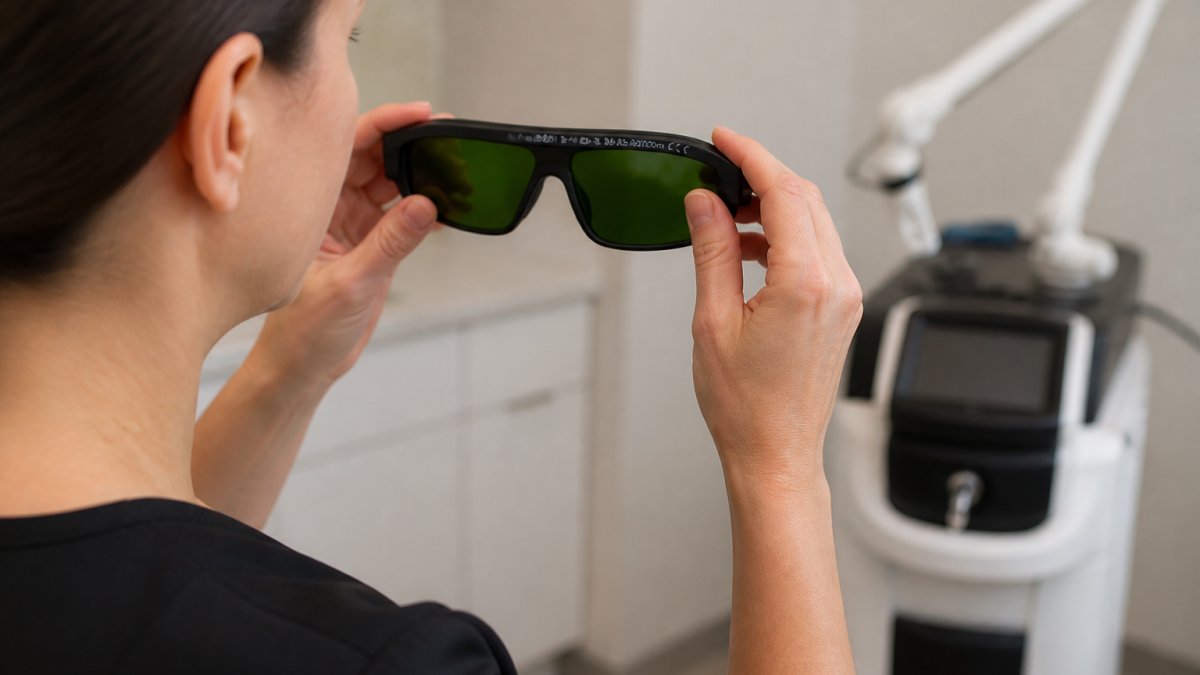
Every compliant pair of laser safety glasses carries markings on the frame or lens. Read them, then compare them to the device.
- Wavelength covered, in nanometres. It must include the wavelength your laser emits.
- Optical density (OD) at that wavelength. Higher OD means more attenuation.
- Laser class rating the eyewear is rated for.
- Standard the eyewear was tested to, typically EN 207 or a recognised equivalent.
- Manufacturer and model, so you can trace the certificate.
Now the critical step: calculate the OD you actually need. The required OD depends on the laser’s power, the wavelength, and the exposure duration. Do not guess.
Two failure modes to watch for:
- Wrong wavelength. Eyewear bought for one laser is worn with a second laser that emits at a different wavelength. The glasses offer almost no protection at the new wavelength.
- Wrong OD. The eyewear is rated for the wavelength but at an OD too low for the device’s power output.
Label every pair of glasses with the device it belongs to. Store them with that device. Do not let them float around the clinic.
Never let staff share eyewear between devices without checking the markings first. A pair that protects against a 1064 nm laser may be useless against a 2940 nm device. The consequence is permanent eye injury, and it happens in seconds.
Step 6: Assign Accountability, Training and Competency Sign-Off
Compliance without a named owner drifts. Someone in the clinic must hold the laser safety role, and that person needs the authority to stop a treatment.
Define the role in writing. In larger clinics this is often called a Laser Safety Officer. In a small practice it may be the owner or a senior clinician. What matters is that the role is named, documented and backed with time to do the work.
The role should own:
- The standards register and safety file
- The risk assessment and its review
- The eyewear register and markings check
- Training records and competency sign-off
- Incident reporting and corrective actions
- The annual audit
Training is not a one-day workshop and a certificate on the wall. Competency means a practitioner can demonstrate correct setup, correct eyewear selection, correct parameters and correct shutdown. Sign them off against a written competency list, observe them doing it, and record the date.
Re-sign competency annually and after any new device is introduced. If a staff member has not used a particular platform for a long period, re-sign them before they treat with it again.
The strongest evidence of a working laser safety program is a named person, a dated competency record and a signed audit. Everything else is supporting material.
Step 7: Reverification After Changes, Incidents and New Devices
Reverification is the step most clinics forget. Compliance is not a one-time event. It is a state you maintain, and it breaks the moment something changes.
Trigger a full reverification when any of these happen:
- A new laser or light-based device arrives
- A device is serviced, repaired or has a component replaced
- The treatment room is reconfigured or relocated
- A new practitioner starts, or an existing one changes scope
- New eyewear is purchased
- An adverse event or near miss occurs
- A relevant standard or regulation is updated
The reverification follows the same seven steps you have just worked through, but you can move faster because the baseline exists.
For incidents, the sequence matters. Secure the device, record what happened while it is fresh, notify as required, then investigate and document the corrective action.
If you are replacing or adding a platform, ask the supplier for the full documentation set before the device is commissioned, not after.
Review the whole safety file annually even if nothing has changed. Standards get revised, and a file that was compliant two years ago may not be today.
Laser safety compliance is not a certificate you hang on the wall.
Frequently Asked Questions
How can you verify that a medical laser meets applicable safety standards?
Start with the device documentation: check that the manufacturer’s declaration of conformity, the device classification label and the user manual all name the same model and match the unit in your room. Confirm the classification marking on the housing, then cross-check it against the controlled area signage, eyewear and operating procedures in place. If any of those four items disagree, treat the device as unverified until the supplier resolves the gap in writing.
What documents should a medical laser supplier provide?
Ask for the declaration of conformity, the user and service manuals, the device classification and labelling information, a written statement of the wavelengths and maximum output the device produces, and the eyewear specification that matches those wavelengths. Also request service records, fault logs and the contact path for technical support. Keep all of it in a single laser safety file so an audit can be answered from one folder rather than three people’s email accounts.
What should a medical laser safety audit include?
A workable laser safety audit checklist covers controlled area signage, access controls, eyewear condition and markings, key control, staff training records, competency sign-off, equipment inspection and maintenance logs, fault and incident records, and evidence of corrective action where problems were found. Photograph the controlled area and date the evidence. An audit that only checks paperwork misses the physical controls that protect staff and patients.
How often should medical laser safety equipment and procedures be reviewed?
Review the written safety program and the laser safety audit checklist at least annually, and reverify immediately after any change of device, room, wavelength, operator or procedure. Also reverify after an incident, a near miss, a fault record or a service visit that altered the equipment. Between formal reviews, keep a simple log of equipment inspections so the annual review is a confirmation rather than a reconstruction.