Blog Details
Last Updated: October 29, 2026
Quick Summary
Common laser device hazards in medical aesthetics include thermal burns, pigmentary changes and scarring, eye injury from direct or reflected beams, and equipment failures. Burns usually trace back to wrong fluence or pulse duration, overlapping passes, or cooling failure. Eye injury is the most serious hazard, so wavelength-specific eyewear must be worn by everyone in the room.
- Visible and near-infrared wavelengths of roughly 400-1400 nm can cause retinal burns or haemorrhage from brief exposure.
- Eyewear must be rated for the device’s specific wavelength, pulse duration and radiant exposure, not bought generically online.
- Keep a separate risk assessment and eyewear set for each device class, since cross-compatibility is a common error.
- After any unintended exposure, stop treatment, provide first aid, record settings, and notify your laser safety officer and insurer.
- Use the pre-session checklist to confirm eyewear, calibration, cooling, consent and plume extraction before every treatment.
Table of Contents
- Laser Treatment Risks and Side Effects: What’s Routine and What’s Not
- Skin Injuries: Burns, Pigment Changes and Scarring
- Eye Hazards and Laser Eye Protection for Clinics
- Hazards by Device Type and Wavelength
- Laser Device Maintenance and Safety Checks
- Your Laser Treatment Room Safety Checklist
- What to Do After an Exposure or Adverse Event
- Choosing a Laser Platform That Supports Safe Practice
- Frequently Asked Questions
Laser Treatment Risks and Side Effects: What’s Routine and What’s Not
Laser device hazards in medical aesthetics fall into two groups: expected skin responses that settle on their own, and true adverse events that need review and reporting.
The distinction matters more than ever. For the formal safety standards and regulatory context behind what counts as a routine versus reportable risk, see this guide to laser equipment safety standards. Global demand for aesthetic laser and energy devices keeps climbing, with Persistence Market Research forecasts projecting growth from US$6.3 billion in 2026 to US$10.3 billion by 2033. More devices in more rooms means more chances for operator error, equipment faults and gaps in safety controls.
Here is the core problem: market growth tells you nothing about safety. Those forecasts are commercial projections, not clinical outcomes or incident data. Clinics still carry the duty of care, and that duty sits with the people running the device.
Laser device hazards is the term for any risk arising from laser treatment, whether from the beam itself or from the equipment, the environment and the way staff use it. Below, we break down the common hazards, how to spot them, and how to build controls that prevent them.
Skin Injuries: Burns, Pigment Changes and Scarring
Skin injury is a laser device hazard in medical aesthetics, and it covers a wide spectrum. Some reactions are expected. Others are reportable events.
Thermal Burns and Tissue Damage
A thermal injury happens when the laser delivers more energy than the skin can absorb safely. Tissue temperature rises, proteins denature, and the result ranges from mild erythema to second-degree or third-degree burns.
A review of medical laser complications by S. H. Woo and co-authors identifies skin burns alongside eye injury, airway fire and plume exposure as recognised risks of medical laser use. Most thermal burns trace back to three causes:
- Wrong fluence or pulse duration for the skin type
- Overlapping passes in the same area
- A cooling failure or a device fault mid-treatment
Train staff to map passes and pause between them.
Hyperpigmentation, Hypopigmentation and Scarring
Pigmentary alterations are changes to skin colour after treatment. Hyperpigmentation is darkening, more common in darker skin types and after sun exposure. Hypopigmentation is lightening, which can be permanent.
Scarring is less common but more serious. It usually follows a burn, an infection, or treatment on compromised skin. The honest position: pigment changes are often temporary, but permanent damage is possible and must be disclosed in consent.
Eye Hazards and Laser Eye Protection for Clinics
Eye injury is the most serious laser device hazard in any treatment room. The beam can damage the retina or cornea in a fraction of a second, and the damage may be permanent. Both direct exposure and reflected beam exposure pose a risk, a stray reflection off a metal instrument or glossy surface can be as dangerous as looking into the aperture.
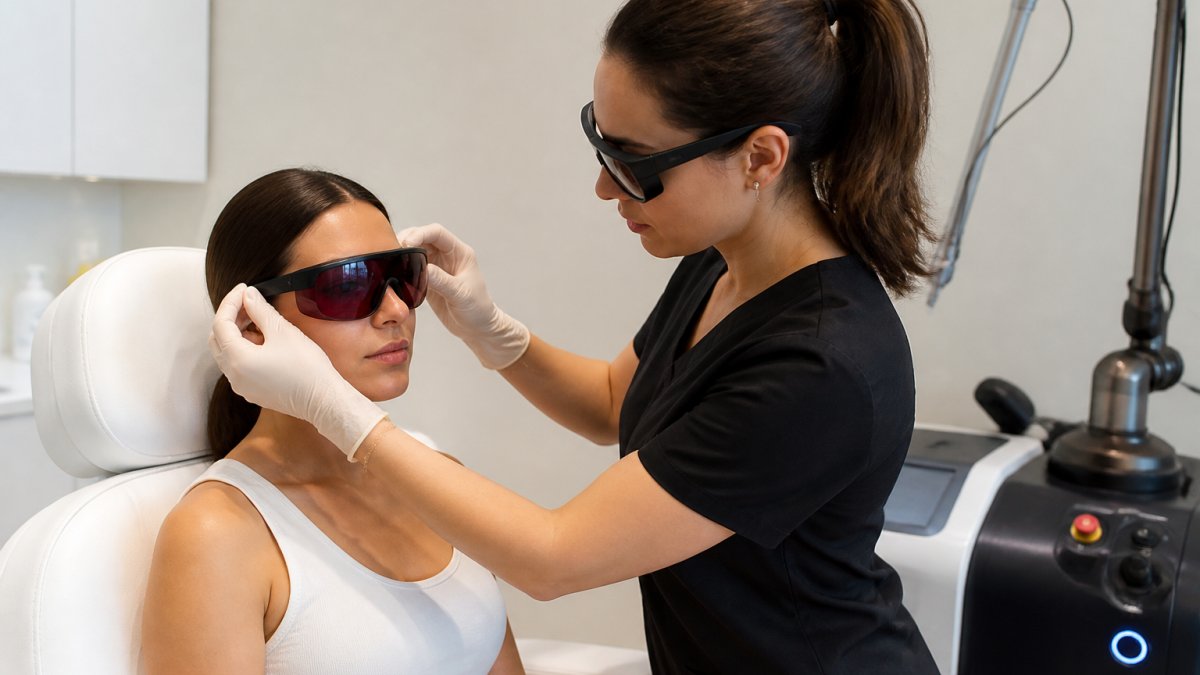
The mechanism matters. Visible and near-infrared wavelengths (roughly 400-1400 nm) pass through the cornea and focus on the retina, so a brief exposure can cause a retinal burn or haemorrhage. Longer wavelengths in the mid- and far-infrared are absorbed at the corneal surface, causing corneal burns and opacities. That is why eyewear cannot be generic: it must be rated for the specific wavelength, pulse duration and radiant exposure of the device in use.
Protective eyewear must match the laser wavelength and be worn by everyone in the room, not just the patient. That includes the operator, assistants and anyone observing. Patient eye protection is not optional, and neither is checking that the goggles are undamaged and correctly rated before every session.
Aesthetic Nursing’s review of energy-based device adverse incidents categorises ocular injuries among the recognised harms from these devices. Practical controls include:
- Wavelength-specific goggles checked before every session, with the optical density and wavelength range recorded in the treatment log
- Warning signage on doors and a visible emission indicator
- No entry during firing, and a designated controlled area
- A nominated laser safety officer with authority to stop treatment
- A documented eyewear register so damaged or mismatched goggles are removed from service
Do not rely on sunglasses, tinted safety glasses or generic ‘laser goggles’ bought online. Eyewear must be labelled with its wavelength range and optical density, and it must be compatible with the device’s actual output. If in doubt, contact the device supplier for the specified eyewear.
::: Proper protection remains equally critical when managing lower-intensity modalities, as understanding the nuances of light therapy safety prevents cumulative ocular damage from prolonged exposure.
Hazards by Device Type and Wavelength
Different devices carry different risks, and treating them as one category is a mistake. The table below summarises the dominant hazard profile for each major device class used in medical aesthetics. It is a starting point for risk assessment, not a substitute for the device’s own instructions for use and your clinic’s laser safety plan.
| Device class | Typical wavelengths | Primary tissue interaction | Dominant hazards |
|---|---|---|---|
| Ablative resurfacing (CO₂, erbium) | 10,600 nm; 2,940 nm | Water absorption, tissue vaporisation | Thermal burns, infection, scarring, delayed pigmentation, plume |
| Non-ablative fractional | 1,550 nm; 1,927 nm; 1,440 nm | Deep dermal heating, micro-injury | Pigmentary change, blistering, thermal injury if fluence too high |
| Vascular (pulsed dye, KTP, diode) | 532 nm; 595 nm; 940 nm | Haemoglobin absorption | Purpura, bruising, burns, rare scarring |
| Hair removal (diode, alexandrite, Nd:YAG) | 755 nm; 808 nm; 1,064 nm | Follicular melanin absorption | Burns, blistering, paradoxical hypertrichosis, pigment change |
| Intense pulsed light (IPL) | Broadband 500-1,200 nm | Non-coherent broadband absorption | Burns if wrong filter or fluence, pigment change, eye risk |
| Pigment-specific (Q-switched, picosecond) | 532 nm; 694 nm; 755 nm; 1,064 nm | Selective photothermolysis of pigment | Hypopigmentation, hyperpigmentation, paradoxical darkening |
Wavelength drives where the energy lands. Shorter wavelengths target pigment and superficial tissue; longer wavelengths penetrate deeper. A device used outside its intended parameters is a hazard regardless of how good the hardware is. For example, a hair-removal laser used on tanned skin can cause burns because the target chromophore (melanin) is present in the epidermis as well as the follicle. An ablative resurfacing device used without adequate plume extraction exposes staff to viable airborne particles.
Use the device class to anticipate the likely hazard, then use the patient’s skin type and history to decide whether that hazard is acceptable. A vascular lesion on a dark skin type, for instance, carries a different pigmentary risk than the same lesion on a light skin type, even with the same device and settings.
If your clinic runs multiple device classes, keep a separate risk assessment and eyewear set for each. Cross-compatibility is a common source of error, particularly where IPL and laser systems share a treatment room.
Laser Device Maintenance and Safety Checks
Equipment failure is an underrated laser device hazard. Smalley’s review of laser safety risks and control measures notes that safety standards often focus on non-beam hazards, including electrical damage, toxic dyes and system failures.
Maintenance is not admin. It is a safety control. See our best practices for laser equipment maintenance for a practical schedule.
Your Laser Treatment Room Safety Checklist
A checklist turns safety protocols into repeatable actions. Readers building a safety checklist can find guidance on comprehensive staff training for laser devices to follow it correctly. Use this before every session:
- Eyewear checked and matched to wavelength
- Device calibration and fault log reviewed
- Cooling system confirmed working
- Skin type and history assessed
- Consent covering pigment and scar risk signed
- Plume extraction running
- Fire risk removed (no alcohol, no flammable drapes)
- Emergency contacts and incident form to hand
What to Do After an Exposure or Adverse Event
Stop, secure the area, and document. That is the order. After any unintended exposure or adverse event:
- Stop treatment and remove the patient from the beam path
- Provide first aid and arrange medical review
- Record the device, settings, wavelength and time
- Notify your laser safety officer and insurer
- Report to the supplier so the fault can be investigated, and see these steps for reliable support for aesthetic laser equipment for investigation and follow-up
Choosing a Laser Platform That Supports Safe Practice
Safe practice starts with the platform. Readers ready to select equipment can use this structured guide on how to choose aesthetic laser equipment focused on safe, suitable platforms.
At DermTech Devices, we supply medical-grade multi-modality laser platforms and skin analysis systems built around performance, reliability and safety. Founded by a Registered Nurse with over 19 years of experience, we focus on safe, efficient and consistent clinical results.
Frequently Asked Questions
What are the most common laser device hazards in medical aesthetics?
Laser device hazards can include skin burns and thermal tissue damage, pigmentary changes such as hyperpigmentation and hypopigmentation, eye injury from direct or reflected beams, and discomfort or prolonged downtime. Non-beam risks can include laser-generated airborne contaminants (plume), electrical faults, fire and equipment failure.
Can aesthetic lasers cause eye damage?
Yes. Laser radiation can injure the cornea or retina depending on wavelength, and the risk is not limited to the person being treated. Reflected beams can reach staff who are not wearing appropriate eyewear.
How can clinics reduce the risk of laser burns?
Start with patient screening for recent tanning, photosensitising medication and darker skin phototypes that raise pigment risk. Use the lowest effective fluence, test on a small area, and keep the handpiece moving. Cooling and correct pulse duration limit temperature rise in tissue. Equipment matters too: regular laser device maintenance and safety checks catch calibration drift and damaged fibres before they affect output. Document settings and follow a treatment room checklist every session.
What should staff do if a laser device malfunctions or a patient is injured?
Stop treatment, switch the device to standby and remove the key if fitted. Give first aid for burns or eye exposure and arrange clinical review; for a serious injury, escalate to emergency care. Record the incident, settings, device serial number and staff present, and report it through your practice’s incident system. Quarantine the device and have it inspected before reuse. Smalley’s review lists system failures among laser risks, so a documented fault history and prompt servicing are part of the response.
Every clinic faces the same challenge: matching clinical excellence with equipment you can trust to perform safely, session after session. DermTech Devices supports that with multi-modality platforms, precision-engineered systems and ongoing technical support. Get started with DermTech Devices and build a treatment room where safety controls are built in, not bolted on.