Blog Details
Last Updated: November 24, 2026
Quick Summary
Medical laser service agreement cost is typically 8% to 10% of the equipment list price per year, so a $200,000 platform can carry a five-figure annual commitment. Contract scope is the biggest driver, followed by device age and utilisation, with consumables often excluded from headline pricing.
- Parts-only agreements cover components but leave labour, travel and consumables billed separately.
- Annual laser maintenance runs $10,000 to $25,000 per device, driven by flashlamps and fibre failures.
- Comprehensive cover at 8-12% of list price converts variable costs into a forecastable operating expense.
- Model lost revenue per hour from downtime before comparing service quotes.
- Check termination notice periods and auto-renewal clauses before signing any multi-year agreement.
Table of Contents
- What Drives Medical Laser Service Agreement Cost Factors
- Medical Laser Maintenance Costs Australia Clinics Should Budget For
- Comparing Service Contract Tiers and What Each One Covers
- Laser Machine Downtime Impact on Revenue
- ARPANSA Laser Safety Compliance for Clinics and Its Effect on Contracts
- Manufacturer Versus Third-Party Service Agreements
- Depreciation, Tax and Termination Clauses to Check Before You Sign
- Request a Service Agreement Quote From DermTech Devices
- Frequently Asked Questions
What Drives Medical Laser Service Agreement Cost Factors
Medical laser service agreement cost factors are the variables that determine what a clinic pays each year to keep a device maintained, calibrated and compliant. The biggest single driver is contract scope, followed by device age and utilisation. According to MediCreations’ analysis of aesthetic device ownership, annual service contract costs typically range between 8% and 10% of the equipment list price, which means a $200,000 platform can carry a five-figure annual commitment before a single tube or handpiece is replaced.
At DermTech Devices, we see clinics sign these agreements without understanding which levers move the number. Below, we break down exactly what you are paying for, how to benchmark a quote, and where the traps sit in the fine print.
Contract scope: parts, labour and travel
Scope is the first thing to interrogate. A parts-only agreement covers components but leaves you paying labour, and labour is where budgets quietly blow out. Full-service agreements bundle parts, labour, travel and calibration into one fixed fee, which converts a variable cost into an operational expenditure line you can forecast.
Ask three questions of any quote: does it include handpiece replacement, does it cover on-site support travel, and is calibration scheduled or billed separately?
Device age, utilisation and consumables
Older devices cost more to cover because failure probability rises with device age. High-utilisation platforms also consume consumables faster, and consumables are frequently excluded from headline contract pricing. All Will Group’s 2026 maintenance cost review puts annual laser maintenance at $10,000 to $25,000 per device, driven largely by flashlamp replacements and fibre optic failures.
Medical Laser Maintenance Costs Australia Clinics Should Budget For
Budget somewhere between 8% and 10% of the original purchase price annually for post-warranty cover, then add a consumables allowance on top. The Device Pulse’s 2026 medical device cost guides note that extended coverage can save clinics $5,000 to $15,000 across a warranty period, but only where the scope matches actual failure patterns.
Annual running costs and percentage benchmarks
| Cost Component | Typical Benchmark | What It Covers |
|---|---|---|
| Service contract | 8-10% of list price | Parts, labour, calibration |
| Annual maintenance | $10,000-$25,000 per device | Flashlamps, fibres, callouts |
| Consumables | Usage-based | Handpieces, tips, gels |
| Downtime | Lost revenue per hour | Unbooked treatment slots |
New devices commonly cost $120,000 to $300,000 upfront, per KevinMD’s equipment cost reporting, so the percentage benchmark matters more than the sticker figure.
Comparing Service Contract Tiers and What Each One Covers
Three tiers dominate the market, and the cheapest is rarely the best value. The table below sets out what each tier typically includes, what it excludes, and the type of clinic it suits. Figures are indicative benchmarks only, always benchmark a quote against your own device’s failure history and booking diary.
| Tier | Typical annual cost | Included | Commonly excluded | Best fit |
|---|---|---|---|---|
| Parts-only | 4-6% of list price | Components, some calibration | Labour, travel, consumables, handpieces | Low-utilisation devices with an in-house biomedical contact |
| Comprehensive / full-service | 8-12% of list price | Parts, labour, travel, scheduled calibration, defined response SLA | Consumables, accidental damage, consumable handpieces unless specified | Busy multi-practitioner rooms where downtime is lost revenue |
| Extended warranty | 6-9% of list price, often bundled at purchase | Manufacturer-backed cover bridging warranty expiry | Wear items, consumables, out-of-hours callouts | New platforms approaching warranty expiry where replacement is not yet justified |
Parts-only suits low-utilisation devices with a strong in-house biomedical contact, but when a flashlamp or fibre fails, labour and travel may be billed separately at callout rates. Comprehensive cover suits busy multi-practitioner rooms where any downtime is lost revenue, and it is the only tier that reliably converts a variable cost into a forecastable operating expense. Extended warranty can bridge the gap between manufacturer warranty expiry and the point where replacement makes more financial sense than repair, check how it is priced, as a percentage of list price or a flat fee can behave differently as the device ages.
Three questions separate a genuine tier from a dressed-up one. First, does the tier include handpiece replacement or is it billed per unit? Second, is calibration scheduled and included, or invoiced separately at each visit? Third, what is the guaranteed response time, and is it measured in business hours or calendar hours? A tier that answers all three in writing is comparable; one that answers none is a headline fee with the real cost buried in the schedule.
For a deeper framework on judging which tier is worth signing, see our guide to evaluating medical laser equipment maintenance contracts. If you need benchmarks for response times and coverage language, our medical laser service level agreement best practices breakdown covers what a credible SLA should specify.
Watch out: a low fixed fee with a high callout charge and a 72-hour response window is not a bargain. It is a variable cost dressed as a fixed one, and the first unplanned stoppage will erase the annual saving.
Laser Machine Downtime Impact on Revenue
Downtime is the cost clinics forget to model. Every unbooked hour on a laser platform is revenue that does not return, and a device waiting on a part for a fortnight can wipe out the annual saving from a cheaper contract. This is why DermTech Devices’ guidance on evaluating maintenance contracts recommends modelling lost revenue per hour before comparing quotes. (Source: Australian Institute of Health and Welfare (AIHW) medical technology reporting)
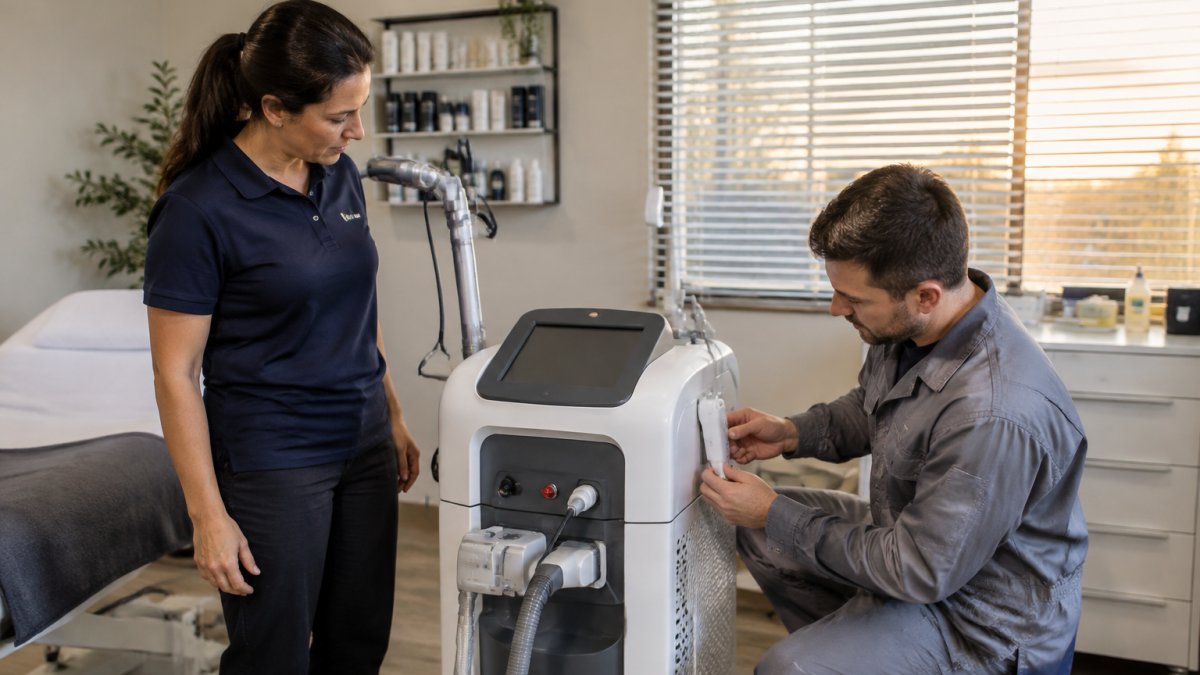
The practical fix is contractual, not technical. Prioritise agreements with defined response times, remote diagnostics and guaranteed spare parts access. For tactics that cut unplanned stoppages, read our guide to reducing downtime for aesthetic laser equipment.
ARPANSA Laser Safety Compliance for Clinics and Its Effect on Contracts
Compliance obligations shape contract pricing more than most buyers realise. ARPANSA publishes the radiation safety framework that clinics operate under, and a service agreement should state who is responsible for calibration records, safety verification and post-repair testing. Contracts that stay silent on compliance hand that liability to you.
ARPANSA’s radiation protection guidance sets out the expectations for laser equipment safety. Before signing, confirm the provider supplies calibration documentation, that laser safety training is included or priced, and that the contract names the responsible officer. Our guide on how to verify medical laser safety compliance standards walks through the checks step by step.
Manufacturer Versus Third-Party Service Agreements
Manufacturer plans offer genuine advantages: OEM parts, factory-trained technicians and software access. They also tend to be restrictive and expensive, and MedEquip Doc’s 2026 analysis cautions that relying solely on manufacturer plans can cost more with less flexibility than independent maintenance.
Third-party providers often deliver faster on-site response and lower fixed fees, but parts provenance and software access need verifying in writing. The honest answer is that it depends on device age. New platforms under warranty: stay with the manufacturer. Older devices past their peak: a vetted third-party agreement usually wins on total cost of ownership.
Depreciation, Tax and Termination Clauses to Check Before You Sign
Three clauses cause most post-signature regret, and none of them appear in the headline fee. Termination is the one buyers read last and regret most, so start there.
Termination and exit. A multi-year service agreement is a financial commitment, and the exit terms matter as much as the annual fee. Check four things in writing: the notice period required to exit at term (30, 60 or 90 days is common, and 90 days is easy to miss); whether exit fees apply and how they are calculated (a flat fee, a percentage of remaining term, or clawback of a discount); what happens to any prepaid service or unused visits; and whether the agreement auto-renews unless cancelled.
Depreciation treatment. Depreciation affects how the device and its service costs are recorded, and it interacts with contract term decisions. A device depreciating on a five-year effective life may reach the point where replacement is more financially sound than another year of comprehensive cover, and the contract term should not outlast that crossover. ResearchGate’s total cost of ownership research confirms that TCO analysis, not headline fees, is the soundest basis for comparison, and TCO includes depreciation, downtime and exit costs, not just the annual premium. Our guide to managing aesthetic clinic equipment depreciation explains how depreciation interacts with contract term decisions.
Tax treatment. The tax treatment of service costs and equipment varies by entity structure and how the contract is characterised, so confirm the position with your accountant before signing. A bundled agreement that rolls equipment, consumables and service into one fee can blur the line between capital and revenue, so confirm the position with your accountant before signing rather than assuming it. Ask the provider to itemise the service component separately on the invoice, it makes the accounting cleaner and the comparison against a third-party quote fairer.
Watch out: an auto-renewal clause with a 90-day notice window is the most common source of post-signature regret. Diarise the notice date the day the contract is executed, not the month before it expires.
Request a Service Agreement Quote From DermTech Devices
The right agreement is the one whose scope matches your actual failure patterns and whose response times match your booking diary. Most clinics overpay for coverage they never claim and underpay for the downtime that actually hurts.
DermTech Devices supplies medical-grade multi-modality laser platforms and next-generation skin analysis systems. We collaborate with globally recognised medical technology brands, and our systems are designed for performance, reliability and consistent clinical results. We were founded by a Registered Nurse with over 19 years of experience.
Partner with us to discuss your requirements, and check our website for current pricing or a quote.
Talk to us before your next contract renewal and we will walk you through the scope, response times and support terms that suit your room. Our multi-modality platforms and next-generation skin analysis systems are built for practices that need reliability without inflated running costs.
Frequently Asked Questions
What is the average annual cost for medical laser maintenance in Australia?
Annual laser maintenance costs vary by device, usage and contract scope. Obtain current figures from your supplier or an independent quote. The figure moves with device age, how often the laser is used, and whether the contract covers parts, labour and travel or just a scheduled inspection.
What is the difference between a comprehensive and a preventative maintenance agreement?
A preventative agreement covers scheduled inspections, calibration and cleaning, and you pay separately for any failed parts or emergency call-outs. A comprehensive agreement folds parts, labour and often travel into one fixed fee, so your service agreement cost is predictable even when a flashlamp or fibre optic fails. Clinics with high device utilisation usually find the comprehensive tier cheaper overall once downtime and emergency repair bills are counted.
Do ARPANSA radiation safety standards affect service agreement requirements?
Yes. Radiation safety obligations for laser equipment are set by ARPANSA and state and territory regulators, and their official guidance should be consulted for current requirements. Contracts that include calibration records, safety checks and documented laser safety training can help with record-keeping. Ask whether the agreement states who holds the laser safety officer role and how training refreshers are scheduled.
How does machine utilisation affect service agreement pricing?
Higher utilisation means more shots on the flashlamp, more handpiece wear and a shorter interval between services, so providers price the risk in. A device used a few hours a week may suit a pay-per-visit or preventative-only plan, while a busy multi-practitioner clinic is usually better served by a comprehensive fixed-fee contract. Track your treatment volume before you negotiate so the tier matches how hard the laser actually works.