Blog Details
Last Updated: November 1, 2026
Quick Summary
Implementing laser safety protocols for staff starts with appointing a Laser Safety Officer who owns hazard classification, training records, incident reporting, and sign-off on new equipment and procedures. Build from there with a documented risk assessment, a written standard operating procedure per laser type, controlled areas with wavelength-matched eyewear, and role-based competency training that is assessed rather than just attended.
- Name a deputy Laser Safety Officer too, because staff turnover can let a program with no backup owner lapse.
- Record each laser’s wavelength, class, maximum power, and delivery method in the risk assessment.
- Select protective eyewear by wavelength and optical density, and label every set by wavelength.
- Assess operator competency through an observed practical signed off by the LSO, not attendance alone.
- Retrain when a new laser, wavelength, or handpiece is introduced, or after an incident or near miss.
Table of Contents
- Step 1: Appoint a Laser Safety Officer and Define Responsibilities
- Step 2: Complete a Laser Safety Risk Assessment
- Step 3: Establish Your Laser Safety Standard Operating Procedure
- Step 4: Set Up Controlled Areas and Protective Equipment
- Step 5: Deliver Laser Safety Training for Staff
- Step 6: Use a Laser Safety Checklist for Clinics to Verify Readiness
- Step 7: Review, Audit, and Respond to Incidents
- Partnering with DermTech Devices for Safe Laser Implementation
- Frequently Asked Questions
Step 1: Appoint a Laser Safety Officer and Define Responsibilities
Implementing laser safety protocols for staff starts with one clear owner.
The role doesn’t need to be a full-time position in a private clinic. It needs to be a named person with written responsibilities. A common mistake is appointing the most senior clinician and leaving it at that.
Define the role in one page:
- Approve laser units, settings, and room setup before first use
- Keep training and competency records current for every operator
- Own the standard operating procedure and review it on a set schedule
- Lead incident and near-miss reporting
- Run periodic audits and escalate gaps to management
For multi-practitioner centres, name a deputy LSO too. Staff turn over, and a safety program with no backup owner quietly lapses.
Step 2: Complete a Laser Safety Risk Assessment
A laser safety risk assessment is a documented review of each laser unit, the room it sits in, who uses it, and how a person could be harmed. It turns vague concern into a list of specific hazards you can control.
Work through it unit by unit. For each laser, record the wavelength, laser class, maximum power, delivery method (handpiece or fiber delivery system), and the treatments it’s used for. Then list the hazards:
- Eye hazard: direct exposure and reflected beam risk from shiny surfaces
- Skin hazard: unintended exposure outside the treatment area
- Fire hazard: flammable drapes, alcohol-based prep, oxygen use
- Electrical hazard: damaged leads, water near equipment
- Airborne contaminants: plume from ablative treatments, which needs smoke evacuation
- Non-beam risks: slips, spills, patient movement during treatment
Score each hazard by how likely it is and how severe the outcome would be. That ranking tells you where to spend on controls first.
Step 3: Establish Your Laser Safety Standard Operating Procedure
A laser safety standard operating procedure (SOP) is the written document that tells staff exactly how to set up, operate, and shut down each laser safely.
Keep it practical. An SOP nobody reads is worse than none, because it creates the appearance of compliance without the substance.
Write one SOP per laser type, covering:
- Authorised personnel and who may operate unsupervised
- Pre-treatment checks: equipment inspection, eyewear check, room setup
- Patient preparation and consent, including eye protection for the patient
- Machine settings and treatment limits
- Emergency stop location and shutdown sequence
- Clean-down, fibre and handpiece care, and fault reporting
Use plain language and short steps. Add a one-page quick-reference sheet at the machine.
Step 4: Set Up Controlled Areas and Protective Equipment
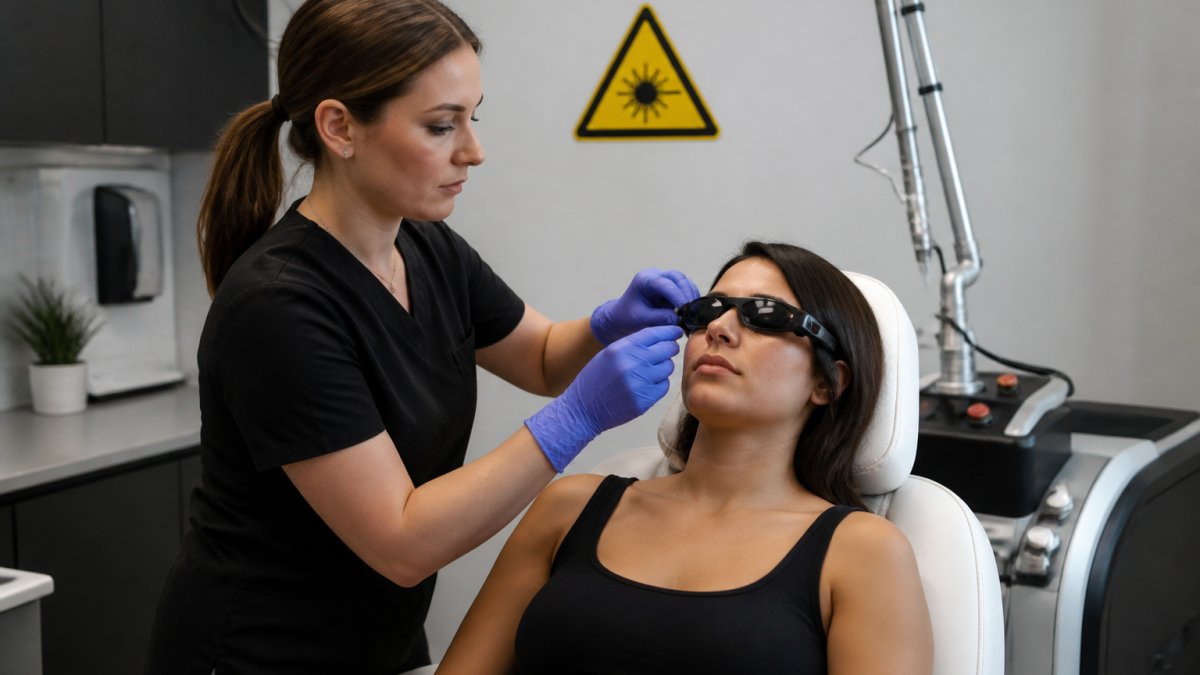
Maintaining these restricted zones requires the same rigorous attention to detail as your clinic infection control, ensuring that every environmental hazard is mitigated before a procedure begins.
A controlled area is a defined space where laser use is restricted to authorised personnel and the hazard controls are in place.
Mark the room clearly. Warning signs at the door, a light or sign showing laser in use, and a door that closes.
Protective eyewear must match the laser. Eyewear is selected by wavelength and optical density, not by whatever is in the drawer. Check:
- Eyewear rated for every wavelength in use in that room
- Enough pairs for staff, patient, and any observer
- Lenses inspected for cracks, scratches, and coating damage
- Storage clean and labelled by wavelength
- Beam path kept below eye level where practical
- Mirrors, shiny instruments, and reflective surfaces removed from the beam path
Watch out: mismatched eyewear gives staff false confidence. A pair rated for one wavelength may offer little protection at another, so label every set and audit the drawer.
Step 5: Deliver Laser Safety Training for Staff
Laser safety training for staff should be role-based, assessed, and repeated, not a single induction session signed off in a lunchbreak. For a deeper guide on comprehensive laser device training, see our dedicated article.
Build training around four roles, because each needs different depth and a different assessment method. Our guide to best practices for aesthetic staff training covers broader program design.
Operators (anyone who fires the laser unsupervised)
- Full SOP for each laser type they use
- Wavelength and class awareness, beam-path control, eyewear selection by optical density
- Machine settings, treatment limits, and when to stop
- Emergency stop location and shutdown sequence
- Assessment: observed practical, set up the room, select eyewear, run a simulated treatment, shut down, signed off by the LSO or a nominated assessor
Assisting staff (nurses, technicians in the room during treatment)
- Patient eye protection and positioning
- Plume and smoke evacuation setup and filter checks
- Room setup, clean-down, and fault reporting
- Assessment: short practical checklist signed off before first assisted session
Maintenance and service staff
- Lockout and safe isolation before service
- Eyewear and signage checks they are responsible for
- What they must not touch and who to escalate to
- Assessment: induction sign-off plus a witnessed service procedure
Nearby and front-desk personnel
- Warning signs, restricted access, and what to do if the door alarm or laser-in-use indicator activates
- Incident reporting route
- Assessment: short written or verbal check, recorded
Assess competency, don’t just record attendance. A common pattern is to have each operator demonstrate setup, eyewear selection, and shutdown while an assessor signs a one-page competency record. Keep that record with the training log, it is the evidence an auditor will ask for.
Set refresher triggers rather than a single annual date. Retrain when:
- A new laser unit, wavelength, or handpiece is introduced
- The SOP changes
- An incident or near miss involves that person or that procedure
- An operator has not used the laser for an extended period (many practices use three to six months as a trigger)
- A competency assessment identifies a gap
Keep a training matrix, one row per staff member, one column per competency, with dates and assessor initials. That single document answers the question “who is currently authorised to do what?” in seconds.
Step 6: Use a Laser Safety Checklist for Clinics to Verify Readiness
A laser safety checklist for clinics turns the program into something you can verify in minutes. Use it before each session and again at audit.
| Check | Frequency | Owner |
|---|---|---|
| Eyewear present, labelled, undamaged | Every session | Operator |
| Warning signage and door control working | Every session | Operator |
| Pre-use equipment inspection logged | Every session | Operator |
| Training and competency records current | Monthly | LSO |
| SOP reviewed and version-controlled | Quarterly | LSO |
| Incident and near-miss log reviewed | Monthly | LSO |
| Smoke evacuation filters and function | Per manufacturer schedule | LSO |
The checklist is only useful if someone signs it. A blank form filed away proves nothing.
Step 7: Review, Audit, and Respond to Incidents
Audits and incident response are what separate a real laser safety program from a folder of documents. This is also where most practices are thinnest: they can describe the controls but cannot show that the controls are working or what happens when one fails.
Run a monthly self-audit
Work through the same checklist you use before each session, plus a document review. Record the result, the date, and who signed it. A blank form filed away proves nothing.
Track a small set of measurable indicators so you can see the program slipping before an incident does:
- Training completion rate against the training matrix (target: every authorised operator current)
- Competency assessments overdue
- Eyewear audit pass rate (present, labelled, undamaged, correct wavelength)
- Near-miss reports per month, a rising count can be good news if reporting culture is improving
- Corrective actions open versus closed, and average days to closure
- Equipment faults logged and resolved, see best practices for laser equipment maintenance to keep equipment compliant
- SOP version current and acknowledged by staff
Pick three or four indicators, not fifteen. A monthly one-page dashboard the LSO can show the clinic owner is worth more than a comprehensive spreadsheet nobody reads.
Respond to incidents and near misses
Have a written response workflow so nobody improvises. A workable sequence:
- Stop and make safe, emergency stop, isolate the laser, secure the room
- Assess and treat, first aid or medical assessment for anyone exposed; for suspected eye exposure, seek ophthalmological assessment promptly and record the time
- Preserve evidence, do not reset settings or move equipment until the LSO has recorded the state; note laser type, wavelength, settings, eyewear in use, and who was present
- Notify, escalate to the LSO and clinic owner; follow any reporting obligations that apply to your setting and jurisdiction
- Investigate, root cause, not blame; identify whether the SOP, training, equipment, or environment contributed
- Correct, change the SOP, retrain, adjust equipment or signage, and assign an owner and due date
- Close the loop, verify the corrective action was completed and record the closure; feed the lesson back to the team
Log every near miss, no matter how small. Near misses are free lessons, and a program where staff feel safe reporting them is a program that improves. Thank the person who reports.
Keep the documentation audit-ready
An auditor or inspector will typically ask for four things: the current SOP and its version history, training and competency records, the incident and near-miss log, and evidence of periodic audit. Keep them in one place, dated and signed, and review them on the same monthly rhythm as the checklist.
Partnering with DermTech Devices for Safe Laser Implementation
Building a laser safety program takes structure, records, and equipment you can trust to behave consistently.
DermTech Devices supplies medical-grade, multi-modality laser platforms and skin analysis systems built for performance and reliability. We were founded by a Registered Nurse with over 19 years of experience.
Visit the DermTech Devices website for current pricing or a quote. Contact us to talk through your setup.
Frequently Asked Questions
Who is responsible for laser safety in an aesthetic clinic?
A designated Laser Safety Officer (LSO) holds overall responsibility for the laser safety program, including risk assessments, SOPs, training records, and incident reporting. In smaller clinics, this may be the practice owner or a senior clinician with additional training. The LSO does not need to operate the laser but must ensure all staff follow protocols and that equipment is maintained and inspected. Clear delegation of duties, such as room setup and eyewear checks, should be documented so accountability is never assumed.
What should laser safety training for staff cover?
Laser safety training for staff should cover laser classification and hazards, wavelength-specific risks to eyes and skin, safe operation of each device, protective eyewear selection and use, controlled area rules, emergency stop procedures, and incident reporting. Role-based training is important: operators need hands-on competency, while front-desk staff need awareness of access control and warning signs. Competency should be assessed and recorded, with refresher training scheduled at least annually or when new equipment is introduced.
How often should laser safety procedures be reviewed?
Review your laser safety standard operating procedure at least annually, and update it whenever you introduce a new laser, change room layouts, or after any incident or near miss. A six-monthly internal audit of checklists, training records, and equipment logs helps catch gaps before they become problems. If regulations or Australian Standards relevant to your equipment change, review immediately. Document each review with a date and reviewer name so your compliance record stays current.
What protective equipment should staff use during laser treatments?
Staff should wear wavelength-specific protective eyewear matched to each laser’s output, not generic safety glasses. Optical density must meet the requirements for the laser class and wavelength in use. Other protective equipment may include laser-safe drapes, smoke evacuation systems for ablative procedures, and gloves where appropriate. Inspect eyewear before every treatment for cracks or damage, store it in a clean, labelled location, and replace any damaged item immediately.