Blog Details
Table of Contents
- Why Equipment Depreciation Matters for Aesthetic Clinics
- Understanding ATO Effective Life of Depreciating Assets
- Medical Equipment Depreciation: Classification and Tax Treatment
- Building a Depreciation Schedule for Clinic Equipment
- Equipment Replacement Planning for Clinics
- Managing Repairs, Upgrades, Trade-Ins and Disposal
- Asset Register and Compliance Documentation
- Frequently Asked Questions
Last Updated: October 21, 2026
Why Equipment Depreciation Matters for Aesthetic Clinics
Managing equipment depreciation clinic operations directly impacts your bottom line. Every piece of medical-grade equipment you buy loses value over time, and tracking this matters for tax deductions, financial planning, and knowing when to upgrade. (Source: Australian Taxation Office (ATO) guidelines on effective life)
Your devices, laser platforms, skin analysis systems, surgical instruments, are capital investments. They’re expensive, they wear out, and their tax treatment can significantly reduce what you owe.
The problem most clinic owners face is simple: they don’t have a system. Equipment sits on the books at purchase price, no one tracks depreciation, and thousands in deductions get missed. When equipment fails or needs replacement, there’s no plan in place.
This guide covers how to classify your devices, calculate depreciation correctly, and build a system that works for your clinic.
Understanding ATO Effective Life of Depreciating Assets
The Australian Taxation Office (ATO) defines effective life as the period over which an asset can reasonably be expected to be used by any business to generate income, not how long your device will physically switch on.
There are two ways effective life is set:
- Commissioner’s effective life, the ATO publishes determinations for common asset types. You can rely on these without further analysis.
- Self-assessed effective life, you estimate the life yourself, based on how your clinic actually uses the asset. This is legitimate and often more accurate for specialised devices, but you must keep a record of the reasoning.
For self-assessment, the ATO expects you to consider usage frequency, operating conditions, the manufacturer’s recommended service life, and industry practice. A high-throughput laser platform running six days a week will not have the same realistic life as an identical unit used two days a week.
Tax effective life versus real-world device lifespan
This is where most clinic owners get caught. A device can be fully depreciated for tax while still being clinically and commercially useful, or fail before its tax effective life ends. The two numbers serve different purposes:
- Tax effective life drives your annual deduction. It is a statutory construct.
- Real-world lifespan drives replacement planning, resale value, and maintenance budgeting. It is an operational judgement.
Keep both figures side by side in your asset register: the ATO effective life you are using, and your own expected service life based on usage intensity, service history, and technology cycle. When they diverge significantly, review your depreciation method or replacement timeline, don’t ignore the difference.
Device-specific considerations
Aesthetic equipment is not homogeneous. A few patterns are common:
- Laser and IPL platforms, high capital cost, fast technology turnover, and consumable components (handpieces, filters, lamps) that wear at different rates to the base unit.
- Skin analysis and diagnostic imaging systems, software-dependent, so obsolescence can arrive before physical failure.
- Treatment beds and furniture, long physical life, low technology risk, but upholstery and motors are the usual failure points.
- Computers and practice-management software, short effective life and rapid obsolescence; often better treated separately from clinical devices.
Before relying on a published effective life, check whether the ATO determination matches your specific device type and configuration. A multi-modality platform may not fit neatly into a single category, and a reasonable self-assessment with documented reasoning is often the safer position.
Knowing the correct effective life, and separating it from your own service-life expectations, is the foundation of accurate tax planning and smarter replacement decisions.
Medical Equipment Depreciation: Classification and Tax Treatment
Medical equipment depreciation depends on how the ATO classifies your assets. Aesthetic clinic devices fall into healthcare categories, and the classification determines the depreciation rate you can claim.
Depreciating assets must be used to generate income, have a limited effective life, and be owned by your business.
You claim a percentage of the asset’s cost each year, depending on the effective life and depreciation method you choose.
Key classifications for aesthetic clinics:
- Medical-grade laser systems: capital medical equipment
- Skin analysis and diagnostic devices: capital medical equipment
- Surgical instruments and tools: capital equipment or consumables (depending on durability)
- Furniture and fixtures: capital equipment with longer effective lives
The ATO allows two main depreciation methods, covered next. Your choice affects how quickly you recover the cost through tax deductions.
Building a Depreciation Schedule for Clinic Equipment
A depreciation schedule is your record of every depreciating asset: original cost, effective life, depreciation method, and annual deductions. Without it, you’re flying blind at tax time.
List every piece of equipment your clinic owns with purchase date, cost, and intended use, then assign each item to the correct ATO effective life category.
Your depreciation schedule should include:
- Asset description and serial number
- Purchase date and original cost
- Effective life category (per ATO guidelines)
- Depreciation method (prime cost or declining value)
- Annual depreciation amount
- Cumulative depreciation to date
- Current book value
Update your schedule annually. Add new equipment. Remove fully depreciated assets. Review for accuracy before lodging your tax return. This record protects you if the ATO ever questions your deductions.
Prime Cost and Declining Value Methods
The ATO allows two depreciation methods, each producing different results. (Source: ATO’s guide to depreciating assets)
Example: A laser system costs $50,000 with a 10-year effective life. Prime cost depreciation is $5,000 per year for 10 years.
Declining value method depreciates assets faster in early years. You apply a fixed percentage to the asset’s remaining book value each year.
Example: The same $50,000 laser system with a 10-year effective life.
Which method suits your clinic? Prime cost is simpler for record-keeping. Declining value recovers costs faster early on.
Equipment Replacement Planning for Clinics
Knowing your equipment’s depreciation schedule helps you plan replacements.
Consider the clinical reality too. Aesthetic technology improves rapidly, newer laser platforms offer better results, skin analysis systems become more accurate, and patients expect current technology. Staying current matters for patient satisfaction and treatment outcomes.
Build a replacement schedule aligned with your equipment’s effective life, plan capital expenditure for slower business periods, and consider financing to spread costs.
Replacement planning checklist:
- Track effective life dates for all equipment
- Monitor equipment performance and reliability
- Evaluate newer technology benefits annually
- Plan capital budgets 12-24 months ahead
- Explore financing options early
- Document reasons for upgrade decisions
Managing Repairs, Upgrades, Trade-Ins and Disposal
Repairs and maintenance are different from depreciation.
The distinction matters: a repair restores equipment to working condition; an upgrade adds new capability or extends useful life. Claim the full repair cost as an expense; capitalise and depreciate upgrades.
Trade-ins create a different scenario. When you trade old equipment for new, you may have a gain or loss on disposal.
Disposal of fully depreciated equipment often creates no tax impact: book value is zero and any sale price is income. If you dispose of equipment before it’s fully depreciated, you may have a loss.
Common repair and upgrade scenarios:
- Laser tube replacement: typically a repair (immediate deduction)
- Software updates: typically immediate expense
- New handpiece for laser system: may be capitalised if it adds capability
- Cosmetic refurbishment: typically a repair
- Major component overhaul: may be capitalised depending on scope
Asset Register and Compliance Documentation
Your asset register is the master record that proves what you own, when you bought it, what you paid, and how you are depreciating it. The ATO expects this documentation if your deductions are ever reviewed. Most clinic owners have a shoebox of invoices and a spreadsheet six months out of date, the fix is a repeatable workflow, not a one-off clean-up.
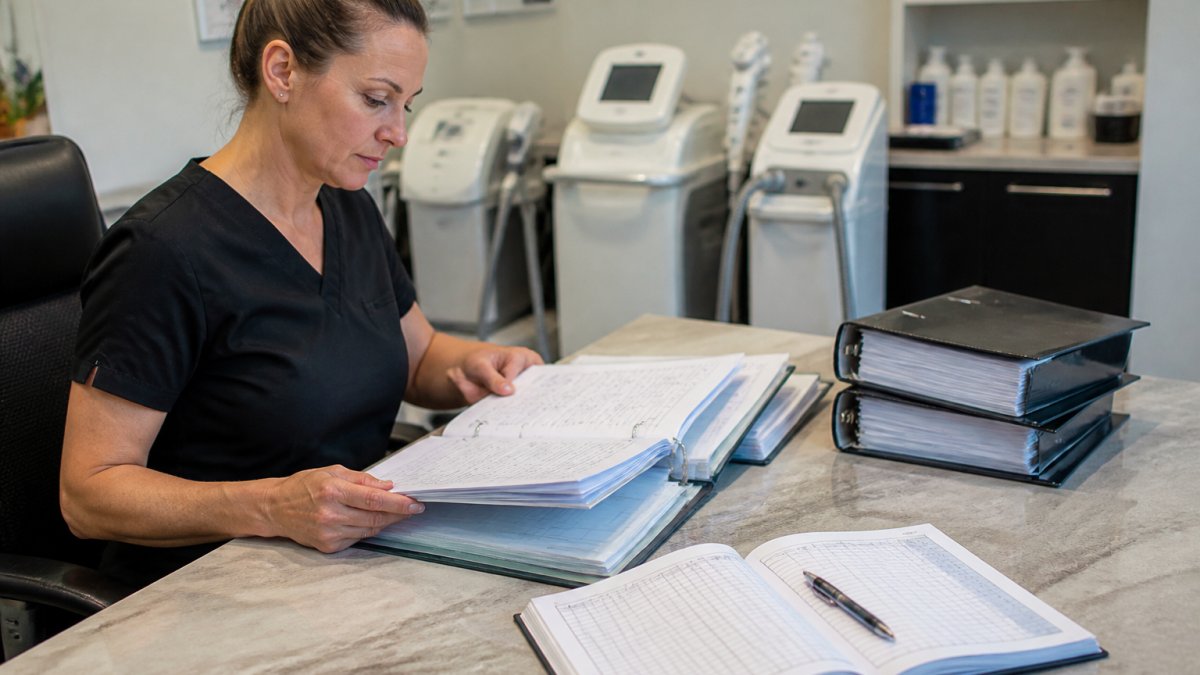
A practical asset-register workflow
- Capture at acquisition. Record each device the same week it is delivered and installed, don’t wait for the accountant at year end.
- Assign a unique asset ID. Use a simple internal code (for example, LAS-001) and attach it physically to the device to link the asset to the record.
- Record the core fields. Description, make and model, serial number, purchase date, purchase cost (excluding GST if you are GST-registered and can claim it), supplier, invoice reference, installation date, and clinic location.
- Set the depreciation treatment. Record the ATO effective life used, whether Commissioner’s or self-assessed, the method (prime cost or declining value), the start date, and the annual deduction.
- Log lifecycle events. Every repair, upgrade, trade-in, relocation, or disposal gets a dated entry against the asset ID with the supporting document reference.
- Reconcile quarterly. Compare the register to your accounting software and spot-check high-value devices physically. Fix discrepancies while they are small.
- Review annually before lodgment. Confirm opening book values, additions, disposals, and the current-year deduction reconcile to your tax return.
What to keep as supporting evidence
- Purchase invoices and contracts
- Installation and commissioning records
- Warranty documents
- Service and maintenance logs
- Upgrade invoices and scope descriptions
- Trade-in or disposal documentation, including proceeds received
- Any written reasoning for a self-assessed effective life
Handling lifecycle events in the register
Common events that affect the record:
- Repairs, record the date, cost, and nature. If it is a restoration rather than an improvement, note that so the immediate-expense treatment is supported.
- Upgrades, record what was added or replaced, the cost, and whether it was capitalised and added to the depreciable base.
- Trade-ins, record the old asset’s disposal (date, proceeds or trade-in value, book value at disposal) and the new asset as a separate line.
- Disposal, record the date, method (sale, scrapping, donation), and any proceeds. Retain the document evidencing the disposal.
A register that is only updated at tax time is a compliance risk, not a management tool. The ATO’s concern is substantiation, if you cannot show the asset existed, cost what you claimed, and was used to produce assessable income, the deduction is exposed. Quarterly reconciliation is the cheapest insurance you can buy.
Minimum register fields checklist
- Asset ID and description (specific model and capability)
- Serial number or other unique identifier
- Purchase date, supplier, and invoice reference
- Purchase cost and GST treatment
- Installation date and clinic location
- ATO effective life used and basis (Commissioner’s or self-assessed)
- Depreciation method and start date
- Annual and cumulative depreciation
- Current book value
- Lifecycle event log (repairs, upgrades, trade-ins, disposal)
- Disposal date and proceeds, if applicable
Your register becomes your depreciation schedule, the source document for your tax return and the evidence base if the ATO ever asks. Review it quarterly, reconcile it annually, and treat every lifecycle event as a reason to update the record, not defer it.
Frequently Asked Questions
How do I calculate depreciation on aesthetic clinic equipment?
Depreciation is calculated using either the prime cost method (straight-line depreciation) or the declining value method. Under prime cost, divide the cost by the effective life in years. For example, a $50,000 laser system with a 10-year effective life depreciates at $5,000 per year. The declining value method applies a percentage to the remaining value each year, typically resulting in higher deductions early on. The ATO provides guidance on effective life for medical equipment depreciation. Consult a tax professional to choose the method that suits your clinic’s cash flow.
What is the typical depreciable life of medical equipment?
Medical equipment depreciation depends on the device type and its intended clinical use. Laser systems, skin analysis devices, and surgical instruments typically have effective lives ranging from 5 to 15 years under ATO guidelines, though real-world device lifespan may differ. The ATO effective life of depreciating assets is published in the tax office’s asset life tables. Cosmetic equipment such as radiofrequency or ultrasound devices may have different effective lives than surgical instruments. Your tax adviser can confirm the correct effective life for each asset in your clinic, as misclassification can affect your tax deductions.
What records should a clinic keep for depreciating equipment?
Maintain a detailed asset register recording the purchase date, cost, supplier, serial number, effective life, depreciation method, and annual depreciation amount for each item. Keep purchase invoices, warranties, and service records. Document any repairs, upgrades, or trade-ins separately, as these may be deductible expenses rather than capital additions. Record the disposal date and any proceeds from sale or trade-in. The ATO may request these records during audit, so store them securely for at least five years. A spreadsheet or dedicated asset management system helps ensure compliance and simplifies end-of-year tax preparation.
How should a clinic plan for equipment replacement as assets depreciate?
Track the real-world performance and maintenance costs of each asset alongside its depreciation schedule. When repair costs exceed 50% of replacement value or downtime affects patient care, replacement planning becomes urgent. Use your depreciation schedule to forecast when assets will be fully written off, then budget for replacements in the years before failure. Consider equipment replacement planning for clinics as part of your end-of-financial-year strategy. Modern multi-modality platforms may offer better clinical outcomes and lower maintenance costs than older single-function devices, justifying earlier replacement. Consult your accountant about timing replacements to optimise tax deductions and cash flow.