
Blog Details
Last Updated: November 24, 2026
Quick Summary
Medical laser calibration service requirements are the checks, measurements and records that keep a clinic laser delivering the output it is meant to deliver, safely and consistently. A calibration visit measures actual output, compares it to specification, adjusts if needed, and documents both as-found and as-left states along with safety inspections and a certificate.
- Adjust your calibration interval beyond the manufacturer baseline for treatment volume, device age, service history and clinical risk.
- Ask what as-found readings were before adjustment, which tolerance applies and where it comes from.
- Where manufacturer and clinical tolerances conflict, the tighter tolerance governs.
- If the measured value plus or minus the uncertainty crosses the tolerance limit, treat the result as a fail until re-tested.
- Keep certificates for the life of the device plus the retention period your quality system requires.
Table of Contents
- What Medical Laser Calibration Service Requirements Actually Cover
- How Often to Calibrate: Intervals Based on Risk and Use
- Your Medical Laser Servicing Checklist, Start to Finish
- Reading a Laser Calibration Certificate: As-Found, As-Left and Uncertainty
- Safety Checks That Go Beyond Output Power
- What a Medical Laser Service Contract Should Include
- Medical Laser Service Costs: Why Quotes Differ So Much
- Planning Your Laser Service Schedule with DermTech Devices
- Frequently Asked Questions
What Medical Laser Calibration Service Requirements Actually Cover
Medical laser calibration service requirements are the checks, measurements and records that keep a clinic laser delivering the output it is meant to deliver, safely and consistently. It is really the backbone of safe treatment and predictable results. (Source: Work Health and Safety Act 2011)
The core of any calibration visit is straightforward. A technician measures the laser’s actual output, compares it to the specification, adjusts if needed, and documents both states. Around that sit safety inspections, service records and a certificate you can show an auditor.
Confused about what a visit includes? Read our guide to laser calibration safety testing and service intervals for the deeper detail.
The standards and rules that apply to clinic lasers
Australian clinics work within a layered framework. General work health and safety duties require a safe workplace and safe plant.
Those layers overlap, and none of them is optional. A clinic that follows only the manufacturer’s schedule may still fall short on record-keeping or safety inspection.
For a practical walkthrough of verifying medical laser safety compliance standards, start there before booking a service.
How Often to Calibrate: Intervals Based on Risk and Use
The right calibration interval depends on how hard the laser works, not just the calendar. A high-volume platform used daily needs closer attention than a device used twice a week.
Manufacturer recommendations are your baseline. From there, adjust for:
- Treatment volume: busy clinics should test output more often
- Device age: older lasers drift more and need tighter checks
- Service history: a device with past faults warrants closer monitoring
A common mistake is treating the annual service as the only checkpoint. Daily and weekly output checks catch drift long before the formal calibration does.
The article lists the factors that should adjust your baseline calibration interval beyond the manufacturer’s recommendation.
| Factor | Effect on interval |
|---|---|
| Manufacturer recommendations | Baseline starting point |
| Treatment volume | Busy clinics should test output more often |
| Device age | Older lasers drift more and need tighter checks |
| Service history | Past faults warrant closer monitoring |
| Clinical risk | Narrow tolerances need more frequent verification |
Your Medical Laser Servicing Checklist, Start to Finish
A good service visit runs on preparation. Clinics that prepare well get faster visits, fewer surprises and cleaner records. The checklist below is laser-specific: it covers the access, safety and records a technician needs before they can test output meaningfully.
Before the technician arrives
- Confirm the service scope in writing, including which parameters are tested, whether safety functions are inspected, and what certificate you will receive
- Block the treatment room for the full visit, including set-up and pack-down time
- Confirm the device is powered down and locked out according to your clinic’s procedure, and that the key or access code is available to the technician
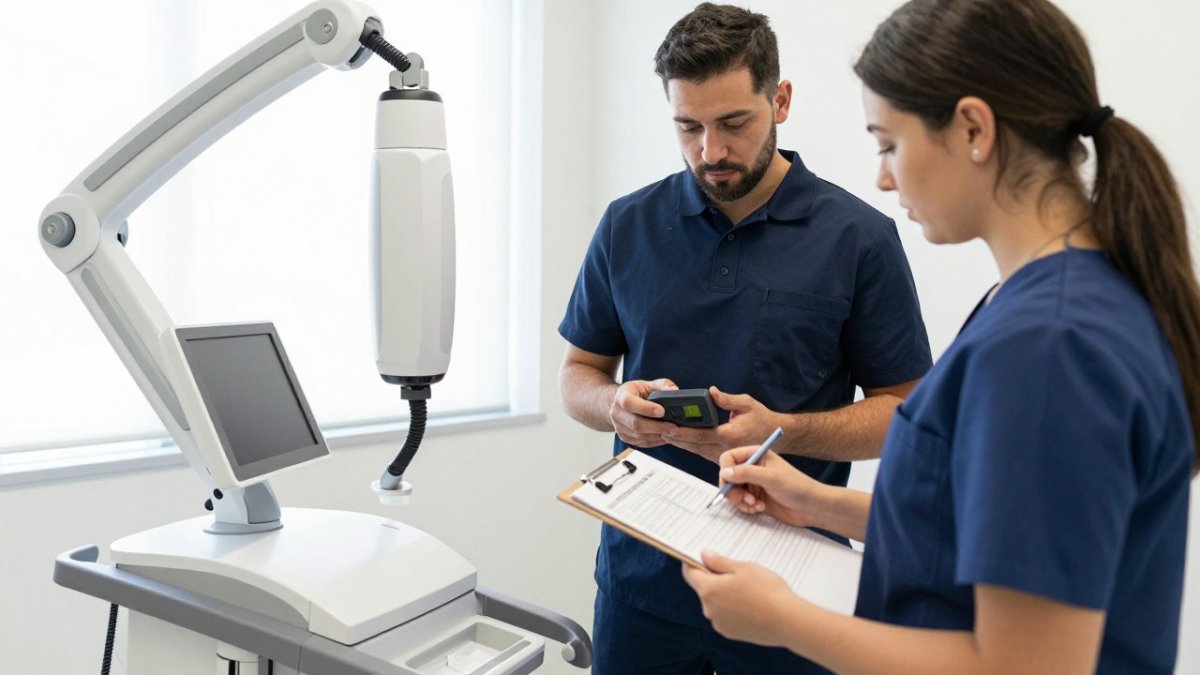
During the visit
Watch the technician work through the checks, and ask three questions as they go:
- What are the as-found readings before any adjustment?
- Which tolerance are you testing against, and where does it come from?
- Which safety functions are being checked, and how are the results recorded?
A technician who cannot answer these on the spot is not giving you a calibration you can defend. The as-found reading is the single most useful number in the visit: it tells you whether the laser had drifted and by how much.
Watch out: a quick output check that skips warm-up or uses the wrong sensor for the wavelength can read within tolerance on a device that is actually out. Ask what warm-up and sensor were used.
After the visit
- File the certificate with the device records, not in a general folder
- Log the service date and the next due date in your equipment schedule
- Record any as-found drift and adjust the next interval if the trend warrants it
A visit without a filed record is a visit you cannot prove happened. The record is the deliverable as much as the adjusted laser.
Reading a Laser Calibration Certificate: As-Found, As-Left and Uncertainty
A calibration certificate is only useful if you can act on it. Reading the tolerance result alongside the service record makes the certificate actionable, and the same habit of documenting checks applies to security screening equipment calibration.
The certificate should let you answer three questions: what the laser measured before adjustment, what it measured after, and how confident the measurement is. The sections below show how to turn those numbers into a decision.
As-found and as-left results
As-found results show the device’s condition on arrival. As-left results show it after adjustment. If as-found was already within tolerance, the device was holding well and no adjustment was needed.
Ask for both states in the certificate. A certificate that shows only as-left results hides whether the device had drifted, which is exactly the trend data you need to decide whether to shorten the next interval. (Source: Australian Radiation Protection and Nuclear Safety Agency)
Tolerances and acceptance criteria
A tolerance is the range within which the measured output must sit to be considered acceptable. Tolerances usually come from three places, in this order of authority:
- Manufacturer specification for the model, which sets the design tolerance
- Clinical requirement for the treatment, which may be tighter than the manufacturer allows
- Applicable standards or regulatory guidance for the device type
Where these conflict, the tighter tolerance governs. A common pattern is a manufacturer tolerance of plus or minus 20 per cent on output, while a clinical protocol for a fractional treatment assumes much closer consistency.
Watch out: a certificate that says “within specification” without naming the specification is not evidence of anything. Ask the provider to state the tolerance and its source on the certificate.
Measurement uncertainty and pass/fail decisions
Measurement uncertainty is the range within which the true value sits. A reading of 10 W with an uncertainty of plus or minus 0.2 W is a different claim from the same reading with a wider band.
The practical rule is simple: if the measured value plus or minus the uncertainty crosses the tolerance limit, the result is inconclusive and should be treated as a fail until re-tested with better equipment or a tighter method.
Metrological traceability
Metrological traceability links the technician’s power meter back to a national standard through an unbroken chain of calibrations, each with its own uncertainty. Without it, the numbers are just numbers. The certificate should identify the reference instrument used, its calibration status and the laboratory that calibrated it.
What a defensible certificate contains
At minimum, a laser calibration certificate should record:
- Device identification: make, model, serial number and asset number
- Date of calibration and the next due date
- Environmental conditions during test, where relevant
If any of these are missing, the certificate is weaker evidence than it looks. For audit purposes, keep certificates for the life of the device plus the retention period your quality system requires, and store them where you can retrieve them within minutes, not hours.
Safety Checks That Go Beyond Output Power
Output power is the headline, but it is not the whole safety picture. A laser can measure correctly and still be unsafe.
The checks that matter alongside output:
- Interlocks: door and hood interlocks must stop emission
- Emergency stop: must function immediately when pressed
- Foot switch: should operate reliably and not stick
What most guides miss is that these checks fail quietly. An interlock that works intermittently passes a quick test and fails in use.
For broader upkeep between formal services, our aesthetic clinic equipment maintenance tips cover the routine checks staff can run.
What a Medical Laser Service Contract Should Include
A service contract is where clinics get caught. The headline price often hides what is excluded.
Check that the contract states:
- Response times for breakdowns, in writing
- Scope of calibration, including which parameters are tested
- Parts and labour treatment
A common mistake is signing on price alone. A cheap contract that excludes parts or loan devices costs far more when a laser is down for a week.
Before signing, use our guidance on evaluating medical laser equipment maintenance contracts to compare terms properly.
Medical Laser Service Costs: Why Quotes Differ So Much
Two quotes for the same laser can differ widely, and the gap is usually scope, not greed.
Cost drivers include:
- Number of calibration points tested
- On-site versus laboratory calibration
- Travel and logistics for remote clinics
A low quote may cover output power only. A higher one may include safety inspection, traceability statements and a full certificate. Compare line by line, not total to total.
Service pricing depends on scope, device and clinic circumstances. For current pricing or a quote, visit the DermTech Devices website.
Planning Your Laser Service Schedule with DermTech Devices
A service schedule is a living document, not a wall chart. It should flex with your treatment volume, your device mix and your audit calendar.
Our step-by-step guide to reliable equipment support walks through planning ongoing service for your devices.
Downtime and unclear service terms are the two things that hurt a clinic most. DermTech Devices supplies medical-grade laser platforms and supports them with service planning built around real clinical use. Our team offers multi-modality platforms, next-generation skin analysis systems and ongoing support designed to keep your devices performing.
Frequently Asked Questions
How often should a medical laser be calibrated?
Most clinics should plan formal calibration at least annually, with many device manufacturers recommending a specific interval in the service manual. Risk and use should adjust that baseline: a high-volume platform running daily treatments may need output verification more often, while a backup unit used occasionally can follow the longer end of the manufacturer’s range. Daily and weekly checks, such as output power spot checks and interlock tests, sit on top of formal calibration and do not replace it. Record the interval you choose and the reasoning behind it, because auditors and insurers will ask.
What records should a medical laser service provider supply?
Ask for a laser calibration certificate that states the device identifier, the date of service, the parameters measured, as-found and as-left results, the tolerance or acceptance criteria applied, and the measurement uncertainty. The certificate should also name the calibration procedure or standard used and the metrological traceability of the reference instruments. Keep the service report, any parts replaced, and the technician’s sign-off alongside it. A provider that cannot supply traceable documentation leaves you without evidence that the laser performed to specification, which is a problem at audit time.
What is the difference between medical laser calibration and maintenance?
Maintenance covers the physical upkeep of the device: cleaning optics, checking cooling systems, inspecting cables, handpieces and foot switches, and replacing worn parts. Calibration is the measurement side, confirming that the optical output at set parameters matches the displayed value within a stated tolerance, and adjusting the device if it does not. A service visit usually combines both, but they answer different questions. Maintenance keeps the laser running; calibration proves it is delivering the energy you and your patients expect, and the certificate is the evidence.
Who is qualified to service and calibrate medical lasers?
Look for a provider with demonstrated experience on your specific laser platform, technicians trained by the manufacturer or an equivalent body, and reference instruments calibrated by an accredited laboratory. Ask how the provider handles measurement uncertainty and whether they can supply as-found results before any adjustment is made. Manufacturer recommendations matter here: some platforms require OEM-trained service to keep warranties valid. Confirm the provider’s scope in writing before booking, and check that their certificate format will satisfy your quality assurance and audit requirements.