Blog Details
Table of Contents
- Step 1: Map Your Equipment Lifecycle and Support Needs
- Step 2: Build a Medical Laser Preventative Maintenance Schedule
- Step 3: Meet Laser Safety Compliance Requirements Australia
- Step 4: Use an Aesthetic Laser Service Level Agreement Checklist
- Step 5: Troubleshoot Common Minor Errors Before You Call
- Step 6: Keep Digital Maintenance Logs and Service Records
- Step 7: Decide Between In-House and Outsourced Maintenance
- Ensuring Reliable Support for Aesthetic Laser Equipment: What Matters Most
- Frequently Asked Questions
Last Updated: September 28, 2026
Step 1: Map Your Equipment Lifecycle and Support Needs
Reliable support for aesthetic laser equipment starts with one question: what will this device need over the next five years? Aesthetic laser support is the planned combination of maintenance, calibration, safety compliance, training and technical backup that keeps a platform performing from installation to replacement. Practices that map this upfront spend less on emergency repairs and lose fewer treatment days. (Source: AS/NZS IEC 60825.1)
Every medical aesthetic device moves through four stages:
- Commissioning: installation, baseline calibration, staff training
- Peak operation: daily use, preventative checks, consumable replacement
- Aging: more frequent servicing, possible component swaps, software updates
- End of life: trade-in, upgrade, or disposal
A common mistake is buying on purchase price alone. Ask instead what the device will cost to run each year, and who fixes it when it stops mid-treatment.
Step 2: Build a Medical Laser Preventative Maintenance Schedule
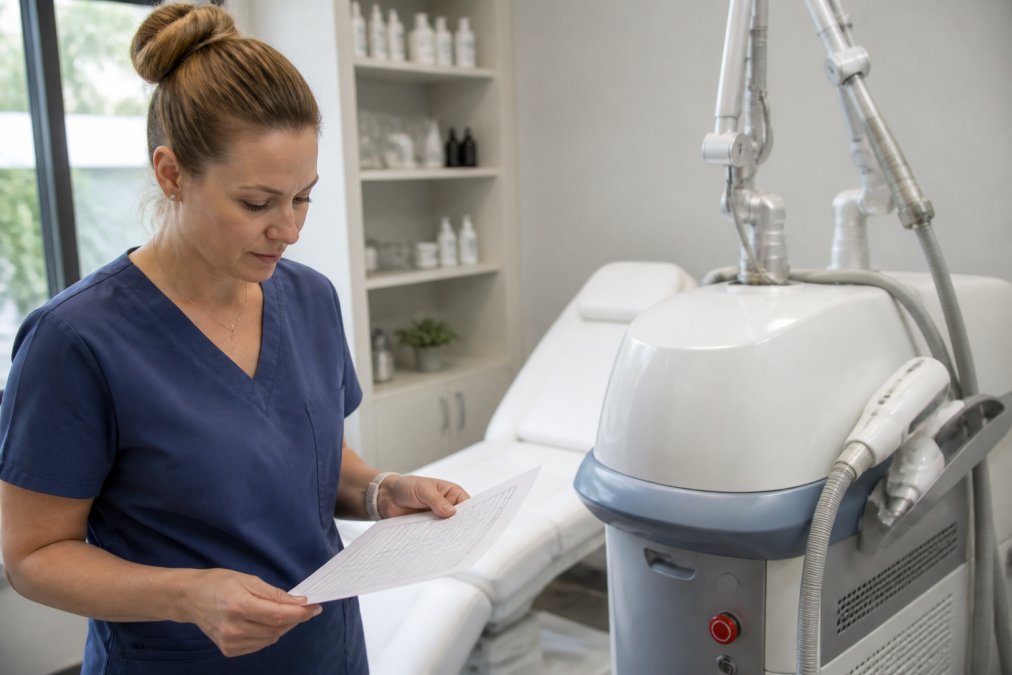
A medical laser preventative maintenance schedule is a written plan of daily, weekly, monthly and annual tasks that keep output stable and catch faults early. Without one, small drifts in output consistency go unnoticed until someone spots an uneven result.
Daily and Weekly Preventative Checks
Daily and weekly checks take minutes and prevent most downtime. Train every operator to complete them before the first patient.
- Wipe down the handpiece and check for cracks or residue
- Confirm the emergency stop works
- Check the footswitch and cables for wear
- Test the aiming beam and treatment guide
- Log any error codes shown on startup
Monthly and Annual Calibration Tasks
Monthly and annual tasks belong to a trained technician. Calibration confirms the device still delivers the energy the settings claim, protecting outcomes and keeping records defensible.
- Monthly: inspect cooling systems and filters, verify power output
- Quarterly: check optics and beam profile
- Annually: full calibration, safety inspection, and written service report
Step 3: Meet Laser Safety Compliance Requirements Australia
Laser safety compliance requirements Australia practices must follow sit across two layers: national codes that classify and control laser equipment, and state or territory radiation regulators that license, register and inspect premises. Rules differ between jurisdictions, so confirm current guidance with your local regulator.
The National Framework You Are Working From
Most Australian aesthetic laser regulation is built on two documents:
- AS/NZS IEC 60825.1, the joint Australian/New Zealand standard for safety of laser products, which sets the Class 1 to Class 4 classification system and the engineering controls each class requires.
- The national model regulations and code of practice for radiation protection developed by the Australian Radiation Protection and Nuclear Safety Agency (ARPANSA), which state and territory regulators adopt or adapt into their own radiation protection legislation.
Who Regulates What, by Jurisdiction
Each state and territory has its own radiation regulator and its own rules on registration, licensing and inspection. Common examples include:
- New South Wales: NSW Environment Protection Authority (EPA) under the Radiation Control Act 1990 and Radiation Control Regulation 2013.
- Victoria: Department of Health (Radiation Health) under the Radiation Act 2005.
- Queensland: Queensland Health (Radiation Health Unit) under the Radiation Safety Act 1999.
- Western Australia: Radiological Council under the Radiation Safety Act 1975.
- South Australia: EPA South Australia under the Radiation Protection and Control Act 2021.
- Tasmania: Department of Health under the Radiation Protection Act 2005.
- ACT: ACT Health Protection Service under the Radiation Protection Act 2006.
- Northern Territory: NT Health under the Radiation Protection Act 2004.
Your Laser Safety Officer and Radiation Safety Duties
A trained laser safety officer (LSO) is usually required wherever a Class 3B or Class 4 laser is used. The LSO writes standard operating procedures, runs hazard assessments and checks controls match the device. Typical duties include:
- Registering the laser and the premises where your regulator requires it
- Maintaining a controlled treatment area with warning signs and, where required, interlocked doors
- Restricting access to trained, authorised staff
- Keeping a laser register listing each device, its class, and its service history
- Documenting incidents and near misses, and reporting notifiable incidents to the regulator within the required timeframe
- Ensuring the LSO’s own training and reappointment are current
PPE, Optical Density and Hazard Assessment
Personal protective equipment (PPE) for laser work means wavelength-specific eyewear, not generic safety glasses. Optical density (OD) tells you how much light the eyewear blocks at a given wavelength, and it must match every device in the room, one pair rarely covers a multi-modality platform.
Wearing the wrong wavelength eyewear gives a false sense of protection. Match optical density to each laser you operate, label the eyewear with the wavelength it covers, and store it with the device it belongs to.
Keep a one-page compliance summary per site: regulator name, registration number, LSO name, last inspection date, and next review date. It answers most regulator and insurer questions in under a minute.
Step 4: Use an Aesthetic Laser Service Level Agreement Checklist
An aesthetic laser service level agreement checklist turns vague promises into measurable commitments. Before signing, confirm what happens when a device fails on a busy day.
Use this checklist:
- Response time for phone and on-site support
- Uptime guarantee and how it is measured
- Parts availability and lead times
- Warranty coverage: what is included and excluded
- Preventative service visits per year
- Training included, and refresher training
- Loan equipment if repair drags on
- Escalation contact when something goes wrong (Source: Therapeutic Goods Administration (TGA))
| Support Element | What to Ask | Why It Matters |
|---|---|---|
| Response time | Hours to first reply | Keeps bookings on track |
| Warranty coverage | Parts and labour included | Avoids surprise invoices |
| Training | Initial and refresher sessions | Protects staff competency |
| Parts | Local stock or order-in | Shortens downtime |
Response Times, Warranty Coverage and Parts
Response time decides whether you cancel patients. Get it in writing, and ask whether it applies after hours. Warranty coverage should spell out parts, labour and travel, exclusions are where costs hide.
Training, Staff Competency and Technical Support
Staff competency is a safety requirement, not a bonus. Ask how training is delivered, how new staff are onboarded, and whether refreshers are included. Good technical support also means someone who can talk a practitioner through a fault by phone.
The cheapest device becomes expensive fast if support is slow. Weigh response time and training as heavily as the purchase price.
Step 5: Troubleshoot Common Minor Errors Before You Call
Many faults are minor and fixable in minutes. A short checklist first saves a service call and gets you back to patients faster.
Common minor errors and their fixes:
- Device will not start: check the power outlet, emergency stop, and key switch
- Low or uneven output: confirm the correct handpiece and tip are fitted
- Error code on startup: note the code, restart once, and check the manual
- Overheating: check vents and filters for dust, then let it cool
- Footswitch unresponsive: reseat the cable and test on another port
Step 6: Keep Digital Maintenance Logs and Service Records
Digital maintenance logs make audits, warranty claims and resale far easier. Paper logs get lost; a shared digital folder does not.
Keep these records for every device:
- Installation date and baseline calibration report
- Every preventative check, with date and initials
- Calibration and repair reports
- Error codes and the fix applied
- Training records for each staff member
Snap a photo of each completed service report and file it the same day. Chasing paperwork months later is where warranty claims fall apart.
Step 7: Decide Between In-House and Outsourced Maintenance
In-house versus outsourced maintenance comes down to volume, skills and risk. Neither wins outright, most clinics land on a hybrid. Apply this framework device by device.
The Four Questions That Decide It
Work through these in order. The first ‘no’ usually points to outsourcing that task.
- Volume: How many treatment hours per week does this device run? Below roughly 15-20 hours, an in-house technician rarely pays for themselves.
- Skill: Do you have (or can you hire) someone trained on this specific platform? Platform-specific training is the bottleneck, not general electronics.
- Risk: If this device fails mid-treatment, what is the clinical and reputational cost? Higher risk favours a contract with a guaranteed response time.
- Records: Can you produce a complete, dated service history on demand? If not, you are exposed at audit, warranty claim or resale, whoever does the work.
Where Each Model Actually Wins
| Factor | In-House | Outsourced |
|---|---|---|
| Best for | High device volume, multi-site, predictable schedule | Small clinics, single device, specialist platforms |
| Cost shape | Fixed staff cost, spread across devices | Pay per service, plus call-out and parts |
| Response speed | Fast if trained staff on site and available | Depends entirely on contract terms |
| Skills needed | Ongoing training investment, plus cover for leave | Covered by provider, but only within scope |
| Records | You manage them, and you own the gaps | Provider supplies reports, but you must still file them |
| Scalability | Slower, hiring takes time | Faster, contract can expand with device count |
The Hybrid Model Most Clinics Land On
A practical middle path suits many clinics:
- Daily and weekly checks stay in-house. These are operator tasks, not technician tasks, and they are the cheapest downtime prevention you have.
- Monthly and quarterly inspections sit with a trained staff member where volume justifies it, or with the provider where it does not.
- Annual calibration, safety inspection and complex repairs go to a provider with platform-specific training and calibrated test equipment.
- Emergency response is contracted, with a written response time and a loan-device clause if repair drags beyond an agreed window.
That split keeps routine care cheap and specialist work safe, so you never pay technician rates for tasks a trained operator can do.
The Cost Logic, Without Guessing at Numbers
Do not compare a service contract against a salary in isolation. Compare the total cost of ownership per treatment hour:
- Contract fees, call-outs and parts, divided by annual treatment hours
- In-house salary, training, tools and calibration equipment, divided by the same hours
- Add the cost of downtime: cancelled appointments, refunded deposits, and the marketing spend to refill the diary
The cheapest device becomes expensive fast if support is slow. Weigh response time, parts availability and training as heavily as the purchase price, and put every one of those commitments in the written agreement.
Ensuring Reliable Support for Aesthetic Laser Equipment: What Matters Most
Reliable aesthetic laser support is not one purchase, it is a system. Map your equipment lifecycle, run a preventative schedule, meet your regulator’s safety rules, and put every commitment in writing.
Frequently Asked Questions
What should be included in a medical laser service level agreement?
A service level agreement should spell out response and repair timeframes, what warranty coverage includes and excludes, parts availability, the number of preventative maintenance visits per year, and how technical support is delivered. It should also state who provides staff training and how competency is assessed. Ask for these terms in writing before you sign, and confirm what happens to your support if the supplier changes ownership or discontinues the model.
How often should aesthetic laser equipment undergo preventative maintenance?
Daily and weekly preventative checks cover handpieces, fibres, cooling and cleanliness. Calibration and deeper inspection usually follow a monthly and annual rhythm, but the exact interval depends on the device, how many treatments you run, and the manufacturer’s schedule. Your medical laser preventative maintenance schedule should be written down, assigned to a named person, and recorded so you can show continuity of care and equipment reliability over time.
Who is legally responsible for laser safety in an aesthetic clinic?
Responsibility sits with the clinic’s management, which must appoint a trained laser safety officer and ensure radiation safety controls are followed. In practice the laser safety officer handles hazard assessment, signage, PPE, optical density checks and record keeping, while the practice owner remains accountable for regulatory compliance. Confirm the current requirements with your state or territory radiation regulator, because the rules and enforcement differ across jurisdictions.
How do I ensure reliable support for aesthetic laser equipment long term?
Treat support as part of the purchase, not an afterthought. Ask for a written service level agreement, confirm local access to parts and engineers, and check how quickly technical support responds. Keep maintenance logs and calibration records, train more than one staff member, and review device performance data each quarter. Reliable support for aesthetic laser equipment depends on documented routines and a supplier who stays contactable after installation.
Reliable support for aesthetic laser equipment is a planning problem before it is a technical one. DermTech Devices helps practices solve it with medical-grade multi-modality laser platforms, next-generation skin analysis systems, and support covering installation, staff training and ongoing technical backup. Get started with DermTech Devices and build a support plan that keeps your treatment rooms running.