Blog Details
Last Updated: November 8, 2026
Quick Summary
Plan technology upgrades for established med spas by fixing the device that constrains your calendar first, then sequencing later purchases so each one funds the next. Calculate aesthetic device ROI on total cost of ownership, including consumables, servicing, training and downtime, using conservative booking data rather than full capacity from month one.
- Upgrade because the workflow is constrained, not because a device looks tired.
- Build ROI in five lines: treatments, revenue per treatment, total cost, financing and payback.
- A supplier quote excluding freight, installation, training and first-year consumables is not total cost.
- Phase one should always be the device constraining your calendar; everything else can wait.
- Set a baseline before installation and review device performance at 30, 90 and 180 days.
Table of Contents
- Why Established Med Spas Outgrow Their Original Equipment
- Your Med Spa Equipment Guide: The Device Categories Worth Upgrading
- How to Calculate Aesthetic Device ROI Before You Commit
- Building a Step-by-Step Upgrade Roadmap for Your Clinic
- Medical Spa Operations Software: The Upgrade That Pays for Itself
- Med Spa Staff Training and Change Management That Sticks
- Measuring Whether Your Technology Upgrades for Established Med Spas Are Working
- Partnering With a Device Supplier Who Stays After Installation
- Frequently Asked Questions
Why Established Med Spas Outgrow Their Original Equipment
Most established clinics do not decide one morning to replace a working device. This guide covers how to plan technology upgrades for established med spas without guessing which purchase moves the business forward. (Source: Therapeutic Goods Administration (TGA) guidelines)
The pattern is predictable: treatment capacity maxes out before revenue does, consumable costs creep up on older handpieces, and clients ask for combinations the current platform cannot run in one session.
Watch out: the most common mistake is upgrading because a device looks tired, not because the workflow is constrained. A shiny new platform that duplicates existing capability adds cost without adding capacity.
Your Med Spa Equipment Guide: The Device Categories Worth Upgrading
A med spa equipment guide is only useful if it helps you decide what to buy next. Most established clinics own the basics; the question is which category removes the biggest bottleneck. What follows is a decision framework for each, including the trade-offs that determine whether an upgrade pays.
- Laser and light platforms: hair removal, skin resurfacing, vascular and pigmentation work
- Radiofrequency and microneedling: skin tightening and texture, often combined with light-based treatments
- Body contouring: non-surgical fat reduction and circumferential reduction
- Skin analysis systems: objective imaging and facial mapping to support treatment planning
- Operations software: scheduling, inventory, documentation and client communication
Laser and Light-Based Platforms
Laser and light platforms carry the highest revenue ceiling and the highest risk. A multi-modality system that covers laser hair removal, intense pulsed light and resurfacing work can replace two ageing devices with one. That consolidation matters for floor space, staff training and service continuity.
The trade-off is real: multi-modality platforms demand more from the operator than single-purpose devices. If your team is not confident switching wavelengths and settings, the extra capability sits unused.
Watch out: a platform that requires a separate handpiece for every indication can quietly multiply your consumable and maintenance costs. Ask the supplier for a full handpiece and consumable schedule before you compare purchase prices.
Radiofrequency and Microneedling
The operational consideration is treatment cadence. These devices generate revenue through courses of three to six sessions, not one-off appointments. If your front desk is not set up to book and remind clients for a course, the device underperforms. The upgrade decision should therefore include a review of your rebooking workflow, not just the device specification.
Body Contouring
A common mistake is buying a body contouring device to fill a gap in the menu without building the consultation and follow-up process around it. The equipment will work; the business case may not.
Skin Analysis and Consultation Tools
Skin analysis can support more structured consultations. Objective imaging can help turn a subjective consultation into a documented treatment plan, which clients may find easier to follow.
Where clinics get this wrong is treating analysis as a free add-on nobody owns. Assign it to a practitioner, build it into every initial consultation, and track how many consultations convert to packages. Interoperability matters too: if the imaging system does not export to your client records or treatment planning software, staff will duplicate data entry and eventually stop using it.
Operations Software
Operations software belongs in the equipment guide because it competes for the same capital.
How to Calculate Aesthetic Device ROI Before You Commit
Aesthetic device ROI is the return a device generates against its full cost of ownership, not just its purchase price. That distinction decides most upgrade arguments: a cheaper device with expensive consumables and frequent downtime can cost more over five years than a higher-priced platform that runs reliably.
Build the calculation in five lines:
- Realistic monthly treatments. Use current booking data, not a best-case forecast. Use a conservative utilisation estimate based on your own booking data. Do not model full capacity from month one.
- Average revenue per treatment. Net of discounting you actually apply, and including GST if your practice is registered for it. Use your real average, not list price.
- Total cost of ownership. Purchase price, consumables, servicing, extended warranty, installation, freight, staff training hours and any software integration. Add downtime cost, a week out of action is a week of lost bookings.
- Financing cost. If using equipment finance or a chattel mortgage, include interest and fees. A device that pays back over 24 months on a cash basis may look different once financing costs are added.
- Payback period. Total cost divided by monthly contribution. If the number feels uncomfortable, the device is not the problem, the forecast is.
Run the numbers on a conservative utilisation rate. Compare the payback period against a window your practice considers reasonable. If it only works at full capacity from month one, wait. For a full walkthrough of the calculation, see our guide on how to calculate medical equipment ROI.
The costs competitors leave out
Many ROI discussions stop at purchase price and consumables. The costs that quietly erode returns include:
- Consumable creep. Handpiece tips, gels, filters and single-use cartridges add a meaningful percentage to each treatment’s cost. Ask for a per-treatment consumable estimate in writing.
- Service and downtime. Ask about warranty and service arrangements, and budget for servicing and a realistic downtime allowance.
- Training and competency time. Factor in the first three months at reduced productivity while staff learn the platform.
- Software and integration. If the device must talk to your practice management system, expect setup or subscription costs.
- Obsolescence risk. A device superseded in two years may still work, but resale value and client appeal decline. Shorter payback periods reduce this risk.
Watch out: a supplier quote that excludes freight, installation, training and the first year of consumables is not a total cost of ownership figure. Ask for the full five-year cost before you sign.
A simple worked example
The framework forces you to test conservative and optimistic scenarios before committing, using your own treatment volumes and prices.
Building a Step-by-Step Upgrade Roadmap for Your Clinic
A step-by-step upgrade roadmap sequences purchases so each one funds the next. Clinics that buy everything at once usually regret it, because training, workflow changes and cash flow all land in the same quarter.
A workable sequence looks like this:
| Phase | Focus | Typical Timing | Success Marker |
|---|---|---|---|
| 1 | Fix the bottleneck device | Months 0-3 | Waitlist clears |
| 2 | Add analysis and consultation tools | Months 3-6 | Higher package conversion |
| 3 | Upgrade operations software | Months 6-9 | Fewer admin hours per week |
| 4 | Add a new treatment category | Months 9-15 | New revenue line established |
| 5 | Replace the second ageing device | Months 15-24 | Maintenance costs drop |
Phase one should always be the device constraining your calendar. Everything else can wait. For a broader view of how technology supports growth across a multi-practitioner clinic, read our guide on scaling an aesthetic practice with technology.
Medical Spa Operations Software: The Upgrade That Pays for Itself
The mistake is buying software nobody owns internally. Nominate one person as the system owner, give them authority to change workflows, and review adoption monthly. Software that everyone logs into but nobody maintains becomes expensive clutter within a year.
Med Spa Staff Training and Change Management That Sticks
Med spa staff training fails when it is delivered as a single induction day and never revisited. New devices get learned to the level of “enough to get through a treatment” and then stop improving.
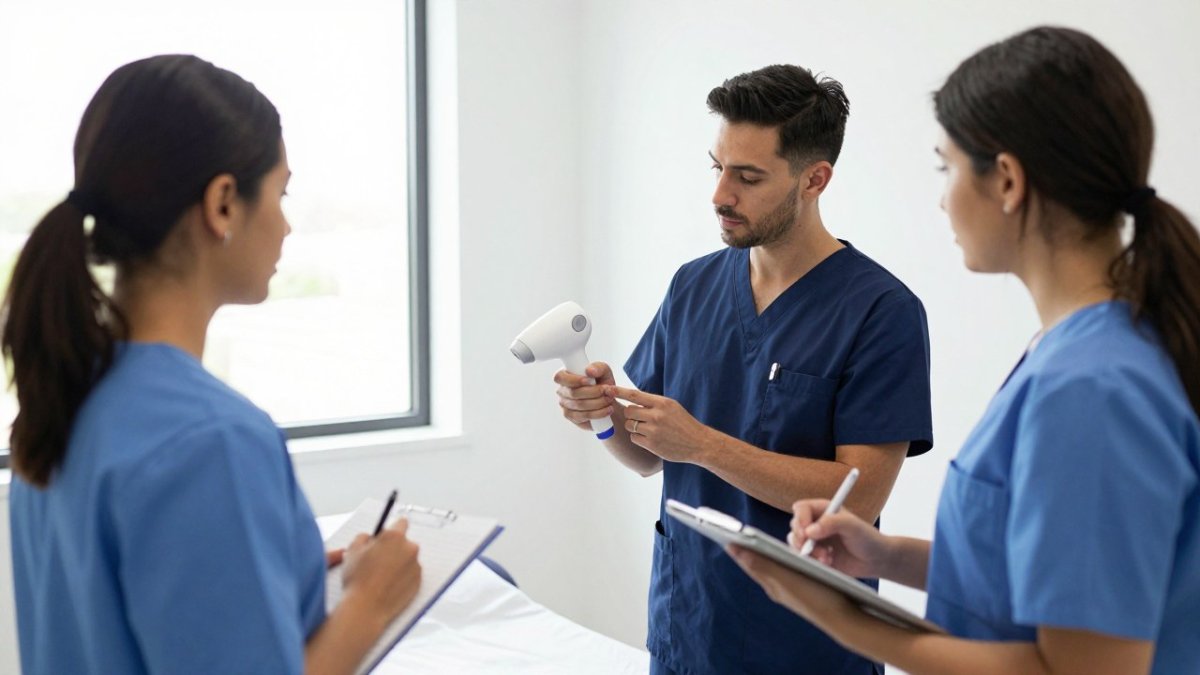
What works better is a staged approach:
- Pre-installation: reading, manufacturer modules and a written protocol for each treatment
- Supervised first sessions: a trainer present for the first cohort of real clients
- Competency sign-off: each practitioner cleared on each modality before independent use
- Refresher cycles: scheduled reviews, not reactive ones after an incident
Change management matters as much as technique. Practitioners who feel consulted about a new device adopt it faster than those told to use it. Our guide on staff training for laser devices covers how to structure this properly.
Measuring Whether Your Technology Upgrades for Established Med Spas Are Working
Technology upgrades for established med spas should be judged on a small set of numbers agreed before purchase. Without a baseline, every review becomes an argument about impressions rather than performance.
Track these from day one:
- Utilisation rate per device, per week
- Revenue per treatment by modality
- Booking conversion from consultation to package
- Client retention at the three and six month marks
- Downtime hours and maintenance spend
- Consumable cost as a share of treatment revenue
Set the baseline before installation and review at 30, 90 and 180 days. If a device misses its targets twice in a row, that is a signal about training or protocol, not necessarily the equipment. For a deeper framework on tracking clinical results, see our guide on improving patient outcomes with technology.
Partnering With a Device Supplier Who Stays After Installation
The supplier question matters more than most clinics expect. Equipment that arrives with a delivery docket and a phone number is a transaction.
Ask any supplier three things before signing: what training is included and for how long, what the response process looks like when a device faults, and what ongoing support costs beyond the warranty period. Get the answers in writing.
DermTech Devices was founded by a Registered Nurse with over 19 years of experience. If you are weighing up suppliers, our guide on choosing a medical technology partner sets out the criteria worth testing.
Upgrading equipment in an established clinic is a sequencing problem, not a shopping problem. Get the order right and each purchase can help fund the next. DermTech Devices supplies medical-grade multi-modality laser platforms and skin analysis systems.
Frequently Asked Questions
What technology should an established med spa upgrade first?
Start with whatever limits your booking capacity or your treatment menu. If clients are turned away or referred out for laser hair removal, skin resurfacing or skin tightening, a multi-modality platform fixes a revenue leak. If consultations are vague and conversion is low, objective skin analysis gives you data to build treatment plans around. Operations software comes next when scheduling, inventory and documentation are eating staff hours. Rank each option by how many bookings it unlocks, not by how new the device is.
How do you evaluate whether a new aesthetic device is worth the investment?
Work out the numbers before the demo. Estimate how many treatments per week the device could realistically deliver at your current client volume, multiply by your treatment price, then subtract consumables, maintenance, finance costs and staff time. That gives you a payback period. Anything that takes longer to repay than your comfortable finance term deserves scrutiny. Also ask what happens if utilisation stays low for six months, and whether the supplier offers training and support that will actually get the device into use.
How do you train staff to use new med spa technology?
Treat training as a staged process rather than a single day. Begin with hands-on device training from the supplier, then pair each practitioner with a supervised treatment log until they are confident. Keep a written protocol for settings, contraindications and aftercare so knowledge does not sit with one person. Refresh training when staff turn over and after any software update. Ask prospective suppliers what ongoing support looks like, including whether they return for refresher sessions or only appear at installation.
How can med spas measure the return on investment of new technology?
Track four numbers from the day the device goes live: treatments performed per week, average revenue per treatment, consumable cost per treatment and device downtime. Compare those against your pre-purchase projections at 30, 90 and 180 days. Also watch the softer signals, such as rebooking rates for the new treatment and how often clients accept an upgraded plan after skin analysis. If utilisation sits below half your projection after three months, review pricing, staff confidence and how the treatment is presented at consultation before blaming the device.