Blog Details
Last Updated: November 7, 2026
Quick Summary
Laser hair removal machine safety training requirements are the minimum knowledge and supervised practice a clinic operator must complete before treating a paying client. A compliant program covers laser physics, skin assessment, hazard identification and risk control, protective eyewear, contraindications, incident response and infection control.
- Verify the qualification, the training provider and the local rules for your premises before an operator treats anyone.
- A credible course combines theory with supervised hands-on practice on the actual device class you use.
- Match protective eyewear to your device’s wavelength and laser class, as there is no universal pair.
- Assess competency by direct observation against a written checklist at induction and then annually.
- Keep training certificates, competency sign-offs, risk assessments and procedure versions dated and audit-ready.
Table of Contents
- What Laser Hair Removal Machine Safety Training Requirements Actually Cover
- Laser Hair Removal Operator Qualification: What to Verify Before Anyone Touches a Handpiece
- Building a Laser Hair Removal Risk Assessment for Your Treatment Room
- Writing Laser Safety Operating Procedures Staff Will Actually Follow
- Laser Protective Eyewear Requirements for Staff and Clients
- Competency Assessment, Refresher Training and Audit-Ready Records
- Equipping Your Clinic With Training-Ready Laser Platforms
- Frequently Asked Questions
What Laser Hair Removal Machine Safety Training Requirements Actually Cover
Laser hair removal machine safety training requirements are the minimum knowledge and supervised practice a clinic operator must complete before using a light-based device on a paying client. This guide breaks down what a compliant program covers, how to check a course is real, and how to keep records that survive an audit.
Most operators learn this the hard way. They book a short course, get a certificate, and only later discover the training never covered device physics, eye protection or risk assessment.
The gap matters. Light-based devices can cause burns, eye injury and scarring when handled by untrained staff. The broader laser equipment safety standards guide sets out the framework these training requirements sit inside.
Here is what a genuine program must deliver:
- Laser physics basics: wavelength, laser class, how light energy becomes heat in tissue
- Skin anatomy and physiology: skin type, skin assessment, hair follicle behaviour
- Hazard identification and risk control: the controlled treatment room, reflective surfaces, warning signs, access control
- Protective eyewear and personal protective equipment for staff and clients
- Contraindications, adverse effects and incident response
- Treatment protocol, patch testing and client consultation
- Infection control and equipment maintenance
Anything less is a certificate, not training.
Laser Hair Removal Operator Qualification: What to Verify Before Anyone Touches a Handpiece
Laser hair removal operator qualification is not a single national licence. Requirements sit across state and territory health regulators, and they can differ in what they mandate and what they leave to the employer. That is the first thing most guides get wrong: they describe a national standard that does not exist.
So verify three things before an operator treats anyone: the qualification itself, the training provider behind it, and the local rules that apply to your premises.
Core knowledge a training program must deliver
A credible course combines theory with supervised hands-on practice on the actual device class you use. Ask for the syllabus. Check it names laser safety, skin assessment, wavelength and laser class, hazard identification, risk control and adverse effects. It should also state the supervised practice hours and who supervises them.
If the syllabus is vague, walk away.
How to check a course is genuinely accredited
Accreditation is where clinics get caught. A certificate with a logo proves nothing on its own. Work through this checklist and keep the evidence:
- Confirm the course maps to a recognised vocational or postgraduate qualification, not a weekend attendance certificate
- Check the provider is registered and the qualification is current on the national training register
- Confirm the course covers your specific device type, not just generic light-based treatment
- Ask whether supervised practice hours are included and how they are signed off
- Verify the certificate names the units completed, not just the course title
- Confirm the course distinguishes laser from IPL equipment and covers both if you use both
A certificate that lists attendance only, with no assessed competency, will not stand up if a regulator or insurer asks questions.
Check the rules that apply where you work
This is the step most operators skip. Before you book training, confirm what your state or territory health regulator requires for the treatments you intend to offer. Check the rules for your own state or territory with its health regulator, as they are not uniform and change over time.
A practical sequence:
- Identify the health regulator for the state or territory where the clinic operates.
- Check whether the treatments you plan are restricted to particular health practitioners or require delegated supervision.
- Confirm any premises, infection control or device registration obligations that attach to the treatment.
- Check whether your regulator publishes guidance for laser and IPL use, and read the current version.
- Record the date you checked and the version you relied on, because guidance is updated.
Relying on a course provider’s summary of the rules is not verification. Confirm the position with the regulator that covers your premises, and keep a dated note of what you found.
For a deeper breakdown of what comprehensive device training should include, see our guide to comprehensive staff training for laser devices.
Building a Laser Hair Removal Risk Assessment for Your Treatment Room
A laser hair removal risk assessment is a written document that identifies every hazard in your treatment room and states how you control it. It is not a form you fill in once and file away.
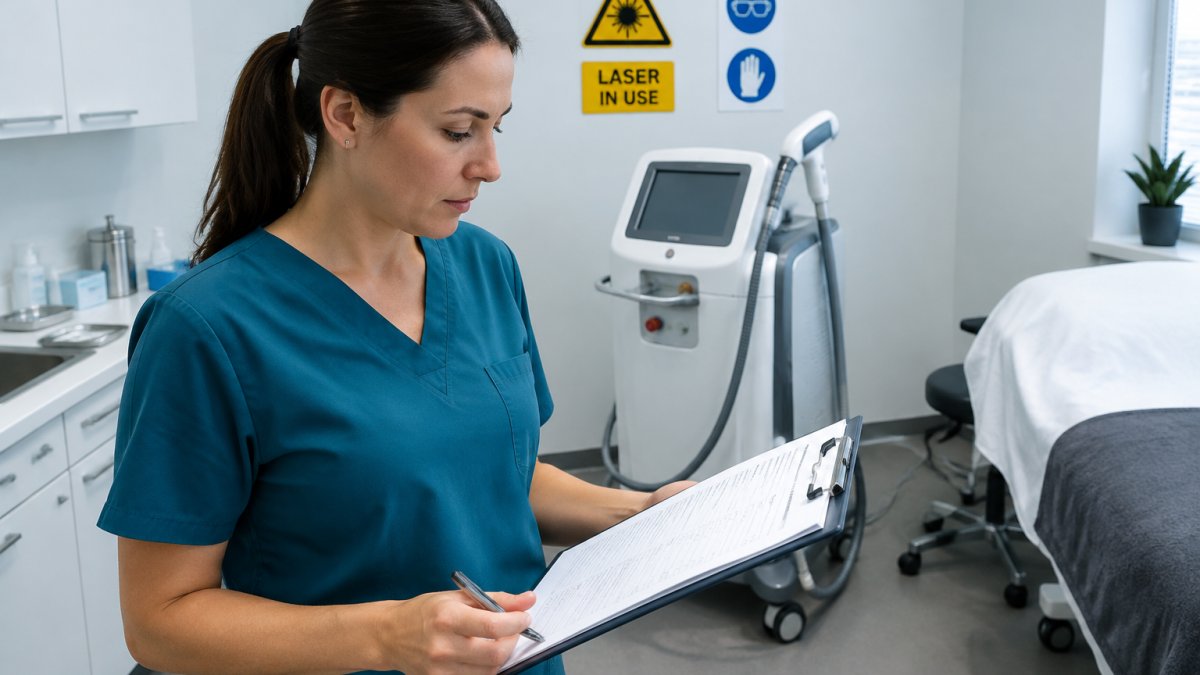
Work through it in this order:
- Hazard identification: laser beam exposure, eye injury risk, reflective surfaces, electrical hazards, fumes, infection control
- Risk control: engineering controls first, then administrative controls, then personal protective equipment
- Access control: who enters the controlled treatment room, and when
- Warning signs: displayed at every entry point
- Incident response: what staff do after an adverse event
Review the assessment whenever you add a device or change a protocol. A risk assessment that does not match your actual equipment is a liability, not a safeguard.
Writing Laser Safety Operating Procedures Staff Will Actually Follow
Laser safety operating procedures are the written steps staff follow for every treatment, from client consultation to equipment shutdown. The test of a good procedure is simple: can a new staff member follow it without asking? (Source: Safe Work Australia)
Keep each procedure short and specific. Cover:
- Pre-treatment client consultation and patch testing
- Skin assessment and contraindication screening
- Protective eyewear fitting for staff and client
- Device settings and treatment protocol
- Post-treatment care and adverse effect reporting
- Equipment maintenance and device compliance checks
Store procedures where staff actually work, not in a folder nobody opens. Review them at every refresher training session.
Laser Protective Eyewear Requirements for Staff and Clients
Laser protective eyewear requirements are set by the device’s wavelength and laser class. There is no universal pair of glasses. Eyewear should match the wavelength you are using and be rated for the laser class of your device. Because eyewear must match each device’s wavelength and laser class, tracking staff compliance helps ensure that everyone uses the correct protection consistently.
Getting this wrong risks eye injury, so match eyewear to the device carefully.
- Staff, clients and anyone in the controlled treatment room wear eyewear rated for the device wavelength
- Eyewear is inspected before each use for cracks, scratches or loose frames
- Eyewear is stored clean and labelled with its wavelength rating
- Clients are told why the eyewear matters, not just handed it
Personal protective equipment extends beyond eyes. Gloves, and where relevant masks, form part of the control set. But eyewear is the one item where a mismatch is genuinely dangerous.
Competency Assessment, Refresher Training and Audit-Ready Records
Competency assessment checks whether an operator can perform a treatment safely, not just whether they completed a course. Observation against a written checklist beats a multiple-choice test every time, because it tests the behaviour a regulator or insurer will ask about: did the operator assess the client, fit the eyewear, control the room and respond to an adverse event?
Structure it like this:
| What to assess | How to assess it | How often |
|---|---|---|
| Device setup and settings | Direct observation | At induction, then annually |
| Client consultation and skin assessment | Observed role-play or live consultation | At induction, then annually |
| Eyewear fitting and room control | Direct observation | At induction, then annually |
| Incident response | Scenario walkthrough | Annually |
| Procedure knowledge | Written check against current SOPs | Annually |
Refresher training keeps competency current. Schedule it, do not wait for a reminder. A common pattern is to refresh annually and sooner when a device is added, a protocol changes, an incident occurs, or an operator returns after a long break from treating. Record the reason for each refresher, not just the date.
A step-by-step compliance sequence
Training is one link in a chain. Work through the sequence in order and keep the evidence at each step:
- Check the local rules for your state or territory and note the version and date.
- Confirm the qualification and provider meet those rules.
- Complete theory and supervised practice on the device class you use.
- Assess competency against a written checklist and sign it off.
- Set up the controlled treatment room and complete the risk assessment.
- Write and version the operating procedures.
- Schedule refresher training and re-assessment.
- Retain records and review them on a set cycle.
Documentation and audit-ready records
Records are where audits are won or lost. Keep the following together, dated, and version-controlled so you can produce them on request:
- Training certificates and the units completed
- Competency assessment checklists and sign-offs
- Current risk assessment, with the review date
- Operating procedure versions, with a change log
- Device maintenance and service logs
- Treatment records, including patch test and settings
- Incident reports and the corrective action taken
- Eyewear inspection and wavelength-rating records
A simple rule: if you could not hand the file to a regulator or insurer tomorrow and explain every entry, the record is not audit-ready. Our guide to best practices for aesthetic staff training shows how to structure refresher cycles and keep records audit-ready.
Equipping Your Clinic With Training-Ready Laser Platforms
Training is easier when the platform supports it. A device with clear settings and proper supplier support helps safe operation.
When you assess a platform, check what device-specific training, operating manuals and technical support are available. Our guide to reliable support for aesthetic laser equipment walks through what to ask before you commit.
DermTech Devices supplies multi-modality laser platforms, developed in collaboration with medical technology brands. Our founder is a Registered Nurse with over 19 years of experience. You can browse our laser platforms to see what fits your clinic.
Meeting laser hair removal machine safety training requirements is not a box you tick once. It is an ongoing cycle of training, assessment, documentation and review. If your clinic needs equipment that supports that cycle rather than fighting it, DermTech Devices can help.
Frequently Asked Questions
What training is required to operate a laser hair removal machine?
Requirements differ by state and territory, so confirm the rule with your local health department before hiring or training staff. Training usually covers laser physics, skin anatomy, hazard identification and risk control, and supervised practice on the device class used. A certificate alone is not enough: clinics should also document device-specific induction, a signed laser safety operating procedures acknowledgement and a competency sign-off before the operator treats clients unsupervised.
Do laser hair removal operators need a formal qualification?
Formal qualifications vary by jurisdiction and by who is treating. Some states restrict who may perform light-based treatments. Check your state health regulator’s current position and keep a copy of each operator’s qualifications and scope of practice on file.
What protective equipment is needed when performing laser hair removal?
Laser protective eyewear requirements depend on the wavelength and laser class, so match eyewear to the device rather than buying generic glasses. Staff, the client and anyone in the controlled treatment room need appropriate eye protection. Beyond eyewear, consider gloves and other controls identified in your risk assessment. Keep eyewear inspected, labelled with its rating and replaced if scratched or damaged.
How often should laser hair removal operators refresh their safety training?
Many clinics set a refresher cycle, with retraining after a new device is installed, an incident occurs or procedures change. Build a competency matrix that records each operator’s last assessment date and the device models they are cleared to use. Refresher sessions should revisit laser hair removal risk assessment findings, eyewear checks, incident response and any updated state guidance, and the attendance record should be signed and kept for audit.