
Blog Details
Table of Contents
- Why a Medical Laser Service Level Agreement Protects Your Clinic
- Medical Laser Service Contract Checklist: 10 Clauses to Verify Before You Sign
- Medical Laser Repair Response Time: What to Expect and What to Negotiate
- Medical Laser Preventive Maintenance: Building a Component-by-Component Schedule
- Medical Laser Warranty and Service Coverage: What Should Be Included
- How to Choose a Medical Laser Service Provider You Can Rely On
- Frequently Asked Questions
Last Updated: October 15, 2026
Why a Medical Laser Service Level Agreement Protects Your Clinic
A medical laser service level agreement sets out how fast a supplier must respond when your device fails, what maintenance they must perform, and what happens when they don’t, the difference between a planned cost and an open-ended one. (Source: Australian Competition and Consumer Commission (ACCC) guidance on unfair contract terms)
At DermTech Devices, we supply medical-grade laser platforms to dermatology and aesthetic practices, and clinics that negotiate service terms before signing spend less on repairs and lose fewer treatment days.
An idle aesthetic laser device means cancelled appointments and patients who book elsewhere. A written agreement with clear response times and scheduled servicing contains that risk.
Below: ten clauses worth checking before you sign, realistic response times, and how to build a maintenance schedule that gets followed.
Medical Laser Service Contract Checklist: 10 Clauses to Verify Before You Sign
A medical laser service contract checklist should cover response times, parts, labour, calibration, and exit terms. If any are vague, you will pay for that vagueness later.
- Response time, in writing. “Prompt service” means nothing. Get hours, not adjectives.
- Parts included or excluded. Ask which components are covered and which are billed separately.
- Labour rates and call-out fees. Confirm whether travel and after-hours work cost extra.
- Preventive maintenance visits. Check how many are included per year and what they cover.
- Calibration and performance testing. Insist this is named, not bundled under “servicing”.
- Loan or replacement equipment. Ask what you get if a repair runs long.
- Uptime commitments. A guaranteed uptime figure gives you use if service slips.
- Documentation you receive. You need service records for your own compliance file.
- Warranty interaction. Confirm the service agreement does not void remaining warranty coverage.
- Exit and renewal terms. Know how to leave, and what notice period applies.
The most common mistake is signing a service agreement that is silent on loan equipment. When a laser is out for weeks, you have no contractual right to a replacement, and your treatment list stalls.
Medical Laser Repair Response Time: What to Expect and What to Negotiate
Medical laser repair response time splits into two numbers: how long until a technician responds, and how long until the device works again. The first is easy to promise; the second is what matters to your bookings.
Realistic service agreements separate these clearly:
- Response time: how quickly the supplier acknowledges and starts work. Often measured in hours.
- Resolution time: how long until the device is back in service. Measured in days.
- On-site vs remote: some faults are fixed over the phone; others need a technician on site.
When you negotiate, push for a resolution target, not just a response target. A supplier can answer the phone in an hour and still leave you waiting a fortnight for a part.
Ask for the escalation path by name. Knowing who to call when the first response stalls is worth more than a slightly faster standard response time.
Medical Laser Preventive Maintenance: Building a Component-by-Component Schedule
Medical laser preventive maintenance works best when built around the parts that actually fail, not a generic annual visit. Components wear at different rates, so a single yearly service misses problems that develop in between. The schedule below is split by cadence.
Daily checks (before the first patient)
- Handpiece and fibre connector: inspect the tip and connector for scorching, discolouration, or debris. A brown tip is a warning, not a cosmetic issue.
- Cooling airflow: confirm fans spin freely and vents are unobstructed. Dust build-up is the most common cause of early overheating.
- Chiller temperature readout: confirm the console reports within the manufacturer’s stated range before treatment.
Weekly checks
- Coolant level and clarity: top up if low; if cloudy or discoloured, book a flush rather than topping up.
- Filter condition: inspect air and water filters for dust loading; replace or clean per the manufacturer’s interval.
- Handpiece cable and strain relief: flex the cable and look for cracking or exposed conductors.
Monthly checks
- Optics inspection: inspect lenses and fibres under the manufacturer’s recommended lighting; clean only with approved solutions and lint-free wipes.
- Electrical connections: check mains plug, IEC lead, and umbilical connectors for heat marks or looseness.
- Cooling system performance: log the chiller’s pull-down time and compare it to last month; a creeping time is an early warning.
Quarterly checks
- Calibration and output verification: measure delivered energy at the handpiece with a calibrated meter and compare against the set point; record the deviation.
- Cooling performance verification: confirm the chiller holds temperature under a simulated treatment load, not just at idle.
- Safety systems: re-test interlocks, alarms, and any skin-temperature or contact sensors.
Annual checks
- Full system service: comprehensive inspection, replacement of wear items, firmware review, and a documented safety check.
- Electrical safety testing: insulation resistance and earth continuity, with a dated tag on the device.
- Optical alignment: verify beam delivery alignment and spot size against the manufacturer’s specification.
| Component | Check | Typical Frequency |
|---|---|---|
| Handpiece and fibre | Tip and connector inspection | Before each clinic day |
| Cooling system | Coolant level, filters, airflow, chiller temperature | Daily to monthly |
| Optical components | Lens and fibre inspection, cleaning | Monthly to quarterly |
| Electrical connections | Plug, lead, umbilical, earth continuity | Monthly, with annual testing |
| Calibration | Output consistency and performance verification | Quarterly |
| Full system | Comprehensive service and safety checks | Annually |
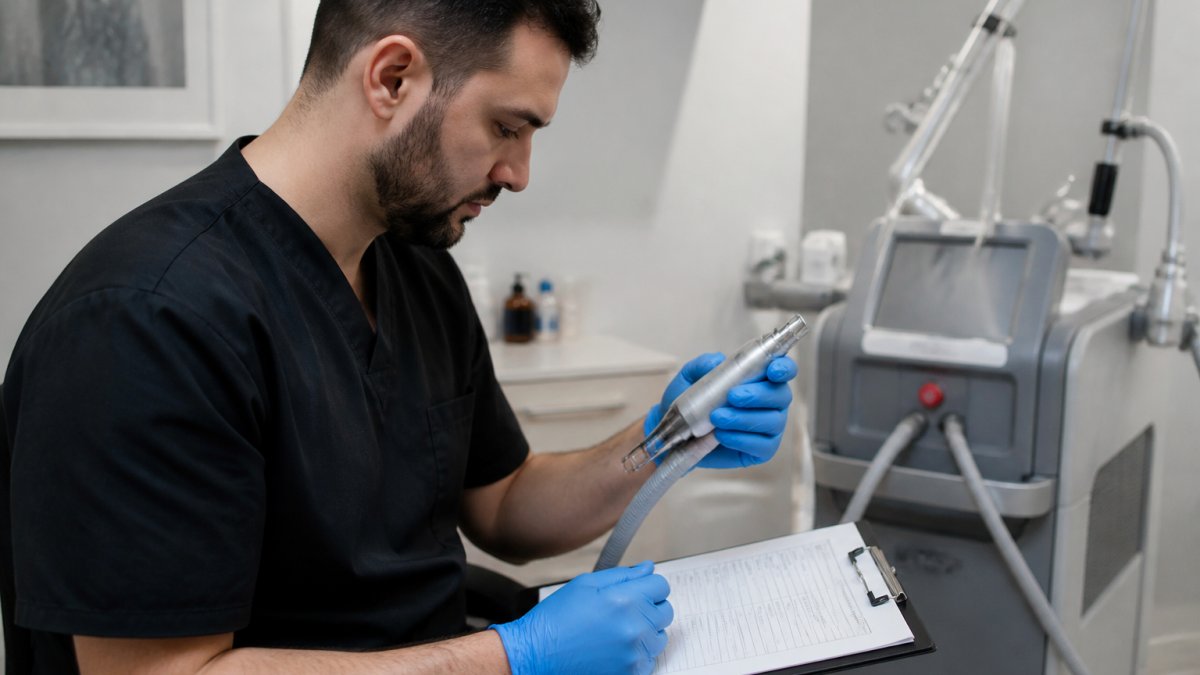
Cooling and optics show wear first, and both affect treatment accuracy. Catching a failing filter early is cheap; replacing a damaged optical component after it has affected output is not.
When to stop using the device and escalate
Some faults should never be worked around. Stop treatment and escalate immediately if you see any of the following:
- Burning smell, smoke, or visible arcing from the console, handpiece, or cable.
- Unexpected energy output, a patient reporting a sensation inconsistent with the set parameters, or a calibration check showing a deviation outside the manufacturer’s tolerance.
- Cooling failure, chiller temperature rising above the stated range, or a coolant leak.
Escalation should follow a written path: stop treatment, tag the device out of service, log the fault with time and symptoms, notify the service provider through the agreed channel, and record the response. Do not return it to service until the fault is cleared and documented.
Documentation that survives an audit
Every check, clean, calibration, and repair should be logged with the date, the person who performed it, the result, and any action taken. A simple log with these columns is enough:
| Date | Device ID | Task | Performed by | Result | Action / parts | Next due |
|---|
Consistent records turn a maintenance program into something you can show an auditor, warranty provider, or prospective purchaser, and make it obvious when a provider has missed a scheduled visit, the evidence you need to enforce an uptime commitment.
Medical Laser Warranty and Service Coverage: What Should Be Included
Medical laser warranty and service coverage should be read together, because one can quietly cancel the other. A warranty covers defects. A service agreement covers upkeep. Overlap between them is where disputes start.
Check these points before you rely on either:
- What the warranty covers: parts, labour, or both, and for how long.
- What voids it: unauthorised repairs, missed servicing, or use outside the specified conditions.
- How the service agreement interacts: does it extend cover, or replace it?
Warranty coverage and service coverage are not the same thing, and a gap between them is where most unexpected repair costs land. Map both on one page before you sign.
If your service agreement requires servicing at set intervals, missing one can void your warranty, a strong reason to put maintenance dates in your clinic calendar the day you sign.
How to Choose a Medical Laser Service Provider You Can Rely On
Choosing a medical laser service provider comes down to four things: documented response commitments, genuine parts access, a checkable track record, and a cost structure you can model before signing. Most clinics skip the fourth, which is why service costs surprise them at year end.
The qualification questions that actually matter
Ask every provider the same questions and compare the answers side by side:
- Can you show me response and resolution times in writing, with the remedy if they are missed?
- Are you manufacturer-authorised for this platform, and can you provide the authorisation reference?
- Do you stock parts locally, or order them in? What is your typical lead time for the three most common failures on this model?
A provider who hesitates on any of these is telling you something; the best answer with specifics, not reassurance.
Manufacturer-authorised versus independent providers
Both can be the right choice, but the trade-offs differ.
- Manufacturer-authorised providers typically have guaranteed parts access, current firmware and calibration tools, and service records that are less likely to raise questions if warranty cover is ever disputed. They usually cost more per visit and may have longer response times outside metropolitan areas.
- Independent providers can be faster and cheaper, and often more flexible on after-hours work. The risks are non-genuine parts, calibration equipment that is not traceable, and service records that a manufacturer may not accept when assessing a warranty claim.
A common pattern is to use an authorised provider for calibration and warranty-sensitive work, and an independent provider for routine cleaning and first-line response. If you do this, check the authorised provider’s terms do not treat third-party work as warranty-voiding.
Modelling the cost: planned service versus emergency repair
The decision to sign a service agreement is financial, and worth modelling rather than guessing. The comparison is not “service agreement cost versus nothing”, it is “service agreement cost versus the expected cost of unplanned failure.”
Build the comparison from four numbers:
- Annual planned service cost, the agreement fee plus any exclusions you expect to use (consumables, after-hours call-outs).
- Expected emergency repair cost, the call-out, labour, and parts for a typical failure on your platform, multiplied by the number of failures you would expect without preventive maintenance. A reasonable planning assumption is one to two unplanned failures per device per year for a heavily used platform, but your own service history is the better guide.
- Lost treatment revenue, the average revenue per treatment day multiplied by the number of days the device would be out. This is usually the largest number in the model and the one most often left out.
- Replacement cost and lifespan impact, the cost of bringing a replacement forward if poor maintenance shortens the device’s working life.
A simple worked example, using round figures for illustration only: if a planned agreement costs a few thousand dollars a year, a single unplanned failure costs a similar amount in parts and labour, and the device is out for three treatment days at a few hundred dollars of revenue per day, the agreement pays for itself on the first avoided failure.
Ask your provider for a service history report on your specific device before you renew. If the report shows repeated failures in the same component, that is a signal the preventive schedule is not addressing the root cause, and a reason to renegotiate the scope rather than the price.
What to put in the agreement before you sign
- Named response and resolution times, with a remedy if they are missed.
- Parts and labour inclusions, with a current price list for exclusions.
- Calibration frequency and record format, so the output is audit-ready.
At DermTech Devices, our platforms are built for performance and reliability, backed by servicing and support that keeps them running. Founded by a Registered Nurse with more than 19 years of experience, we know downtime in a clinic is not an abstract metric, it is patients waiting and revenue lost.
Frequently Asked Questions
What should a medical laser service level agreement include?
A thorough medical laser service agreement covers preventive maintenance schedules, response and resolution timeframes, parts and labour inclusions, calibration and performance testing, loaner equipment availability, documentation and reporting, and clear termination and renewal terms. It should also state what is excluded, such as damage from misuse or unauthorised third-party repairs. Ask for all exclusions in writing before you sign, and confirm whether the agreement covers every laser platform in your clinic or only specific units.
What response time should a clinic expect for medical laser repairs?
Response times vary by provider and contract tier. A common structure is remote support within 24 hours, on-site attendance within 48 to 72 hours for metropolitan areas, and longer for regional locations. Emergency repairs that halt treatment delivery should be prioritised. Read the fine print carefully: some agreements define response as a phone call, not a technician on site. Clarify whether the clock starts when you log the fault or when the provider acknowledges it.
How often should medical laser equipment be serviced?
Most manufacturers recommend a full scheduled service every 6 to 12 months, with more frequent checks for high-use devices. Between services, your team should perform daily safety checks, handpiece inspections before each session, and weekly cleaning of cooling systems and optical components. Log every check so you have a documented maintenance history. Your service agreement should specify the exact intervals for your specific device model, as these differ between platforms.
Does a medical laser service agreement cover parts and labour?
It depends on the contract type. Comprehensive agreements typically include both parts and labour, while limited agreements may cover labour only and charge separately for parts. Some providers cap annual parts spending or exclude high-cost components like laser fibres or handpieces. Compare the total cost of each option over 12 months, including any excess or callout fees. Ask for a written list of covered and excluded components before signing.