Blog Details
Quick Summary
Best practice for consultation documentation is a complete, factual written record of the patient’s history, medications, allergies, goals, assessment, risks discussed and decision made before any treatment begins. Record each item as its own field, name the specific risks, and keep consent and photograph consent separate.
- Record medical history, medications, allergies and previous procedures as separate, distinct fields.
- Write the patient’s goals in their own words rather than as a procedure name.
- Record each suitability check and its result, rather than a single overall statement.
- Name the specific risks discussed instead of writing that risks were explained.
- Keep consent and photograph consent separate, and record the scope of image use.
Table of Contents
- Why Consultation Documentation Matters for Aesthetic Practices
- What to Record: Patient History, Medications, Allergies and Previous Procedures
- Recording Goals, Expectations and Suitability Assessments
- Skin Analysis Documentation: Recording Findings Consistently
- A Practical Aesthetic Consultation Form Template
- Consultation Notes Examples and Quality Checks
- Documenting Declined or Deferred Treatment, Consent and Photographs
- Building Your Documentation Workflow and Booking a Practice Review
- Frequently Asked Questions
Why Consultation Documentation Matters for Aesthetic Practices
Good consultation documentation is the record that protects your patient, your clinic and your decisions. Without it, a clinician’s memory of what was discussed becomes the only evidence, and memory is unreliable under pressure.
The Primacy of Ethics in Aesthetic Medicine: A Review argues that aesthetic providers, including non-surgical practitioners, should work to formal guidelines and ethical training standards. Good records are one practical way to support that expectation. See how advanced skin analysis has been shown to improve patient outcomes.
A 2026 study on expectation management in patient-surgeon consultations recommends that clinicians assess how much a patient uses social media before treatment, discuss how digitally modified images may shape expectations, and provide patient education. Each of these steps is hard to evidence without a written record. Expectation management in patient-surgeon consultations
Documentation also helps when a patient’s understanding changes over time. A note that records what was explained, and what the patient said they wanted, lets you revisit the conversation accurately at the next visit. Keeping these conversations consistent with essential documentation records also makes it easier to support continuity when safety concerns arise.
What to Record: Patient History, Medications, Allergies and Previous Procedures
A complete history is the starting point for every consultation. Record the patient’s medical history, current medications and supplements, known allergies, smoking status and any previous aesthetic procedures, including the product, area treated and date.
Treat each of these as a separate field, so gaps are visible at a glance. “No known allergies” should be written as a statement the patient has confirmed, not an assumption.
Watch out: a history recorded only at the first visit goes stale. Confirm medications and allergies again at each appointment, and note the date of the review.
Recording Goals, Expectations and Suitability Assessments
Write the patient’s goals in their own words. A note that says “wants to look less tired around the eyes” is more useful than “requests blepharoplasty”, because it shows what the patient actually asked for.
Record your suitability assessment separately from the patient’s wishes. State what you found, which contraindications you checked for, and whether the treatment is suitable, deferred or not recommended. Where you discussed alternatives, list them.
Note the expected outcome and its limits as you explained them. This is the record you will return to if expectations are later disputed.
Skin Analysis Documentation: Recording Findings Consistently
Objective skin analysis gives you a baseline that can be compared over time, which subjective notes cannot. See how objective skin analysis is applied in aesthetic clinics. Record the device used, the date, the lighting and positioning conditions, and the parameters measured. Store the images with the consultation notes rather than in a separate folder. Understand how AI skin diagnostics generate their outputs so you can record them accurately.
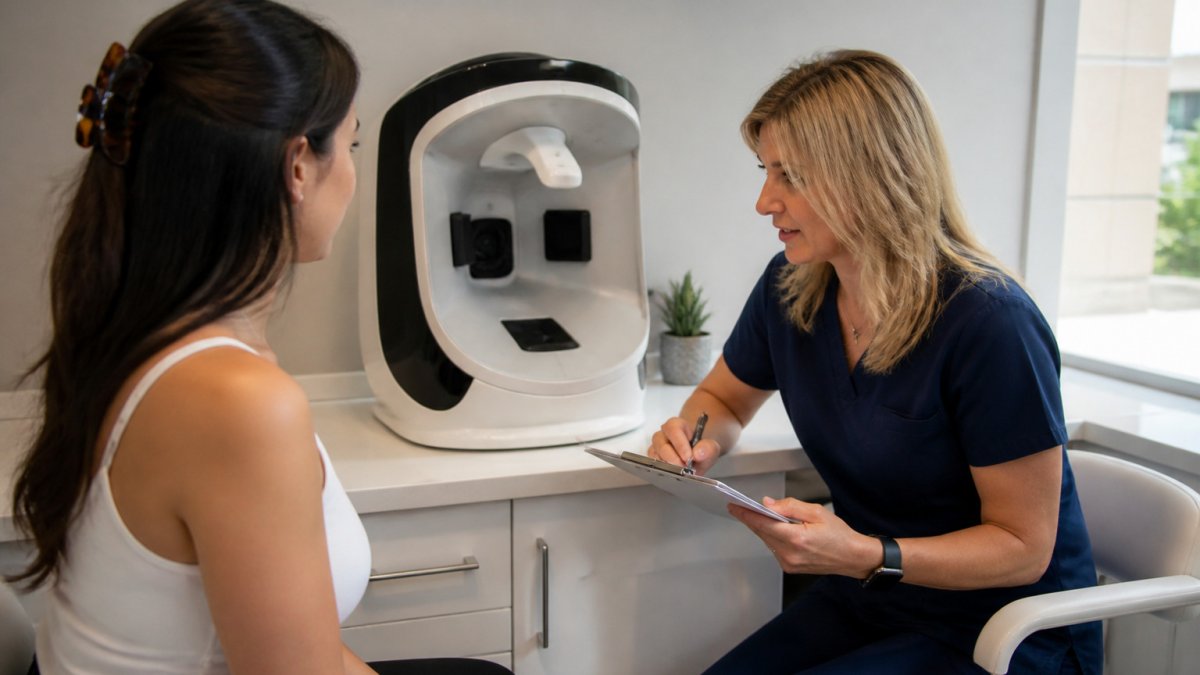
Use the same protocol every time. See how clinical skin analysis tools are used in practice to standardise what you capture. If you change conditions between sessions, record that change, otherwise differences in results may reflect the setup rather than the skin.
Objective skin analysis systems can capture measurements in a consistent format, which supports this kind of comparison across visits. Objective skin analysis for aesthetic clinics
A Practical Aesthetic Consultation Form Template
A structured form makes it harder to skip a field, but a list of field names is not a template. The version below adds a prompt to each field so the person completing it knows what a satisfactory entry looks like, plus a short example of a completed entry.
Patient details, Full name, date of birth, contact number, date and time of consultation. Example: Jane Citizen, 14/03/1988, 0400 000 000, 12/06/2025, 10:30am.
Clinician, Name, qualification, registration number and role. Example: A. Practitioner, RN, registration number, cosmetic nurse.
Medical history, Conditions, surgeries, pregnancy or breastfeeding status, autoimmune conditions, bleeding disorders.
Watch out: a template that is too long gets completed in shorthand. Keep the prompts visible in your digital form as helper text rather than as extra fields, so the record stays complete without adding clicks.
If your practice uses a paper form, keep a version number and a review date on each page so you can show which template was in use at the time of a consultation. If you use a digital system, check that the template fields map to searchable data rather than free-text boxes, because a field that can only hold free text is hard to audit later.
Consultation Notes Examples and Quality Checks
Good notes are specific and factual. Compare these two entries:
- Weak: “Pt happy with plan. Discussed risks.”
- Stronger: “Patient wants reduction in forehead lines. No contraindications on screening. Discussed bruising, temporary asymmetry and the need for a review at two weeks. Patient asked about onset time; advised effects usually appear over several days. Patient agreed to proceed.”
Before you close a record, check it against these questions:
- Could another clinician understand what was agreed without asking you?
- Is every field completed, or marked as not applicable with a reason?
- Are the risks you discussed named, not summarised as “risks explained”?
- Is the decision clear, including any decision to defer or decline?
The table below summarises the quality checks the article recommends before closing a consultation record.
| Check | What it confirms | Example of a weak entry |
|---|---|---|
| Understandable by another clinician | Agreed plan is clear without asking the author | “Pt happy with plan” |
| Every field complete | Fields are filled or marked not applicable with a reason | Blank medication field |
| Risks named | Each specific risk is written down | “Risks explained” |
| Decision clear | Proceed, defer or decline is stated, including reasons | No decision recorded |
Documenting Declined or Deferred Treatment, Consent and Photographs
Documentation matters most when you do not proceed. If you decline treatment, record the reason, the alternatives offered and the patient’s response. If you defer, record what needs to change before treatment could be reconsidered, such as a medication being stopped or a skin condition settling.
Consent should be recorded as a separate, signed step, with the date and the information provided. Photographs need their own consent, which covers how the images will be stored, who can access them and whether they may be used for teaching or marketing. Keep clinical photographs separate from marketing use.
Privacy rules for health information apply to photographs and records alike. Check the current requirements from the Office of the Australian Information Commissioner and your professional registration body, and set retention periods and access controls to match. Australian Privacy Principles guidance
Building Your Documentation Workflow and Booking a Practice Review
A documentation workflow works best when each step has a clear owner and a defined record. Write the sequence down and keep it with your policies, because a workflow that lives only in staff memory changes when staff change. Read guidance on training staff to follow consistent consultation practices.
For each step, record the time as well as the date. A timestamp shows the order in which history, assessment, consent and treatment occurred, which matters if a patient later says consent was obtained after treatment began.
Decide where records live and how the two formats are kept in step if you use both paper and digital. A common pattern is a digital practice management system for the main record with paper consent forms scanned in on the day. If you work this way, record the scan date and the location of the original, and set a rule for how long originals are kept before secure destruction.
Amendments need their own rule. Never overwrite an entry. Add a dated addendum that states what changed and why, and keep the original visible.
Privacy rules for health information apply to photographs and records alike. Check the current requirements from the Office of the Australian Information Commissioner and your professional registration body, and set retention periods and access controls to match. Australian Privacy Principles guidance Access should be role-based: front-of-house staff generally do not need clinical notes, and marketing staff should not have access to clinical photographs unless a separate, specific consent covers that use.
Run a short audit every few months. Pick a sample of records across clinicians, check them against the quality questions in the previous section, and record the patterns you find rather than individual errors.
If you are reviewing your current process, a practice review can show where your records are incomplete or inconsistent. Best practices for aesthetic staff training covers how to train staff to follow the same process.
Frequently Asked Questions
What should be included in an aesthetic consultation record?
A consultation record should capture the patient’s identity and contact details, medical and medication history, allergies, previous aesthetic procedures, stated goals and concerns, the practitioner’s assessment, suitability findings, the treatment options discussed, the risks and alternatives explained, and the patient’s decision. Recording the date, the practitioner’s name and any photographs taken with consent makes the record usable if questions arise later. Keep entries factual and specific rather than general, so another clinician reading the notes can understand exactly what was discussed and agreed.
How do you document a cosmetic consultation?
Use a structured template so every consultation captures the same core fields in the same order. Begin with history and screening, then record the patient’s goals in their own words, followed by your clinical assessment, the options offered, the risks discussed and the agreed plan. Note any questions the patient asked and how they were answered. Sign and date the entry at the time of the consultation, and amend later additions with a clear timestamp rather than overwriting the original text.
How should patient goals and expectations be recorded?
Record goals in the patient’s own words where possible, using quotation marks for direct statements. Note whether the expectations are realistic, and document where you corrected or clarified a misunderstanding, such as what a treatment can and cannot change. If the patient has seen digitally modified images online, record that you discussed how those images may shape expectations. This creates a clear trail showing that expectations were actively managed rather than assumed.
What should be documented when a patient is not suitable for treatment?
Document the reason for deferring or declining treatment in specific clinical terms, such as an active infection, a medication interaction or a contraindication identified during screening. State what was explained to the patient, what alternatives or next steps were offered, and whether a referral or a follow-up review was arranged. Recording the patient’s response shows the decision was communicated clearly. This entry protects both the patient and the practitioner and should be stored with the same care as treatment records.
How do you document informed consent for aesthetic treatment?
Informed consent documentation should show that the risks, benefits, alternatives and expected recovery were explained, and that the patient had the opportunity to ask questions. Use a signed consent form stored with the consultation record, and add a brief clinical note confirming the discussion took place and the patient’s understanding was checked. Consent requirements and the standards that apply to your practice should be confirmed with the relevant Australian professional body or regulator for your profession.
Should photographs be included in aesthetic consultation notes?
Clinical photographs can support assessment and treatment planning, but they should be stored separately from the written notes with access controls and a defined retention period. Obtain specific written consent for photography and for any use beyond the clinical record, including marketing. Note in the consultation entry that photographs were taken, their purpose and who can access them. Keep images in a secure system with audit trails rather than on personal devices.
How can skin analysis findings be recorded consistently?
Standardise the fields you record for each analysis, such as the areas assessed, the parameters measured, the date and the settings used, so results can be compared between visits. Attach or link the analysis output to the consultation record rather than summarising it from memory. Recording the same parameters at each review helps you track changes over time. Describe findings in neutral clinical language and avoid conclusions the data does not support.